

Archive position — measured, not model output
0 likes on Devpost
2,263 of the 7,850 archived projects have more likes, and 5,587 share exactly 0 — so this project's #4,934 place in the like-ranked listing is a tie-break inside that group, not a ranking.
Projects (log scale)
Likes on Devpost. ▲ marks this project's group.
Show the figures
| Likes | Projects | Share of archive |
|---|---|---|
| 0 | 5,587 | 71.2% |
| 1 | 1,758 | 22.4% |
| 2 | 284 | 3.6% |
| 3–4 | 132 | 1.7% |
| 5–9 | 75 | 1.0% |
| 10+ | 14 | 0.2% |
 User Stories BotA demo video on every pull request
Get a demo video on every new feature
GitHub App that watches your pull requests and records a narrated, captioned demo.
Save time on demo prep and make informed decisions faster with a video walkthrough of every new feature.
Executive Summary
Ledger is a self-reported store management application designed to transform invoice data into ranked, deterministic actions for Indian kirana stores. The author states that it ingests POS exports (CSV/JSON), text PDFs, and OCR’d scans; applies machine learning models to forecast demand, identify bundles, and segment customers; and outputs actionable insights in plain Indian English without using LLMs. It includes a dashboard UI covering Action Center, Revenue, Intelligence, Loyalty, Reports, and Admin.
The product is described as built by one developer (Hemant Nagar) over a hackathon period, with no evidence of revenue, customers or traction beyond the author’s own account. The description indicates an end-to-end pipeline including ingestion, ML processing, insight scoring, feedback learning, and nightly refreshes — but does not provide any data on performance, adoption, or commercial viability.
The single most important open question
Is there sufficient evidence of real-world utility or traction to justify further diligence into whether this product can scale beyond a hackathon prototype?
What The Product Actually Is
The description states that Ledger is a store app that turns invoice history into a daily Action Center. It processes:
- Ingestion of POS data (CSV/JSON), text PDFs, or OCR’d scans
- ML models for demand forecasting, basket bundles, price elasticity, inventory signals, anomalies, RFM/loyalty segments, and festival prep
- A deterministic insight engine that scores actions based on impact × confidence × urgency × weight
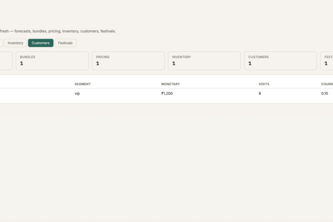
- A UI covering Action Center, Revenue (D/W/M), Intelligence (ML tables), Loyalty, Reports, and Admin
It is built using FastAPI, SQLite/PostgreSQL, Python libraries like pandas, scikit-learn, and chart.js, with no LLMs involved in generating insights.
Inference: The product appears to be a single-developer hackathon project, not yet a commercial offering. It lacks independent verification of functionality or user feedback.
Positioning & Claim Evolution
The author positions Ledger as:
- A ledger book for actions, not another analytics wall
- Tuned specifically for Indian retail (festival calendars, phone loyalty, POS push)
- Without wrapping an LLM around every recommendation
- A deterministic insight engine that scores actions rather than relying on AI chat layers
They emphasize:
- “Ranked, quantified next steps from the bills they already have”
- “No black-box chat layer”
- “End-to-end path: invoice in → ranked action out”
Inference: The positioning is clearly aspirational, focused on solving a specific pain point for small retailers in India. However, it is not backed by any market validation or customer feedback.
Target Customer & ICP
The description states that Ledger targets:
- Indian kiranas and small stores
- Owners who sit on years of invoice data but don’t turn it into decisions
- Users who still guess what to reorder before Diwali, which SKUs to bundle, or which VIP customers are going quiet
It also mentions:
- Festival calendar integration
- Phone loyalty with festival multipliers
- Indian-English action copy
- Kirana-oriented pilot defaults
Inference: The ICP is very narrow and localized, focused on small retail owners in India. There is no indication of broader market expansion plans or customer segments beyond this.
Business Model & Pricing Evidence
There is no evidence provided about:
- Revenue model
- Pricing structure
- Subscription plans
- Monetization strategy
The description mentions an API key for live POS ingest and includes admin features like subscription, POS key, monitoring, and pilot tools — but no details on how these would be monetized.
Inference: The business model remains undefined, and there is no evidence of any revenue-generating mechanism or pricing framework.
Technical & Delivery Signals
The author describes the technical stack as:
- Built with FastAPI, Python (pandas, scikit-learn, numpy), chart.js, SQLAlchemy
- Uses YAML rules for insight scoring
- No LLMs involved in generating actions
- Four phases: adapters, ML models, insight engine, dashboard
- Nightly jobs, health checks, MAPE monitoring
They also note:
- Ingestion reliability (idempotency, error logs)
- Configurable field mappings to handle messy invoices
- Backtesting and pilot tools for tuning thresholds
Inference: The technical architecture is functional but minimal, likely built for a hackathon prototype. It shows some engineering rigor in handling data quality issues, but lacks evidence of scalability or production-grade deployment.
Traction & Maturity Signals
There is no evidence of:
- Revenue
- Customers
- Adoption metrics
- Pilot testing with real stores
- Product usage data
- Market traction
The description notes that the team plans to pilot on real multi-month POS history, but this has not yet occurred.
Inference: There is zero traction or maturity signal, and the project remains in a pre-pilot phase.
Competitive Context
There is no mention of competitors in the description. The author does not reference any existing solutions for retail analytics, inventory management, or POS systems tailored to Indian kiranas.
Inference: No competitive landscape is described, making it impossible to assess positioning against existing tools or market gaps.
Open Questions & Risks
- No revenue, customers, or traction: The project is described as a hackathon prototype with no evidence of real-world use.
- Single developer team: Limited capacity for rapid iteration or scaling.
- Unproven ML performance: Synthetic data limitations and weak MAPE scores suggest models may not generalize well.
- No monetization strategy: No indication of how the product will be sold or priced.
- Limited UI scope: The dashboard is described as a single-file frontend, suggesting minimal UX investment.
- No external validation: No third-party feedback, user interviews, or pilot results are shared.
Inference: These are high-risk signals, especially for an early-stage investment or partnership consideration.
Questions the description leaves open
- What specific POS systems or invoice formats do you plan to support in production?
- How will you validate the accuracy of your ML models on real-world data?
- Have you conducted any pilot testing with actual kirana store owners?
- What is your go-to-market strategy for reaching small retailers in India?
- Are there any plans to integrate with existing POS vendors or e-commerce platforms?
- How do you intend to scale beyond a single developer and one prototype?
- What are the key assumptions behind your ML scoring system, and how will they be tested?
Overall Assessment
Not evidenced.
The description provides no evidence of:
- Revenue
- Customers
- Traction
- Product-market fit
- Commercial viability
- Scalability
It is a self-reported hackathon project, built by one person, with no external validation or commercial activity. The author states that the product is not yet piloted with real stores.
Confidence Level: Low
This is a pre-product-stage idea, not a product ready for investment or partnership consideration. Any further diligence would require evidence of early traction, pilot results, or a clear path to monetization.
User Stories BotA demo video on every pull request
Get a demo video on every new feature
GitHub App that watches your pull requests and records a narrated, captioned demo.
Save time on demo prep and make informed decisions faster with a video walkthrough of every new feature.
Source
Submitted to the OpenAI 2026 hackathon on Devpost. Project home on Devpost. Back to the full gallery on Devpost.
This competitive analysis was produced by top-founders.com (opens in a new tab)
Generated by a language model from this project's public Devpost page — its tagline, the author's own write-up and any built-with tags listed there — as captured in August 2026. Short quotations are the author's words. It is an opinion on the idea as a business, not on the people behind it, and it reflects the description as published then. If the project has moved on, request a correction below. The analysis is not independent research and contains no verified traction, revenue or customer data.
An independent guide by KFG International LLC — not affiliated with, endorsed by, or connected to Devpost or OpenAI.