

Archive position — measured, not model output
1 like on Devpost
505 of the 7,850 archived projects have more likes, and 1,758 share exactly 1 — so this project's #1,008 place in the like-ranked listing is a tie-break inside that group, not a ranking.
Projects (log scale)
Likes on Devpost. ▲ marks this project's group.
Show the figures
| Likes | Projects | Share of archive |
|---|---|---|
| 0 | 5,587 | 71.2% |
| 1 | 1,758 | 22.4% |
| 2 | 284 | 3.6% |
| 3–4 | 132 | 1.7% |
| 5–9 | 75 | 1.0% |
| 10+ | 14 | 0.2% |
 User Stories BotA demo video on every pull request
Get a demo video on every new feature
GitHub App that watches your pull requests and records a narrated, captioned demo.
Save time on demo prep and make informed decisions faster with a video walkthrough of every new feature.
Executive Summary
What the company appears to be
The description states that Emotional Time Travel is an interactive prototype built using AI-assisted tools (Codex, GitHub Pages, HTML) to help users navigate past, present, and future emotional patterns through a structured experience. It is described as an embodiment of a psychological framework called "Emotional Time Travel" or "Capacity Architecture." The author, Indira M, claims this is the beginning of a larger effort involving books, website development, and educational content.
What changed
The project started as an idea in the author’s mind and evolved into a working prototype during a hackathon. It represents a shift from abstract theory to tangible interaction design using AI tools, with no evidence of prior product development or commercial traction.
Single most important open question
Is there any indication that this prototype will evolve into a scalable, monetizable product or service, or is it purely experimental and educational in nature?
What The Product Actually Is
The description states:
- Emotional Time Travel is an interactive prototype.
- It guides users through three perspectives:
- Visit the Past to recognize adaptive patterns.
- Stay Present to identify available capacity.
- Design the Future by choosing needed capacity.
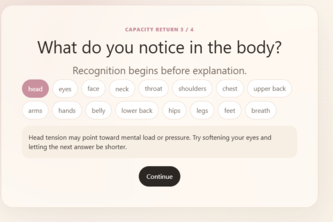
- The experience ends with a Capacity Return summarizing user selections.
- Built using Codex, HTML, and GitHub Pages, with no mention of backend systems or databases.
Inference The prototype appears to be a front-end-only web application, likely static or semi-static, relying on AI-assisted prompt engineering for content generation rather than dynamic data processing.
Positioning & Claim Evolution
The description states:
- The project aims to help users experience Emotional Time Travel and Capacity Architecture instead of just reading about them.
- It is described as a way to move through the past, present, and future in a structured way, recognizing patterns and identifying capacity.
- The author claims this is a tangible way to explore psychological frameworks.
Inference The positioning appears to be educational or therapeutic in nature, targeting individuals interested in personal development or psychology. It does not yet show signs of commercialization or market positioning beyond a prototype.
Target Customer & ICP
The description states:
- The goal is to help people recognize patterns from the past, practice capacity in the present, and intentionally design the future.
- The experience is framed around Emotional Time Travel and Capacity Architecture frameworks.
Inference The target audience likely includes individuals interested in personal development, psychology, mindfulness, or self-improvement. However, no specific customer segments, personas, or user data are provided.
Business Model & Pricing Evidence
The description states:
- The project is described as an interactive prototype, not a commercial product.
- The author mentions plans to expand the experience and develop educational content.
- No pricing model, monetization strategy, or revenue streams are mentioned.
Inference There is no evidence of a business model or pricing structure. The project appears to be experimental or educational in nature, with no indication of commercial intent at this stage.
Technical & Delivery Signals
The description states:
- Built using Codex, HTML, and GitHub Pages.
- The author used prompt engineering and UX design rather than writing code manually.
- The prototype was developed during a hackathon, suggesting a short development cycle.
- No mention of backend infrastructure, databases, or scalability.
Inference The technical stack is minimal and likely non-production-ready. It appears to be a lightweight, AI-assisted front-end experience with no evidence of enterprise-grade delivery or long-term technical architecture.
Traction & Maturity Signals
The description states:
- The project was submitted to the OpenAI 2026 hackathon.
- It is described as a prototype, not a product.
- The author mentions learning and experimentation during development, with no evidence of user adoption or feedback loops.
Inference There is no evidence of traction, customer base, or usage metrics. The project is at an early stage, likely experimental, and has not yet demonstrated any form of market validation or product-market fit.
Competitive Context
The description states:
- No mention of competitors or existing solutions in the space.
- The framework is described as unique to the author’s work ("Emotional Time Travel", "Capacity Architecture").
- No references to similar tools or platforms in personal development, psychology, or AI-assisted therapy.
Inference There is no evidence of competitive analysis or awareness of existing solutions. It is unclear whether this project addresses a gap or overlaps with other tools in the space.
Open Questions & Risks
The description states:
- The project is self-built by one person, with no team or external support mentioned.
- It is described as an interactive prototype, not a product.
- No evidence of monetization, scalability, or long-term vision beyond the author’s personal goals.
Inference
Key risks include:
- Lack of team or technical resources for scaling.
- Unclear path to commercial viability.
- No traction or validation.
- Potential over-reliance on AI tools without a clear roadmap for product development.
Questions the description leaves open
- What is the intended user journey beyond this prototype?
- Are there any plans to collect feedback from users of this prototype?
- How does the author plan to monetize or scale this experience?
- Is there a longer-term vision for integrating this into books, apps, or platforms?
- What is the author’s background in psychology or product development beyond this project?
Overall Assessment
The description states:
- This is an interactive prototype built during a hackathon.
- The author has no prior product or revenue history.
- It is described as the beginning of a larger effort, not a finished product.
Inference At this stage, there is no evidence of commercial viability, traction, or scalability. The project appears to be experimental and educational in nature, with no clear path to investment or partnership opportunities. It may be worth monitoring if the author develops a more structured product or framework, but as-is, it does not meet criteria for due-diligence evaluation.
User Stories BotA demo video on every pull request
Get a demo video on every new feature
GitHub App that watches your pull requests and records a narrated, captioned demo.
Save time on demo prep and make informed decisions faster with a video walkthrough of every new feature.
Source
Submitted to the OpenAI 2026 hackathon on Devpost. Project home on Devpost. Back to the full gallery on Devpost.
This competitive analysis was produced by top-founders.com (opens in a new tab)
Generated by a language model from this project's public Devpost page — its tagline, the author's own write-up and any built-with tags listed there — as captured in August 2026. Short quotations are the author's words. It is an opinion on the idea as a business, not on the people behind it, and it reflects the description as published then. If the project has moved on, request a correction below. The analysis is not independent research and contains no verified traction, revenue or customer data.
An independent guide by KFG International LLC — not affiliated with, endorsed by, or connected to Devpost or OpenAI.