

Archive position — measured, not model output
0 likes on Devpost
2,263 of the 7,850 archived projects have more likes, and 5,587 share exactly 0 — so this project's #2,971 place in the like-ranked listing is a tie-break inside that group, not a ranking.
Projects (log scale)
Likes on Devpost. ▲ marks this project's group.
Show the figures
| Likes | Projects | Share of archive |
|---|---|---|
| 0 | 5,587 | 71.2% |
| 1 | 1,758 | 22.4% |
| 2 | 284 | 3.6% |
| 3–4 | 132 | 1.7% |
| 5–9 | 75 | 1.0% |
| 10+ | 14 | 0.2% |
 User Stories BotA demo video on every pull request
Get a demo video on every new feature
GitHub App that watches your pull requests and records a narrated, captioned demo.
Save time on demo prep and make informed decisions faster with a video walkthrough of every new feature.
Executive Summary
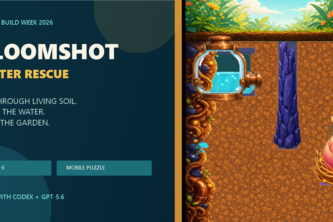
Bloomshot: Water Rescue is a self-reported mobile puzzle game project built as a vertical slice for a hackathon. The author describes it as a portrait-oriented game where players dig through soil to guide water around stone and restore a flower, with a mole that temporarily digs in random directions. It was developed using Unity 6, C#, and OpenAI tools (GPT-5.6), but the final product is not reported to include AI runtime dependencies.
The project appears to be an experimental prototype focused on gameplay mechanics and visual polish, rather than a commercial product or service. No evidence of revenue, customers, or traction exists beyond the author's own description.
Key open question
Is this a playable vertical slice or a pre-commercial prototype with no clear path to monetization or user adoption?
What The Product Actually Is
The description states that Bloomshot: Water Rescue is a portrait mobile puzzle vertical slice. It involves:
- Digging through soil to create continuous channels.
- Guiding fresh water from a reservoir around indestructible stone.
- Restoring a dormant flower.
- A mole that independently digs in random directions inside a protected area, leaving temporary trails that refill after about ten seconds.
The game is built using Unity 6, C#, and integrates OpenAI Codex with GPT-5.6 for development support but not as a runtime dependency.
Inference The project is a vertical slice — a small, playable version of a larger concept — likely intended to demonstrate core mechanics or attract attention at a hackathon.
Positioning & Claim Evolution
The author positions Bloomshot: Water Rescue as a puzzle game with garden-rescue identity, inspired by classic dig-and-route games but with unique elements like the mole system and terrain dynamics. The tagline describes a polished experience involving digging, water routing, and restoration.
Claim
The project is a "polished mobile puzzle game" that blends gameplay mechanics with visual storytelling.
Inference It is not positioned as a full-fledged commercial product or service but rather as an experimental prototype or demo piece.
Target Customer & ICP
The description does not identify any specific customer segment or target audience. The project is described as a vertical slice, suggesting it is not yet aimed at end-users, but at developers or hackathon judges.
Inference There is no evidence of an identified ICP (Ideal Customer Profile) beyond the author’s own use case and goals.
Business Model & Pricing Evidence
There is no evidence in the description of any business model, pricing strategy, monetization plan, or revenue streams. The project is described as a hackathon submission, not a commercial offering.
Inference No commercial viability or monetization path is evident from the provided information.
Technical & Delivery Signals
The author reports:
- Built in Unity 6 with C#
- Uses OpenAI Codex with GPT-5.6 for development assistance (not runtime)
- Separates engine-independent simulation from Unity presentation code
- Implements a fixed-step grid system for terrain, digging, water movement, and scoring
- Uses Universal Render Pipeline, Input System, uGUI, particles, custom artwork, and board-composite shaders
- Includes eight automated tests covering fluid mass, rock behavior, solvability, etc.
- Supports Windows and Android builds
Inference The project shows technical maturity for a prototype, with attention to simulation fidelity and cross-platform delivery.
Traction & Maturity Signals
There is no evidence of traction, adoption, or user engagement beyond the author’s own development and testing. The project is described as a vertical slice, not a product in use.
Inference No data on users, downloads, or performance exists.
Competitive Context
The description does not mention any competitors or market positioning relative to existing puzzle games. It references classic dig-and-route puzzle games as inspiration but does not name or compare specific titles.
Inference No competitive analysis or differentiation strategy is evident in the provided text.
Open Questions & Risks
- The project is described as a hackathon submission, implying no commercial intent or long-term vision.
- No evidence of monetization, user base, or product-market fit.
- The use of AI tools during development (GPT-5.6) does not indicate AI runtime dependencies, but the lack of clarity on how this might evolve is a risk.
- The project is not evidenced to be in production, nor to have any commercial traction.
Inference The project lacks commercial viability or traction and may not represent a scalable or monetizable product.
Questions the description leaves open
- What is the intended path from this vertical slice to a full game or product?
- Is there a plan for monetization, user acquisition, or market entry?
- What are the long-term goals for the project beyond the hackathon?
- Are there any plans to integrate AI runtime dependencies or data collection features?
- Has the author considered how this concept might scale or be extended into a broader product?
Overall Assessment
There is no evidence of a commercial product, revenue, or traction beyond the author’s own description. The project is described as a hackathon vertical slice, not a business or investment-ready offering.
Inference This is not a viable candidate for investment or partnership at this stage. It may be an early-stage prototype with no clear path to monetization or user adoption.
User Stories BotA demo video on every pull request
Get a demo video on every new feature
GitHub App that watches your pull requests and records a narrated, captioned demo.
Save time on demo prep and make informed decisions faster with a video walkthrough of every new feature.
Source
Submitted to the OpenAI 2026 hackathon on Devpost. Project home on Devpost. Back to the full gallery on Devpost.
This competitive analysis was produced by top-founders.com (opens in a new tab)
Generated by a language model from this project's public Devpost page — its tagline, the author's own write-up and any built-with tags listed there — as captured in August 2026. Short quotations are the author's words. It is an opinion on the idea as a business, not on the people behind it, and it reflects the description as published then. If the project has moved on, request a correction below. The analysis is not independent research and contains no verified traction, revenue or customer data.
An independent guide by KFG International LLC — not affiliated with, endorsed by, or connected to Devpost or OpenAI.