

Archive position — measured, not model output
1 like on Devpost
505 of the 7,850 archived projects have more likes, and 1,758 share exactly 1 — so this project's #1,009 place in the like-ranked listing is a tie-break inside that group, not a ranking.
Projects (log scale)
Likes on Devpost. ▲ marks this project's group.
Show the figures
| Likes | Projects | Share of archive |
|---|---|---|
| 0 | 5,587 | 71.2% |
| 1 | 1,758 | 22.4% |
| 2 | 284 | 3.6% |
| 3–4 | 132 | 1.7% |
| 5–9 | 75 | 1.0% |
| 10+ | 14 | 0.2% |
 User Stories BotA demo video on every pull request
Get a demo video on every new feature
GitHub App that watches your pull requests and records a narrated, captioned demo.
Save time on demo prep and make informed decisions faster with a video walkthrough of every new feature.
Executive Summary
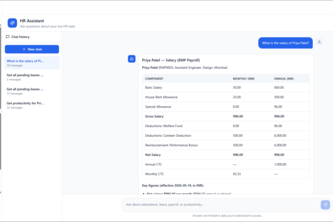
What the company appears to be: EmpCloud HR Assistant is a self-contained AI-powered assistant module built as part of an existing HR platform (EmpCloud). The product allows users to ask natural language questions across three core HR systems — attendance, payroll, and productivity monitoring — and receive synthesized answers in real time. It uses OpenAI's function calling with 21 read-only tools to pull data from separate systems, and enforces role-based access control at the tool level.
What changed: The product replaces traditional dashboard navigation with conversational AI. It was built during a single "Build Week" as a new module, distinct from an existing rule-based chatbot. It introduces multi-step reasoning across systems, streaming answers, conversation history, and scoped data access.
Single most important open question: Does the system actually enforce permission boundaries in production, or is this a demo-level implementation that may not scale to real-world security requirements?
What The Product Actually Is
The description states that EmpCloud HR Assistant is a new module within an existing HR platform, built as a self-contained assistant that replaces traditional dashboards. It allows users to ask questions in natural language and get answers pulled from three systems:
- Core HR (attendance, leave balances, shifts, employee directory)
- Payroll (salary structures, payslips, net pay, run totals)
- EmpMonitor (productivity %, application and website usage, AI-tool adoption)
It uses OpenAI SDK with function calling, a bounded multi-round loop, and 21 read-only tools to pull live data across systems. It supports streaming answers, conversation history, and role-scoping of data access.
Inference: The assistant is not a standalone product but a feature added to an existing platform, built during a hackathon or build week.
Positioning & Claim Evolution
The description states that EmpCloud HR Assistant "replaces traditional dashboards with AI", allowing users to ask questions in natural language and get answers instantly. It claims the assistant can:
- Pull data from multiple systems (HR, payroll, monitoring)
- Synthesize answers across domains
- Handle complex queries like "compare Priya's attendance, productivity, and salary this month"
- Provide streaming answers with conversation history
It also states that "the old rule-based chatbot just told you to go open the Payroll module", implying a shift from static dashboards to conversational AI.
Inference: The positioning evolved from a simple dashboard replacement to a multi-domain, reasoning-powered assistant — but this is based on self-reported claims, not evidence of adoption or usage.
Target Customer & ICP
The description states that the assistant supports role-based scoping, where:
- An employee only sees their own data
- A manager sees their team reports
It also mentions that it's built for "any system" — implying a broad audience, but no specific customer segment or persona is named.
Inference: The target is likely HR teams within organizations using EmpCloud, with different access levels (employees, managers, admins). No explicit ICP or buyer persona is defined.
Business Model & Pricing Evidence
The description does not state anything about pricing, business model, revenue, or monetization. It only describes the product's functionality and architecture.
Not evidenced: No information on how the product is sold, who pays for it, or if there are any pricing tiers.
Technical & Delivery Signals
The assistant was built as a self-contained module, separate from an existing chatbot. Key technical elements include:
- Engine: OpenAI SDK with AI function calling in a bounded multi-round loop
- Tools: 21 read-only tools, each with strict schema validation
- Integration: secure server-to-server calls into Payroll and monitoring systems, direct reads from HR database
- Experience: Server-Sent Events for streaming, React frontend with conversation CRUD
- Use of Codex to generate function-calling loop, tools, UI, and test suite
Inference: The architecture is modular, secure, and designed for multi-system data access. However, no evidence of production deployment or scalability beyond a single build week.
Traction & Maturity Signals
The description states that the product was built during a single Build Week, and shipped as a clean, isolated module. It also mentions:
- 21 tools built in one week
- Streaming answers and conversation history
- Role-scoping of data access
- Full CRUD for conversations
Not evidenced: No customer base, usage metrics, or adoption data. The product is described as a demo-level implementation.
Competitive Context
The description does not mention any competitors or market positioning beyond the claim that dashboards are "broken" and need replacement. It implies that existing HR platforms lack conversational AI capabilities.
Not evidenced: No competitive analysis, pricing comparison, or market share data.
Open Questions & Risks
- Security risk: The description states that enforcing permission boundaries was one of the hardest challenges — implying that this is a high-risk area. It's unclear if these protections are actually enforced in production.
- Demo-level implementation: Built during a single build week, not tested in real-world conditions or at scale.
- No commercial evidence: No revenue, customers, or traction data provided.
- Tooling dependency: Relies heavily on Codex and OpenAI SDK — no indication of fallbacks or alternative tooling if these change.
Inference: The product may be a proof-of-concept with limited production readiness.
Questions the description leaves open
- How is role-based access control enforced in the tools? Is it tested for edge cases?
- What happens when one of the integrated systems (HR, payroll, monitoring) is down or returns an error?
- Has this been tested with real users or only internal teams?
- Are there any plans to monetize this feature or integrate it into a broader product suite?
- How does the assistant handle ambiguous queries or requests that don't map cleanly to tools?
- What are the latency and cost implications of the 8-round loop for complex queries?
Overall Assessment
Not evidenced: No financials, traction, or commercial evidence is provided beyond the self-reported product description.
Inference: This appears to be a demo-level prototype, built during a hackathon or build week. It shows technical capability but lacks commercial maturity, customer data, or scalability proof. The core idea — replacing dashboards with AI — is compelling, but without evidence of traction or a clear path to monetization, it's difficult to assess its investment potential.
The product may be a strong technical demonstration but not yet a viable commercial offering. A follow-up diligence effort would need to verify:
- Production deployment and security
- Real-world usage or feedback
- Commercial viability and scalability
User Stories BotA demo video on every pull request
Get a demo video on every new feature
GitHub App that watches your pull requests and records a narrated, captioned demo.
Save time on demo prep and make informed decisions faster with a video walkthrough of every new feature.
Source
Submitted to the OpenAI 2026 hackathon on Devpost. Project home on Devpost. Back to the full gallery on Devpost.
This competitive analysis was produced by top-founders.com (opens in a new tab)
Generated by a language model from this project's public Devpost page — its tagline, the author's own write-up and any built-with tags listed there — as captured in August 2026. Short quotations are the author's words. It is an opinion on the idea as a business, not on the people behind it, and it reflects the description as published then. If the project has moved on, request a correction below. The analysis is not independent research and contains no verified traction, revenue or customer data.
An independent guide by KFG International LLC — not affiliated with, endorsed by, or connected to Devpost or OpenAI.