

Archive position — measured, not model output
1 like on Devpost
505 of the 7,850 archived projects have more likes, and 1,758 share exactly 1 — so this project's #1,003 place in the like-ranked listing is a tie-break inside that group, not a ranking.
Projects (log scale)
Likes on Devpost. ▲ marks this project's group.
Show the figures
| Likes | Projects | Share of archive |
|---|---|---|
| 0 | 5,587 | 71.2% |
| 1 | 1,758 | 22.4% |
| 2 | 284 | 3.6% |
| 3–4 | 132 | 1.7% |
| 5–9 | 75 | 1.0% |
| 10+ | 14 | 0.2% |
 User Stories BotA demo video on every pull request
Get a demo video on every new feature
GitHub App that watches your pull requests and records a narrated, captioned demo.
Save time on demo prep and make informed decisions faster with a video walkthrough of every new feature.
Executive Summary
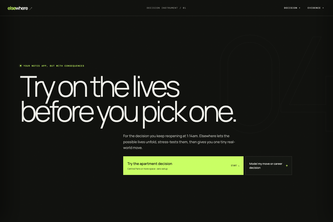
**The company appears to be a solo-built personal decision-support tool named Elsewhere, designed for consequential career and location choices.** The author states it uses deterministic simulation and GPT-5.6 to model life outcomes across multiple dimensions (income, housing, travel, etc.), then synthesizes qualitative perspectives from four lenses (money, people, freedom, regret) before proposing a reversible experiment. It is built with Next.js, React, TypeScript, and integrates OpenAI's GPT-5.6 API.
What changed
The author reports that the product evolved from an analyst dashboard into a focused, experiential tool that guides users through one life at a time, one scene at a time, and one condition at a time — emphasizing user-driven decision rehearsal over prescriptive advice.
The single most important open question
Is there sufficient evidence of user traction or commercial viability to justify further investment or partnership? The description contains no data on users, revenue, or adoption beyond the author’s own experience.
Note: This analysis is based entirely on self-reported information from the project description. No external verification, archived history, or third-party sources are available. All claims are attributed to the author and labeled as such.
What The Product Actually Is
The description states that Elsewhere is a personal decision lab for consequential career and location choices. It models two to four options over twelve months using:
- Income
- Tax rules (France and UK)
- Housing costs
- Recurring travel
- Savings
- Personal priorities
It allows users to walk through ordinary weeks, social moments, and the year after a decision, then change one plausible condition while holding others fixed.
The system uses:
- A deterministic engine for numeric outcomes (income, taxes, rent, etc.)
- Four concurrent GPT-5.6 API calls, each reading the same immutable future record but with one protected value changed per call
- A fifth constrained GPT call to synthesize disagreement and identify uncertainty worth testing
The final step is a reversible fourteen-day experiment — e.g., commuting twice from Montreuil to test energy levels before committing.
Inference: The product is not a generic advice engine but a structured simulation platform that combines deterministic calculation with qualitative GPT interpretation, ending in physical action.
Positioning & Claim Evolution
The author claims Elsewhere helps users:
- Rehearse possible lives
- Identify fragile assumptions holding decisions open
- Test those assumptions before making expensive commitments
It is positioned as an alternative to chatbots that "choose for you", instead offering a space for decision rehearsal.
Claim: The product is not about giving advice, but enabling users to explore consequences and validate their own judgment.
The evolution described shows:
- Early versions felt like analyst dashboards
- Later iteration simplified interface to focus on one life, one scene, one condition, one lens at a time
Inference: Positioning shifted from tool-as-data-sink to tool-as-experience.
Target Customer & ICP
The description states that Elsewhere targets users making consequential career and location decisions, such as:
- Staying in a role or taking an offer
- Keeping a small apartment or moving to a larger one
Claim: The target is individuals who find traditional pros-and-cons lists insufficient for complex, long-term choices.
No explicit customer segment beyond “individuals” is mentioned. No demographic, industry, or geographic targeting is described.
Inference: The ICP likely includes high-income professionals or decision-makers in urban environments (e.g., Paris, London) where housing and career trade-offs are common.
Business Model & Pricing Evidence
There is no evidence of pricing, monetization strategy, or business model in the description.
Not evidenced
Technical & Delivery Signals
The product is built with:
- Next.js, React, TypeScript
- OpenAI GPT-5.6 API
- Node.js, Playwright, Redis, SVG, Zod, Vercel, Upstash
It uses:
- A deterministic engine for numeric calculations
- Immutable future records passed to GPT models
- Structured validation via Zod
- Replayable analysis and production health checks
- Regression tests, source tracing, and verified judge replay
Claim: The system avoids model hallucination by preventing GPT from editing numeric values or recommending winners.
Inference: Technical architecture suggests a focus on reliability, traceability, and control over AI outputs.
Traction & Maturity Signals
There is no evidence of:
- Users
- Revenue
- Customers
- Adoption metrics
- Product usage data
The author mentions:
- A demo comparing Paris vs Montreuil apartments
- A “one-click demo”
- A final flow that reuses original live analysis while keeping deterministic story immediately available
Not evidenced
Competitive Context
No mention of competitors or market positioning beyond the author’s own narrative.
Not evidenced
Open Questions & Risks
- No commercial traction: The product is described as a solo-built hackathon project with no evidence of users, revenue, or adoption.
- Unproven user need: While the author claims it helps with decision-making, there’s no data on whether this resonates broadly.
- Limited scalability: The team size is listed as one; no indication of future scaling plans or team expansion.
- AI dependency risk: Heavy reliance on GPT-5.6 for interpretation and synthesis may not be sustainable without robust control mechanisms.
- Unclear path to monetization: No pricing, business model, or go-to-market strategy is described.
Inference: The product appears experimental and unproven in real-world use cases.
Questions the description leaves open
- What specific user feedback have you received so far?
- How do you plan to scale beyond a solo builder?
- Are there any early adopters or pilot users who’ve tested the platform?
- What is your roadmap for expanding into new decision types (e.g., family, health)?
- How do you intend to monetize this tool if at all?
- Have you considered how to handle edge cases in tax and cost modeling?
- What are the technical limitations or bottlenecks in current GPT integration?
Overall Assessment
There is no evidence of commercial traction, revenue, or customer validation.
The product is described as a personal decision lab, built by one person for personal use and later refined during a hackathon. It is not demonstrated to have any users beyond the author’s own experience.
Assessment: Based on self-reported evidence only, there is insufficient basis to support investment or partnership interest at this stage.
Confidence level: Low — the description lacks any data points on user behavior, market demand, or business viability.
User Stories BotA demo video on every pull request
Get a demo video on every new feature
GitHub App that watches your pull requests and records a narrated, captioned demo.
Save time on demo prep and make informed decisions faster with a video walkthrough of every new feature.
Source
Submitted to the OpenAI 2026 hackathon on Devpost. Project home on Devpost. Back to the full gallery on Devpost.
This competitive analysis was produced by top-founders.com (opens in a new tab)
Generated by a language model from this project's public Devpost page — its tagline, the author's own write-up and any built-with tags listed there — as captured in August 2026. Short quotations are the author's words. It is an opinion on the idea as a business, not on the people behind it, and it reflects the description as published then. If the project has moved on, request a correction below. The analysis is not independent research and contains no verified traction, revenue or customer data.
An independent guide by KFG International LLC — not affiliated with, endorsed by, or connected to Devpost or OpenAI.