

Archive position — measured, not model output
0 likes on Devpost
2,263 of the 7,850 archived projects have more likes, and 5,587 share exactly 0 — so this project's #6,888 place in the like-ranked listing is a tie-break inside that group, not a ranking.
Projects (log scale)
Likes on Devpost. ▲ marks this project's group.
Show the figures
| Likes | Projects | Share of archive |
|---|---|---|
| 0 | 5,587 | 71.2% |
| 1 | 1,758 | 22.4% |
| 2 | 284 | 3.6% |
| 3–4 | 132 | 1.7% |
| 5–9 | 75 | 1.0% |
| 10+ | 14 | 0.2% |
 User Stories BotA demo video on every pull request
Get a demo video on every new feature
GitHub App that watches your pull requests and records a narrated, captioned demo.
Save time on demo prep and make informed decisions faster with a video walkthrough of every new feature.
Executive Summary
What the company appears to be
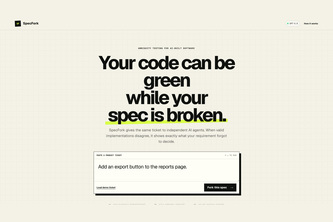
SpecFork is a tool that takes an ambiguous product specification (a "ticket") and uses GPT-5.6 to generate three different interpretations of it. Each interpretation is then turned into a behavioral contract, executed in isolated environments, and compared for consistency. If inconsistencies are found, the system surfaces them as conflicts and asks for clarification.
What changed
The author states that this tool emerged from frustration with teams building different products despite having identical tickets and passing tests. The project was built to detect such ambiguity before implementation begins.
Single most important open question
Is there a real-world use case or demand for this kind of specification validation in product development workflows?
What The Product Actually Is
The description states that SpecFork takes an ambiguous product ticket, generates three GPT-5.6 interpretations, converts each into an executable behavioral contract, and runs probes against all three to detect inconsistencies.
It uses:
- GPT-5.6 for interpretation
- Git worktrees for branching
- Docker containers with hardening (no network, read-only filesystem, resource limits)
- React + TypeScript frontend
- OpenAI API integration
The system is designed to surface conflicts during execution rather than relying on static analysis or pre-defined rules.
Inference This tool operates at the intersection of AI interpretation, behavioral testing, and sandboxed execution. It's not a traditional SaaS product but a development workflow assistant.
Positioning & Claim Evolution
The author claims that SpecFork addresses a common problem in software teams: when everyone reads the same ticket differently and ends up shipping three different products, even though all code and tests are correct.
It positions itself as a solution to ambiguity in specifications, not bugs or poor coding practices.
Inference This is a niche tool aimed at improving specification clarity in early-stage product development or during large-scale collaboration where interpretation of requirements can vary widely.
Target Customer & ICP
Not evidenced. The description does not name specific customers, personas, or industries. It only describes the problem it solves — ambiguity in product specs — without identifying who would use this tool.
Business Model & Pricing Evidence
Not evidenced. There is no mention of pricing models, monetization strategies, or commercial plans beyond a demo mode that requires no API key.
Technical & Delivery Signals
The system uses:
- GPT-5.6 for interpretation
- Git worktrees to isolate branches
- Docker containers with security hardening (no network, read-only FS, CPU/memory caps)
- React + TypeScript frontend
- OpenAI Responses API
- Codex for code generation and testing
It includes:
- A credential-free demo mode
- Automated tests covering behavior, malformed input, policy bypasses, and response validation
- Shared probes to compute conflict scores from actual outputs
- Policy gate to filter interpretations before execution
Inference The tool is built with security and isolation in mind, suggesting it could be used in enterprise or regulated environments where sandboxing is critical.
Traction & Maturity Signals
Not evidenced. There is no mention of users, customers, revenue, adoption, or usage metrics beyond the author’s own account of building and testing it.
Competitive Context
Not evidenced. No competitors or market landscape are mentioned in the description.
Open Questions & Risks
- Unproven demand: The tool is described as a hackathon project with no evidence of real-world adoption.
- Over-reliance on GPT-5.6: The system depends heavily on an AI model that may not be stable or scalable in production environments.
- Limited scope: It appears to target only the early stages of product development, which limits its potential market reach.
- No commercial viability: No pricing, monetization, or business model is described.
- Self-reported maturity: The author notes several early-stage issues (e.g., incorrect conflict scoring) that were later fixed — indicating a lack of prior production-grade experience.
Questions the description leaves open
- What specific types of product tickets or domains does SpecFork currently support?
- Are there any known edge cases where the system fails to detect conflicts?
- How does it handle large-scale repositories or complex dependencies?
- Has there been any feedback from developers or teams using this in practice?
- Is there a plan for integrating with existing CI/CD pipelines or development tools?
- What are the long-term goals for scaling beyond the current demo mode?
Overall Assessment
Not evidenced. No financials, funding history, or strategic fit information is provided.
Confidence level Low This is a self-reported project with no external validation, traction, or commercial evidence. The tool appears to be experimental and built for a narrow use case in early-stage development workflows. There is insufficient data to assess its viability as an investment or partnership opportunity.
User Stories BotA demo video on every pull request
Get a demo video on every new feature
GitHub App that watches your pull requests and records a narrated, captioned demo.
Save time on demo prep and make informed decisions faster with a video walkthrough of every new feature.
Source
Submitted to the OpenAI 2026 hackathon on Devpost. Project home on Devpost. Back to the full gallery on Devpost.
This competitive analysis was produced by top-founders.com (opens in a new tab)
Generated by a language model from this project's public Devpost page — its tagline, the author's own write-up and any built-with tags listed there — as captured in August 2026. Short quotations are the author's words. It is an opinion on the idea as a business, not on the people behind it, and it reflects the description as published then. If the project has moved on, request a correction below. The analysis is not independent research and contains no verified traction, revenue or customer data.
An independent guide by KFG International LLC — not affiliated with, endorsed by, or connected to Devpost or OpenAI.