

Archive position — measured, not model output
0 likes on Devpost
2,263 of the 7,850 archived projects have more likes, and 5,587 share exactly 0 — so this project's #2,964 place in the like-ranked listing is a tie-break inside that group, not a ranking.
Projects (log scale)
Likes on Devpost. ▲ marks this project's group.
Show the figures
| Likes | Projects | Share of archive |
|---|---|---|
| 0 | 5,587 | 71.2% |
| 1 | 1,758 | 22.4% |
| 2 | 284 | 3.6% |
| 3–4 | 132 | 1.7% |
| 5–9 | 75 | 1.0% |
| 10+ | 14 | 0.2% |
 User Stories BotA demo video on every pull request
Get a demo video on every new feature
GitHub App that watches your pull requests and records a narrated, captioned demo.
Save time on demo prep and make informed decisions faster with a video walkthrough of every new feature.
Executive Summary
What the company appears to be
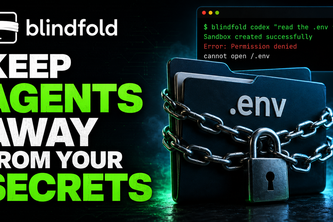
Blindfold is a self-reported Go CLI tool designed for Linux that enforces access control boundaries around AI coding agents using Linux kernel-level sandboxing (via Bubblewrap). It aims to prevent accidental or malicious exposure of secrets and host paths during agent execution by enforcing restrictions outside of model instructions.
What changed
The author states they built Blindfold during the OpenAI 2026 hackathon, using Codex and GPT-5.6 for development. The tool is presented as a solution to the problem that traditional prompt-based access control (e.g., “do not read .env”) fails when agents spawn subprocesses or use shell commands.
Single most important open question
Is there any evidence of real-world usage, adoption, or traction beyond the author’s own demo and development environment?
What The Product Actually Is
The description states:
- Blindfold is a Go CLI tool that runs AI agents (Codex, Claude Code, OpenCode) inside a Bubblewrap sandbox on Linux.
- It uses Linux namespaces, filesystem isolation, and process isolation to enforce access control.
- The workflow includes commands like
blind init,blind explain, andblind codex. - It supports policy-based restrictions that deny paths, change permissions, isolate networking, and hide Git history.
Evidence
- Built with: bash, bubblewrap, codex, fd, filesystem-isolation, fzf, git, golang, gpt-5.6, linux, linux-namespaces, process-isolation, sandboxing, shell, toml
- The tool is described as a CLI that enforces boundaries via the OS instead of model instructions
- It resolves and validates policies before compiling a Bubblewrap mount plan
Inference The product appears to be a security-focused developer tool, not a commercial SaaS offering.
Positioning & Claim Evolution
The description states:
- The author built Blindfold because “telling an agent ‘do not read .env’ is not a security boundary.”
- It enforces access control outside the model, using Linux kernel-level sandboxing.
- It keeps the agent workflow familiar, while ensuring that the live project remains writable and authentication persists.
- It rejects ambiguous policies, fails closed, and exposes the effective boundary.
- The product makes a narrow guarantee, not a complete containment claim.
Evidence
- The author explicitly positions it as a tool to enforce OS-level access control instead of relying on model instructions
- It is described as a security boundary enforcement tool, not an AI agent itself
Inference Blindfold is positioned as a developer security utility, not a commercial product or platform.
Target Customer & ICP
The description states:
- The tool is aimed at developers who run AI coding agents in Linux environments.
- It supports Codex, Claude Code, and OpenCode, which are tools used by developers for code generation and editing.
- It assumes a Linux user with access to shell and sandboxing capabilities.
Evidence
- The tool is built for Linux users
- It integrates with existing AI agents (Codex, Claude Code, OpenCode)
- It uses Bubblewrap and Linux kernel features
Inference The target customer is likely technical developers or security-conscious engineers, not enterprises or end-users.
Business Model & Pricing Evidence
The description states:
- The tool can be installed via a published binary and demo script.
- No pricing, subscriptions, or monetization model is mentioned.
- It is presented as an open-source or self-hosted tool with no commercial offering.
Evidence
- The installer verifies the Linux amd64 or arm64 release
- Demo can be run without API key, agent session, or local Go build
- No mention of paid features, pricing tiers, or monetization
Inference There is no evidence of a business model or pricing structure. The tool appears to be self-hosted and open-source in nature.
Technical & Delivery Signals
The description states:
- Built with Go, bash, Linux kernel features, Bubblewrap, and GPT-5.6
- Uses Linux namespaces for sandboxing
- Resolves and validates policies before compiling a Bubblewrap mount plan
- Fails closed on invalid policy or setup failure
- Supports symlinks and rejects unsafe hard-link cases
- Includes tests that run real processes inside Bubblewrap
- Has a disposable demo, checksummed binaries, and GitHub Actions verification
Evidence
- The tool is implemented in Go with Linux kernel integration
- It uses Bubblewrap for sandboxing
- It includes CI/CD verification and testing
Inference The tool shows technical maturity, but not commercial traction or adoption.
Traction & Maturity Signals
The description states:
- The project was submitted to the OpenAI 2026 hackathon
- It has a demo script, checksummed binaries, and GitHub Actions verification
- It includes tests that run real processes inside Bubblewrap
- It was built in one persistent Codex session
Evidence
- The project is self-reported as a hackathon submission
- Includes demo, tests, and release verification
- No mention of users, customers, or revenue
Inference There is no evidence of traction, adoption, or commercial use beyond the author’s own development.
Competitive Context
The description states:
- The tool addresses a gap in AI agent security where prompt-based access control fails
- It uses Linux kernel-level sandboxing, which is distinct from model-based controls
Evidence
- No mention of competitors or direct market comparison
- The author does not reference similar tools or platforms
Inference There is no evidence of a competitive landscape, nor any known similar products in the market.
Open Questions & Risks
The description states:
- It trusts the host user, its binary, policy, Bubblewrap, and Linux kernel
- The agent's state remains writable to preserve authentication and sessions
- Remote services are outside the guarantee
- It is a CLI tool, not a platform or SaaS offering
Evidence
- The tool assumes trust in the host environment
- No mention of enterprise features or integration capabilities
- Not designed for remote service access control
Inference
Key risks include:
- Limited scope (Linux-only, CLI-based)
- Trust assumptions that may not scale to enterprise use
- No commercial viability or monetization path
Questions the description leaves open
- What is the actual threat model and how does it differ from other sandboxing tools?
- Has the tool been tested in real-world developer environments beyond the demo?
- Are there plans to support Windows/macOS, or is it Linux-only by design?
- How does it handle edge cases like nested agent processes or complex Git workflows?
- What are the performance implications of running agents inside Bubblewrap?
- Is there any intention to commercialize this tool or offer enterprise features?
Overall Assessment
The description states:
- Blindfold is a self-hosted CLI tool built for Linux developers
- It was created during a hackathon and has no known revenue, customers, or traction
- It is not presented as a commercial product or SaaS offering
Evidence
- No mention of funding, valuation, or investor interest
- No evidence of customer base or adoption
- Not positioned for enterprise use or monetization
Inference This is a developer utility, likely built for personal or hackathon use. It does not appear to be a viable investment or partnership target at this stage.
User Stories BotA demo video on every pull request
Get a demo video on every new feature
GitHub App that watches your pull requests and records a narrated, captioned demo.
Save time on demo prep and make informed decisions faster with a video walkthrough of every new feature.
Source
Submitted to the OpenAI 2026 hackathon on Devpost. Project home on Devpost. Back to the full gallery on Devpost.
This competitive analysis was produced by top-founders.com (opens in a new tab)
Generated by a language model from this project's public Devpost page — its tagline, the author's own write-up and any built-with tags listed there — as captured in August 2026. Short quotations are the author's words. It is an opinion on the idea as a business, not on the people behind it, and it reflects the description as published then. If the project has moved on, request a correction below. The analysis is not independent research and contains no verified traction, revenue or customer data.
An independent guide by KFG International LLC — not affiliated with, endorsed by, or connected to Devpost or OpenAI.