

Archive position — measured, not model output
0 likes on Devpost
2,263 of the 7,850 archived projects have more likes, and 5,587 share exactly 0 — so this project's #4,927 place in the like-ranked listing is a tie-break inside that group, not a ranking.
Projects (log scale)
Likes on Devpost. ▲ marks this project's group.
Show the figures
| Likes | Projects | Share of archive |
|---|---|---|
| 0 | 5,587 | 71.2% |
| 1 | 1,758 | 22.4% |
| 2 | 284 | 3.6% |
| 3–4 | 132 | 1.7% |
| 5–9 | 75 | 1.0% |
| 10+ | 14 | 0.2% |
 User Stories BotA demo video on every pull request
Get a demo video on every new feature
GitHub App that watches your pull requests and records a narrated, captioned demo.
Save time on demo prep and make informed decisions faster with a video walkthrough of every new feature.
Executive Summary
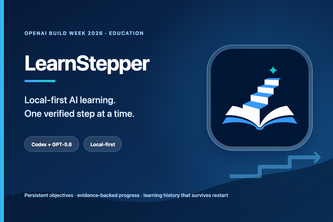
LearnStepper is a desktop application that presents an AI-powered learning companion focused on continuity, accountability, and local-first persistence. The product allows adult learners to create persistent learning projects using a Codex-powered tutor, with conversation history, objectives, and progress stored locally in a SQLite database. It does not claim Web grounding or execute learner code; instead, it relies on an external Codex CLI for AI interaction.
The project is self-reported as a Build Week hackathon submission (July 13–21, 2026) and includes no evidence of revenue, customers, or traction beyond its own description. The author states that the product was built with GPT-5.6 through Codex, but retains all consequential decisions regarding architecture and feature scope.
The single most important open question
What is the actual commercial viability of a local-first desktop learning companion that requires an external CLI for AI tutoring? Does this approach scale beyond a hackathon prototype?
What The Product Actually Is
The description states that LearnStepper is a focused desktop learning companion. It combines:
- A live Codex-powered tutor, accessed through an externally authenticated official Codex CLI.
- Local, persistent learning objectives, evidence, history, and progress, stored in a SQLite database.
- A desktop app with a React/Vinext renderer, Electron host, and Python core for persistence.
Key technical boundaries include:
- A React/Vinext Renderer for the learning experience.
- An Electron host that exposes a narrow IPC surface and starts local services only after eligibility confirmation.
- A Python application core managing SQLite persistence, learning contracts, and communication with an external Codex App Server.
The app is packaged as a macOS arm64 DMG and requires an external Codex CLI 0.144.5 for AI tutoring. Authentication tokens are not stored in the app or database; they are managed by the external CLI.
Inference The product is a local-first desktop application, not a web-based tool, and it emphasizes continuity of learning over AI chat-as-a-service.
Positioning & Claim Evolution
The description states that LearnStepper aims to be a focused desktop learning companion that provides continuity with accountability. It contrasts itself with disposable AI chats by offering:
- A persistent workspace.
- Confirmed conversation history.
- Saved learning objectives.
- Evidence-backed progress.
- Local storage of data.
It also explicitly avoids:
- Web grounding.
- Learner code execution.
- Telemetry.
- Misleading feature claims.
The author notes that the Build Week version deliberately does less, hiding incomplete flows like curriculum, diagnosis, and assessment. The product is positioned as a local-first learning tool with AI tutoring as an optional, external service.
Inference The positioning has evolved from a general-purpose AI learning assistant to a focused, local-first desktop experience that prioritizes accountability over feature breadth.
Target Customer & ICP
The description states that LearnStepper is designed for adult learners, and that it is an adult-only focused scope. It does not claim to target children or students in formal education settings.
It also notes that the product is built for self-directed learning, where users can create topics, set objectives, and return to projects over time.
Inference The ICP appears to be self-directed adult learners who value continuity and accountability in their learning process. No evidence of a specific persona or segment beyond this general description.
Business Model & Pricing Evidence
The description does not state any business model or pricing structure. It only describes the technical architecture and functionality.
Inference There is no evidence of a business model, pricing, monetization strategy, or revenue streams in the provided description.
Technical & Delivery Signals
The product is built with:
- React/Vinext for the renderer.
- Electron for the desktop host.
- Python for the core application logic and persistence.
- A Codex CLI for AI tutoring, not embedded in the app.
Key technical signals include:
- Local-first storage using SQLite.
- Typed events, idempotent commands, and conflict-safe reconciliation for conversation history.
- External authentication via Codex CLI, with tokens never entering the app or database.
- Packaging as a macOS arm64 DMG with checksums, signatures, and deep verification.
The project is validated across:
- Node, React, Python
- Build, lint, type, package, checksum, signature, responsive, keyboard, zoom, reduced-motion checks
Inference The technical architecture is modular, secure, and local-first, with clear separation of concerns. It avoids embedding AI services directly in the app.
Traction & Maturity Signals
The description states that this is a Build Week hackathon submission (July 13–21, 2026). It includes:
- Dated commits.
- Test evidence.
- Packaging checks.
- A narrative of development over the Build Week period.
It also notes that the project was validated across multiple platforms and UI states, with 202 passing automated tests.
However, there is no evidence of revenue, customers, or adoption beyond the author’s own account. The product is not described as having a user base or being used in production.
Inference The product is at an early prototype stage, likely a hackathon demo, with no traction or maturity signals beyond its own development narrative.
Competitive Context
The description does not mention any competitors or direct market context. It only describes the product’s unique features (local-first, persistent history, external AI tutoring) and contrasts it with disposable AI chats.
Inference No competitive landscape is described in the provided text. The author does not reference existing tools or platforms in the learning or AI education space.
Open Questions & Risks
- External dependency on Codex CLI: The app requires an external tool for AI tutoring, which may limit usability and scalability.
- No revenue or monetization model: No evidence of a business plan or pricing strategy.
- Limited scope in hackathon version: Features like curriculum alignment, diagnostics, and assessments are not yet implemented.
- Local-first approach may be niche: The focus on local storage and desktop apps may limit market reach compared to web-based tools.
- No user data or adoption metrics: No evidence of traction, usage, or customer feedback.
Inference The product is highly experimental, with a significant risk that it will not scale beyond the prototype stage without further development and commercialization strategy.
Questions the description leaves open
- What is the long-term vision for LearnStepper beyond this Build Week prototype?
- How does the external Codex CLI dependency affect scalability or user experience?
- Are there plans to monetize or offer a paid version of the product?
- What are the technical and commercial risks of relying on an external AI service?
- How do you plan to validate or improve the local-first, persistent learning model with real users?
- Is there any interest in expanding beyond macOS or adding support for Windows/Linux?
Overall Assessment
The description states that LearnStepper is a Build Week hackathon submission, and no evidence of traction, revenue, or customer adoption is provided.
Inference The project is not ready for investment or partnership at this stage. It is an early-stage prototype with no commercial viability or market validation evident in the description. The product’s local-first approach and external AI dependency raise questions about scalability and user experience that would need to be addressed before considering further engagement.
User Stories BotA demo video on every pull request
Get a demo video on every new feature
GitHub App that watches your pull requests and records a narrated, captioned demo.
Save time on demo prep and make informed decisions faster with a video walkthrough of every new feature.
Source
Submitted to the OpenAI 2026 hackathon on Devpost. Project home on Devpost. Back to the full gallery on Devpost.
This competitive analysis was produced by top-founders.com (opens in a new tab)
Generated by a language model from this project's public Devpost page — its tagline, the author's own write-up and any built-with tags listed there — as captured in August 2026. Short quotations are the author's words. It is an opinion on the idea as a business, not on the people behind it, and it reflects the description as published then. If the project has moved on, request a correction below. The analysis is not independent research and contains no verified traction, revenue or customer data.
An independent guide by KFG International LLC — not affiliated with, endorsed by, or connected to Devpost or OpenAI.