

Archive position — measured, not model output
0 likes on Devpost
2,263 of the 7,850 archived projects have more likes, and 5,587 share exactly 0 — so this project's #2,962 place in the like-ranked listing is a tie-break inside that group, not a ranking.
Projects (log scale)
Likes on Devpost. ▲ marks this project's group.
Show the figures
| Likes | Projects | Share of archive |
|---|---|---|
| 0 | 5,587 | 71.2% |
| 1 | 1,758 | 22.4% |
| 2 | 284 | 3.6% |
| 3–4 | 132 | 1.7% |
| 5–9 | 75 | 1.0% |
| 10+ | 14 | 0.2% |
 User Stories BotA demo video on every pull request
Get a demo video on every new feature
GitHub App that watches your pull requests and records a narrated, captioned demo.
Save time on demo prep and make informed decisions faster with a video walkthrough of every new feature.
Executive Summary
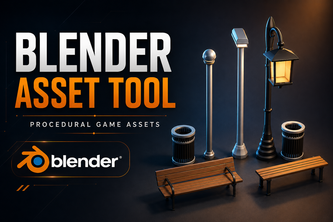
The description states that Blender Asset Tool is a Blender add-on designed to enable reproducible game-asset creation using configurable generators, style presets, material systems, and a controlled Unreal Engine export pipeline. The author, Jannik Wacker, built it as a solo developer over a few days, using AI tools like GPT-5.6 and Codex for development support. It currently includes procedural street lamp variants and is intended to support more asset types through its generator system.
The project is described as having emerged from a personal need to create consistent game assets for a hobby project, but evolved into an independent tool. No revenue, customers or traction are evidenced.
The single most important open question
Is the author's stated goal of building a reusable framework for procedural asset generation actually achievable and scalable beyond the current prototype? The description does not provide evidence of any real-world adoption, usage metrics, or commercial viability.
What The Product Actually Is
- The description states that Blender Asset Tool is a Blender add-on.
- It enables reproducible game asset creation using:
- Configurable generators
- Style presets
- Material systems
- Controlled Unreal Engine export pipeline
- It includes:
- Procedural street lamp variants as production-ready examples
- Generators, material roles, profiles, and export metadata
- The tool supports generating, regenerating, modifying, and exporting assets with consistent naming, materials, pivots, collision data, and export metadata.
- It is built using:
- Python
- AI tools: GPT-5.6 and Codex
- Built as a solo effort by Jannik Wacker
Note
The description does not state whether the tool is publicly available or open-source.
Positioning & Claim Evolution
- The author states that the project was originally intended to help with creating consistent assets for a personal hobby game.
- It evolved into a standalone Blender add-on, suggesting an intent to build a reusable tool.
- The positioning implies:
- A developer or indie game creator workflow tool
- A procedural asset generation system
- A Blender-centric solution with Unreal Engine integration
- The author claims that the tool allows for reproducible asset creation, which is a key differentiator.
- No evidence of prior positioning or evolution in marketing claims beyond the initial personal use case.
Inference The tool may be positioned as an internal utility for indie developers or small teams, but there is no evidence of broader market positioning or branding.
Target Customer & ICP
- The author states that the tool was originally built to help with personal game development.
- It is described as a Blender add-on, suggesting it targets:
- Blender users
- Game developers (especially indie devs)
- Users who need reproducible, consistent assets
- The tool supports Unreal Engine export pipeline, implying use in Unreal-based projects.
- No evidence of specific customer segments or personas beyond the author’s own use case.
Inference Likely targets indie game developers or Blender users needing procedural asset workflows. No evidence of a defined ICP or target market beyond personal use.
Business Model & Pricing Evidence
- The description does not state any pricing model, monetization strategy, or business model.
- It is described as a solo developer project, with no indication of commercial intent or revenue streams.
- The author mentions that if they decide to release it publicly in the future, they would like to make adding new assets possible without relying on Codex — but this is speculative.
Inference No evidence of a business model. The tool appears to be personal development with no stated monetization path.
Technical & Delivery Signals
- Built as a Blender add-on using:
- Python
- AI tools: GPT-5.6 and Codex
- The author used AI for:
- Architecture planning
- Breaking large tasks into smaller ones
- Reviewing design decisions
- Implementing features with Codex
- The tool supports:
- Procedural generation
- Configurable generators
- Style presets
- Material roles and profiles
- Controlled Unreal Engine export pipeline
- The author claims that the system is designed to support many more asset types.
- It includes:
- Procedural street lamp variants as examples
- Consistent naming, materials, pivots, collision data, and export metadata
Inference The tool shows technical sophistication in procedural generation and AI-assisted development. However, no evidence of scalability or production use.
Traction & Maturity Signals
- The author states that the project went from idea to working add-on in a few days.
- It includes procedural street lamp variants as production-ready examples.
- The system is described as designed to support many more asset types.
- No evidence of:
- Customer adoption
- Usage metrics
- Revenue
- Public release or distribution
- Community engagement
Inference The tool is in a very early prototype phase, with no demonstrated traction or maturity.
Competitive Context
- The description does not mention any direct competitors.
- It is positioned as a Blender add-on for game asset generation with Unreal Engine export support.
- No evidence of:
- Existing tools in this space
- Market analysis
- Competitive differentiation beyond the use of AI and procedural workflows
Inference The competitive landscape is unknown. The tool may be unique or niche, but there is no evidence to assess its place in the market.
Open Questions & Risks
- The project is described as a solo developer effort with no team or external support.
- No evidence of:
- Public release
- Community adoption
- Revenue or monetization strategy
- Scalability beyond the current prototype
- Reliance on AI tools (GPT-5.6, Codex) for development raises questions about:
- Reproducibility
- Long-term maintainability
- Dependency risks
- The author states that if they release it publicly, they want to remove reliance on Codex, which suggests current dependency is high.
Inference High risk of being a personal prototype with no commercial viability or scalability. Dependency on AI tools and lack of traction are key concerns.
Questions the description leaves open
- Is the tool currently publicly available, or is it only a prototype?
- What is the current level of automation in asset creation? How much manual work remains?
- Has there been any feedback from other Blender users or developers?
- Are there plans to monetize the tool, and if so, what model are you considering?
- What are the long-term goals for the tool beyond procedural asset generation?
- How do you plan to reduce dependency on AI tools like Codex for future development?
Overall Assessment
- The description states that Blender Asset Tool is a solo developer project, built in a few days.
- No evidence of:
- Revenue
- Customers
- Traction
- Public release
- Commercial viability
- It is described as a personal tool with no stated intent to scale or monetize.
- The author’s own write-up indicates that the project was never intended to become a business.
Assessment Not evidenced as a viable investment or partnership opportunity. The tool appears to be an early-stage prototype with no demonstrated commercial traction, adoption, or scalability. It is not evident that it has evolved beyond a personal development effort.
User Stories BotA demo video on every pull request
Get a demo video on every new feature
GitHub App that watches your pull requests and records a narrated, captioned demo.
Save time on demo prep and make informed decisions faster with a video walkthrough of every new feature.
Source
Submitted to the OpenAI 2026 hackathon on Devpost. Project home on Devpost. Back to the full gallery on Devpost.
This competitive analysis was produced by top-founders.com (opens in a new tab)
Generated by a language model from this project's public Devpost page — its tagline, the author's own write-up and any built-with tags listed there — as captured in August 2026. Short quotations are the author's words. It is an opinion on the idea as a business, not on the people behind it, and it reflects the description as published then. If the project has moved on, request a correction below. The analysis is not independent research and contains no verified traction, revenue or customer data.
An independent guide by KFG International LLC — not affiliated with, endorsed by, or connected to Devpost or OpenAI.