

Archive position — measured, not model output
0 likes on Devpost
2,263 of the 7,850 archived projects have more likes, and 5,587 share exactly 0 — so this project's #4,925 place in the like-ranked listing is a tie-break inside that group, not a ranking.
Projects (log scale)
Likes on Devpost. ▲ marks this project's group.
Show the figures
| Likes | Projects | Share of archive |
|---|---|---|
| 0 | 5,587 | 71.2% |
| 1 | 1,758 | 22.4% |
| 2 | 284 | 3.6% |
| 3–4 | 132 | 1.7% |
| 5–9 | 75 | 1.0% |
| 10+ | 14 | 0.2% |
 User Stories BotA demo video on every pull request
Get a demo video on every new feature
GitHub App that watches your pull requests and records a narrated, captioned demo.
Save time on demo prep and make informed decisions faster with a video walkthrough of every new feature.
Executive Summary
What the company appears to be
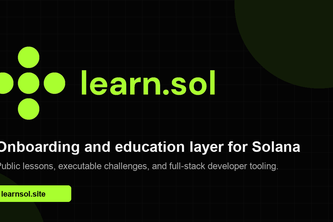
LearnSol is a self-reported, free, open-source platform for learning Solana blockchain development. The description states it offers structured lessons, browser-based coding challenges (in Rust), runtime simulations, a visual builder, AI-assisted documentation, and an agent skill for teaching Solana concepts.
What changed
The project was submitted to the OpenAI 2026 hackathon by one founder, Raghav Sharma. It is described as a learning platform built with Next.js, React, TypeScript, PostgreSQL, Rust, and AI SDKs. The author states it includes over 100 lessons, 30 Rust exercises, an interactive runtime lab, and a visual program builder.
Single most important open question
Is there any evidence of user adoption, revenue, or traction beyond the author’s self-reported claims?
What The Product Actually Is
The description states that LearnSol is:
- A free, open-source platform for learning Solana development.
- Built with Next.js, React, TypeScript, PostgreSQL, Rust, and AI SDKs.
- Designed to teach Solana concepts through structured lessons, coding challenges (in Rust), runtime simulations, a visual builder, and AI-assisted documentation.
It is described as combining:
- Structured lessons covering Solana, Rust, Anchor, and client development
- Browser-based coding challenges with executable Rust
- Runtime Lab simulations for inspecting accounts, logs, signers, and failures
- A Visual Builder for designing Solana program architecture
- AI-assisted documentation search and explanations
- A publishable agent skill that helps coding agents teach Solana
Inference The platform is built around a learning loop: Learn → Practice → Inspect → Build.
Positioning & Claim Evolution
The description states:
- The platform was inspired by the difficulty developers face when starting on Solana.
- It aims to teach "mental models" behind Solana—not just syntax.
- The goal is to move learners from “I copied a snippet” to “I understand what accounts, signers, PDAs, and runtime are doing.”
Inference The positioning evolved from a tool for solving immediate learning gaps into a structured educational platform with interactive elements.
Target Customer & ICP
The description states:
- The target audience is Solana developers, especially beginners.
- It aims to help developers move from copying code snippets to understanding core Solana concepts like account ownership, signers, PDAs, and transaction flow.
Inference The ICP appears to be early-to-mid-level Solana developers or those new to blockchain development who want a hands-on learning experience.
Business Model & Pricing Evidence
The description states:
- LearnSol is free and open-source.
- No pricing model or monetization strategy is described.
Inference There is no evidence of a commercial business model. The platform is self-reported as free and open-source.
Technical & Delivery Signals
The description states:
- Built with Next.js, React, TypeScript, Tailwind CSS, Fumadocs MDX, Monaco Editor, React Flow, PostgreSQL, Drizzle, pgvector, Privy, and the AI SDK.
- Curriculum and challenges are content-defined in MDX.
- Rust challenges are validated through server-side execution.
- Project-based challenges use Solana and Anchor starter repositories with an isolated Rust build runner.
- Authentication and progress tracking are persistent.
Inference The platform is built using modern web and blockchain development stacks, with a focus on interactive learning and content-first architecture.
Traction & Maturity Signals
The description states:
- Over 100 structured lessons
- A 30-exercise Rust challenge track
- An interactive Solana Runtime Lab
- A visual Solana program builder
- Source-grounded AI documentation chat
- A Solana teaching skill for coding agents
- Project-based Solana and Anchor build challenges
- Open-source architecture designed for community contributions
Inference The platform has a substantial amount of content, but there is no evidence of user engagement, adoption, or usage metrics beyond the author’s claims.
Competitive Context
The description does not mention any competitors. It also does not state whether LearnSol is unique in its approach or how it compares to existing tools for learning blockchain development.
Inference No competitive context is provided. The platform appears to be positioned as a new tool in the Solana developer education space, but there is no evidence of prior market analysis or differentiation from other platforms.
Open Questions & Risks
- No traction or revenue data: The platform is described as free and open-source with no indication of user adoption.
- Single founder: The team size is listed as one (Raghav Sharma).
- Unverified claims: All features, content count, and functionality are self-reported without external validation.
- Lack of commercialization strategy: No evidence of monetization or business model beyond open-source.
- No user feedback or usage metrics: No data on how many users interact with the platform or what their experience is.
Questions the description leaves open
- What is the actual user base, if any?
- How are you measuring engagement or learning outcomes?
- Are there plans to monetize the platform beyond open-source?
- What is your roadmap for scaling beyond a single developer’s effort?
- How do you plan to ensure content quality and consistency across lessons and challenges?
- What is the long-term vision for AI integration in the platform?
Overall Assessment
Not evidenced.
The description provides no evidence of revenue, customers, or traction. The platform is described as free and open-source with no commercial model evident. It is built by a single individual and lacks any indication of user adoption or market validation.
Confidence Low. The entire analysis rests on self-reported claims with no external corroboration.
User Stories BotA demo video on every pull request
Get a demo video on every new feature
GitHub App that watches your pull requests and records a narrated, captioned demo.
Save time on demo prep and make informed decisions faster with a video walkthrough of every new feature.
Source
Submitted to the OpenAI 2026 hackathon on Devpost. Project home on Devpost. Back to the full gallery on Devpost.
This competitive analysis was produced by top-founders.com (opens in a new tab)
Generated by a language model from this project's public Devpost page — its tagline, the author's own write-up and any built-with tags listed there — as captured in August 2026. Short quotations are the author's words. It is an opinion on the idea as a business, not on the people behind it, and it reflects the description as published then. If the project has moved on, request a correction below. The analysis is not independent research and contains no verified traction, revenue or customer data.
An independent guide by KFG International LLC — not affiliated with, endorsed by, or connected to Devpost or OpenAI.