

Archive position — measured, not model output
0 likes on Devpost
2,263 of the 7,850 archived projects have more likes, and 5,587 share exactly 0 — so this project's #6,878 place in the like-ranked listing is a tie-break inside that group, not a ranking.
Projects (log scale)
Likes on Devpost. ▲ marks this project's group.
Show the figures
| Likes | Projects | Share of archive |
|---|---|---|
| 0 | 5,587 | 71.2% |
| 1 | 1,758 | 22.4% |
| 2 | 284 | 3.6% |
| 3–4 | 132 | 1.7% |
| 5–9 | 75 | 1.0% |
| 10+ | 14 | 0.2% |
 User Stories BotA demo video on every pull request
Get a demo video on every new feature
GitHub App that watches your pull requests and records a narrated, captioned demo.
Save time on demo prep and make informed decisions faster with a video walkthrough of every new feature.
Executive Summary
What the company appears to be
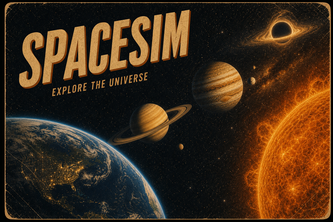
SpaceSim is a browser-based universe simulator built by one developer (Romain SIMON) that allows users to explore the Solar System and other celestial objects in an educational context. It uses scientific sources for planetary positions, time, and motion but presents them with transparency about provenance and limitations.
What changed
The project evolved from a broad ambition to build a realistic space simulator into a focused product emphasizing source-backed Solar System exploration, an ISS observer, and an experimental stellar laboratory. The scope narrowed from "everything realistic" to explicit labeling of what is source-backed vs. reconstructed or experimental.
The single most important open question
Does SpaceSim have any commercial traction, revenue, customers, or adoption beyond the author's own development work? The description states no such evidence exists.
What The Product Actually Is
The description states that SpaceSim is a free, browser-based universe simulator designed for astronomy learners. It allows users to:
- Explore the Solar System including the Sun, Earth, Moon, and planets
- Manipulate date, time, and simulation speed
- Compare physical scale with a "Diagram mode"
- Inspect source and limitations behind each view
- Travel between destinations with narration and audio
- Use an ISS observer with pinned NASA trajectory data
- Access an experimental stellar laboratory covering various star types
The product is built using TypeScript, Vite, Three.js, and leverages WebGPU where supported. It uses scientific inputs from sources like NASA JPL, NAIF, Gaia, SIMBAD, ATNF, VizieR, and others.
Not evidenced: No information about actual users, customer base, or commercial adoption.
Positioning & Claim Evolution
The description states that SpaceSim was inspired by tools like SpaceEngine but aims to be "scientifically careful and beautiful" without hiding where the information comes from or pretending every visual detail is directly observed.
Key claims:
- It makes the universe approachable for students, teachers, and curious learners
- It shows evidence and limitations behind every representation
- It helps users understand scale, time, motion, and scientific uncertainty
- It distinguishes between observed data and visual reconstruction
The positioning evolved from a broad ambition to build "the most realistic possible space simulator" to a more focused approach that emphasizes transparency about provenance and representational limits.
Inferred: The author's stated goal of making the universe approachable suggests an educational or learning platform, though this is not confirmed as a commercial offering.
Target Customer & ICP
The description states that SpaceSim targets:
- Students
- Teachers
- Curious learners
It also mentions that it helps users understand scale, time, motion, and scientific uncertainty — implying an audience with some interest in astronomy or science education.
Not evidenced: No specific customer segments, personas, or usage patterns beyond general educational audiences are provided. No indication of whether this is a B2C or B2B offering.
Business Model & Pricing Evidence
The description states that SpaceSim is free to use and does not require an account for basic exploration.
Not evidenced: No pricing model, monetization strategy, or revenue streams are described. There is no mention of paid features, subscriptions, or partnerships.
Technical & Delivery Signals
The project uses:
- TypeScript, Vite, Three.js
- WebGPU with fallback to WebGL 2
- Scientific inputs from NASA JPL, NAIF, Gaia, SIMBAD, ATNF, VizieR, etc.
- Tools like Codex, GPT-5.6 Sol, GPT Image Pro, ElevenLabs, Suno 5.5 for development and media creation
Not evidenced: No details on performance metrics beyond desktop/mobile testing or technical architecture beyond the stack used.
Traction & Maturity Signals
The description states:
- The project was built in a Build Week period
- Contains more than 240 commits, 120 test files, and 72 documentation files
- Includes independent scientific validators (TypeScript, Rust, CSPICE C, SOFA checks)
- Has retained desktop and throttled-mobile performance evidence
However:
- No user data, customer base, or adoption metrics are provided
- No revenue, ARR, or funding rounds are mentioned
Not evidenced: No commercial traction, usage statistics, or product maturity beyond the author's own development work.
Competitive Context
The description mentions SpaceEngine as a reference point and states that SpaceSim aims to be "scientifically careful" while avoiding the "overwhelming, difficult to verify, and raw" aspects of such tools.
Not evidenced: No competitive analysis, market positioning relative to other simulators or educational platforms, or competitor pricing or features are described.
Open Questions & Risks
- Single-person team: The project is built by one developer (Romain SIMON), which may limit scalability and long-term maintenance.
- No commercial traction: There is no evidence of users, customers, or revenue beyond the author’s own development.
- Educational focus without monetization: While it targets educators and learners, there is no indication of how this will translate into a sustainable business model.
- Highly technical and niche domain: The product may struggle to reach mainstream adoption due to its specialized nature.
Inferred: If SpaceSim were to scale or attract users, the lack of a clear monetization strategy could be a risk.
Questions the description leaves open
- What is your plan for scaling beyond one developer?
- Are there any plans to monetize the platform, and if so, how?
- How do you intend to reach and engage with educators or learners?
- Have you considered partnerships with educational institutions or science museums?
- What are the technical limitations of running such a simulation in a browser at scale?
- Is there any intention to expand beyond the Solar System or add collaborative features?
Overall Assessment
Not evidenced: No financial data, valuation, funding history, or commercial performance is available.
The description indicates that SpaceSim is an educational tool built by one developer, with no evidence of traction, revenue, or customer adoption. It appears to be a personal project or prototype rather than a commercial venture.
Inferred: If this were to become a product with real users and monetization, it could have potential in the educational space — but currently, there is no indication of such development.
User Stories BotA demo video on every pull request
Get a demo video on every new feature
GitHub App that watches your pull requests and records a narrated, captioned demo.
Save time on demo prep and make informed decisions faster with a video walkthrough of every new feature.
Source
Submitted to the OpenAI 2026 hackathon on Devpost. Project home on Devpost. Back to the full gallery on Devpost.
This competitive analysis was produced by top-founders.com (opens in a new tab)
Generated by a language model from this project's public Devpost page — its tagline, the author's own write-up and any built-with tags listed there — as captured in August 2026. Short quotations are the author's words. It is an opinion on the idea as a business, not on the people behind it, and it reflects the description as published then. If the project has moved on, request a correction below. The analysis is not independent research and contains no verified traction, revenue or customer data.
An independent guide by KFG International LLC — not affiliated with, endorsed by, or connected to Devpost or OpenAI.