

Archive position — measured, not model output
1 like on Devpost
505 of the 7,850 archived projects have more likes, and 1,758 share exactly 1 — so this project's #991 place in the like-ranked listing is a tie-break inside that group, not a ranking.
Projects (log scale)
Likes on Devpost. ▲ marks this project's group.
Show the figures
| Likes | Projects | Share of archive |
|---|---|---|
| 0 | 5,587 | 71.2% |
| 1 | 1,758 | 22.4% |
| 2 | 284 | 3.6% |
| 3–4 | 132 | 1.7% |
| 5–9 | 75 | 1.0% |
| 10+ | 14 | 0.2% |
 User Stories BotA demo video on every pull request
Get a demo video on every new feature
GitHub App that watches your pull requests and records a narrated, captioned demo.
Save time on demo prep and make informed decisions faster with a video walkthrough of every new feature.
Executive Summary
What the company appears to be
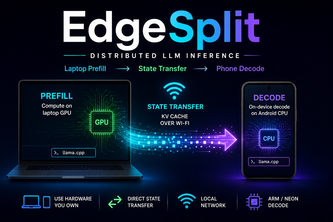
EdgeSplit is a self-reported project that splits LLM inference across two devices — a CUDA-equipped laptop for prefill and an Android phone for decode — using custom software patches and TCP-based handoff protocols. It was submitted as part of the OpenAI 2026 hackathon.
What changed
The author describes building a working prototype with benchmarked performance improvements (60–80% faster time-to-first-token), but no commercial product or traction is evidenced.
Single most important open question
Is there any evidence that this concept has moved beyond a proof-of-concept into real-world usage, adoption or monetization?
What The Product Actually Is
The description states that EdgeSplit runs LLM prefill on a laptop and decode on a phone, using two handoff mechanisms:
- V1: saves state to a file and uploads it over HTTP.
- V2: patches llama.cpp to export raw sequence state directly via a custom TCP protocol.
The system uses:
- CUDA for laptop-side prefill
- Termux on Android for phone-side decode
- FastAPI router on the laptop
- Custom binary framing protocol over TCP
It is built with technologies including: android, arm, c++, clang, cmake, codex, cuda, fastapi, gguf, gpt-5.6, llama, llama.cpp, neon, nvidia-smi, pydantic, python, qwen3, sockets, sqlite, tcp, termux, ubuntu, uvicorn, wsl2.
Inference type
LLM inference split between two devices, with prefill on laptop and decode on phone.
Not evidenced
- No commercial product or service
- No customer base or usage metrics
- No pricing model or revenue streams
Positioning & Claim Evolution
The author claims that EdgeSplit:
- Turns everyday hardware into a distributed inference system.
- Splits LLM inference phases (prefill vs decode) across devices, similar to large-scale production systems like NVIDIA’s Dynamo architecture.
This positioning implies:
- A novel approach to edge computing for LLMs
- Use of existing consumer-grade hardware instead of dedicated infrastructure
Inference The project is positioned as a technical innovation in distributed inference, not a commercial offering. The author emphasizes reproducibility and correctness over scalability or market readiness.
Target Customer & ICP
Not evidenced.
The description does not identify:
- Specific customer segments
- Use cases beyond the hackathon context
- Target industries or personas
Inference If this were to evolve into a product, it would likely target developers or researchers who want to experiment with LLM inference on low-cost hardware. However, no such intent is stated.
Business Model & Pricing Evidence
Not evidenced.
There is no mention of:
- Revenue model
- Pricing structure
- Monetization strategy
- Paid features or tiers
Inference The project appears to be a proof-of-concept with no commercial business model described. Any future monetization would need to be inferred from how the technology might scale or be packaged.
Technical & Delivery Signals
The author reports:
- Implementation in WSL2 Ubuntu (laptop) and Termux (phone)
- Patching of llama.cpp for V2
- Use of FastAPI, TCP sockets, and custom binary framing protocol
- Benchmarking methodology: warmed repetition with statistical tracking
- Challenges including device-specific crashes, profiling issues, and unreliable power sensors
Inference The technical execution shows a high level of engineering effort and attention to detail. However, there is no evidence of production-grade delivery or deployment.
Traction & Maturity Signals
Not evidenced.
There are no signs of:
- Customers
- Revenue
- Product usage
- Adoption metrics
- Market traction
Inference This remains a hackathon project with no demonstrated traction or maturity beyond prototype development.
Competitive Context
Not evidenced.
The description does not reference:
- Competitors
- Existing solutions in the space
- Market positioning relative to others
Inference While the idea of distributed inference is not new, there is no evidence that EdgeSplit is part of a competitive landscape or has differentiated itself from other tools or platforms.
Open Questions & Risks
- Proof-of-concept only: No commercial product or adoption.
- Device-specific limitations: One phone failed due to hardware incompatibility; performance may not generalize.
- Unreliable instrumentation: Power sensor issues suggest lack of robustness in measurement tools.
- Single founder: Team size is listed as 1, which raises questions about scalability and execution capacity.
- No verification of results: Multiple false positives were caught only after deeper inspection.
Questions the description leaves open
- What are the actual performance gains in real-world usage vs. controlled benchmarks?
- Has this been tested across multiple phone models or platforms?
- Are there plans to move beyond a hackathon prototype into a product or service?
- How would you handle edge cases like network interruptions during handoff?
- Is there any interest from developers or enterprises in using this system?
- What are the limitations of the current implementation that prevent broader adoption?
Overall Assessment
Not evidenced.
There is no evidence of:
- Revenue
- Customers
- Product-market fit
- Commercial traction
Inference At this stage, EdgeSplit is a technical demonstration with potential for future development. It does not yet meet criteria for investment or partnership unless it evolves into a scalable product with clear commercial intent and traction.
User Stories BotA demo video on every pull request
Get a demo video on every new feature
GitHub App that watches your pull requests and records a narrated, captioned demo.
Save time on demo prep and make informed decisions faster with a video walkthrough of every new feature.
Source
Submitted to the OpenAI 2026 hackathon on Devpost. Project home on Devpost. Back to the full gallery on Devpost.
This competitive analysis was produced by top-founders.com (opens in a new tab)
Generated by a language model from this project's public Devpost page — its tagline, the author's own write-up and any built-with tags listed there — as captured in August 2026. Short quotations are the author's words. It is an opinion on the idea as a business, not on the people behind it, and it reflects the description as published then. If the project has moved on, request a correction below. The analysis is not independent research and contains no verified traction, revenue or customer data.
An independent guide by KFG International LLC — not affiliated with, endorsed by, or connected to Devpost or OpenAI.