

Archive position — measured, not model output
1 like on Devpost
505 of the 7,850 archived projects have more likes, and 1,758 share exactly 1 — so this project's #993 place in the like-ranked listing is a tie-break inside that group, not a ranking.
Projects (log scale)
Likes on Devpost. ▲ marks this project's group.
Show the figures
| Likes | Projects | Share of archive |
|---|---|---|
| 0 | 5,587 | 71.2% |
| 1 | 1,758 | 22.4% |
| 2 | 284 | 3.6% |
| 3–4 | 132 | 1.7% |
| 5–9 | 75 | 1.0% |
| 10+ | 14 | 0.2% |
 User Stories BotA demo video on every pull request
Get a demo video on every new feature
GitHub App that watches your pull requests and records a narrated, captioned demo.
Save time on demo prep and make informed decisions faster with a video walkthrough of every new feature.
Executive Summary
Project: EduMind AI (Education Platform with AI Integration)
Self-reported basis only — no independent verification of claims, traction, customers, or revenue.
Author's stated intent: Build a multi-modal AI education platform for distance learners, using GPT-5.6 and related OpenAI APIs, deployed via Firebase + React stack.
What changed: The author reports building a full-stack prototype with four distinct AI capabilities (tutoring, voice Q&A, image analysis, quiz generation) in a single service layer, leveraging GPT-5.6 for agentic behavior and structured outputs. The platform includes role-based access control and CI/CD via GitHub Actions.
Most important open question: Is there evidence of real-world usage or demand from distance learners? The description lacks any data on adoption, user feedback, or institutional deployment beyond the author’s own use case at IFHE.
What The Product Actually Is
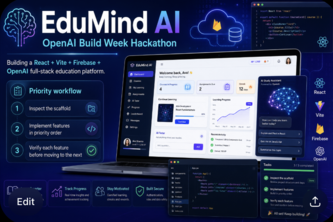
The description states that EduMind AI is a multi-modal education platform built with React and Firebase, integrating four distinct AI capabilities powered by GPT-5.6:
- AI Tutor: A conversational tutor using function calling to search course context, generate practice questions, and adapt explanations.
- Voice Q&A: Transcribes audio via Whisper, generates answers with GPT-5.6, and reads responses aloud using TTS.
- Image Analysis: Uses GPT-5.6 Vision to transcribe, explain, and contextualize handwritten notes or diagrams.
- Quiz Center: Generates JSON quizzes on any topic using structured outputs from GPT-5.6.
It also includes an admin dashboard for course management, student analytics, AI-generated study plans, and tools for summarizing content and auto-creating courses.
The platform is built with:
- Frontend: React 18 + Vite
- Backend: Firebase (auth, Firestore, hosting)
- CI/CD: GitHub Actions
- AI APIs: GPT-5.6, Whisper, TTS, Vision
Inference: The author claims to have implemented an agentic loop for the tutor using function calling and tool execution against Firestore data.
Positioning & Claim Evolution
The author positions EduMind AI as a personal AI tutor for distance learners, aiming to solve the problem of isolation and lack of support during online study. The platform is described as:
- Always available
- Speaking the learner’s language
- Understanding course content
- Providing adaptive explanations and follow-up questions
Inference: The author frames this as a shift from static textbooks or recorded lectures to dynamic, interactive AI support.
The platform is also described as built for online learning, with features like voice Q&A and image analysis tailored for commuters and multitaskers. It includes an admin dashboard suggesting it targets institutions rather than just individuals.
Claim: The author states that the platform was built to address a recurring issue in distance education — students getting stuck at 11pm before exams, with no one to ask.
Target Customer & ICP
The description states that EduMind AI is built for distance learners, particularly those studying alone and needing support outside of traditional classroom settings.
It also mentions an admin dashboard suggesting institutional use cases, such as deployment at IFHE (a deemed university), where the author works as Director of CDOE.
Inference: The core ICP appears to be:
- Distance learners in higher education
- Institutions offering online learning programs
- Users who benefit from AI tutoring, voice Q&A, and image-based learning
There is no evidence of segmentation beyond this — no mention of K-12, corporate training, or other verticals.
Business Model & Pricing Evidence
The description does not state any business model or pricing strategy. It only mentions that the platform includes an admin dashboard for course management and analytics, which implies a potential SaaS or institutional licensing model.
There is no mention of:
- Subscription tiers
- Freemium vs paid features
- Revenue streams
- Pricing per user or per course
Inference: The business model is not defined in the description. It may be assumed to be B2B (institutional) with possible SaaS-style access, but this is unconfirmed.
Technical & Delivery Signals
The platform is built using:
- Frontend: React 18 + Vite
- Backend: Firebase (auth, Firestore, hosting)
- CI/CD: GitHub Actions
- AI APIs: GPT-5.6, Whisper, TTS, Vision
- Tools: Codex for scaffolding and engineering decisions
Key technical claims:
- Agentic loop implemented using function calling and tool execution against Firestore
- Structured outputs used for quiz generation (JSON schema)
- Real-time chat via
onSnapshotinstead of polling - Role-based access control with secure Firestore rules
- Voice pipeline latency managed with animated waveform indicators
Inference: The author demonstrates a clear understanding of full-stack development and AI integration, but no evidence of production deployment or scalability.
Traction & Maturity Signals
The description does not provide any traction data:
- No revenue figures
- No customer base
- No user metrics
- No institutional adoption beyond the author’s own role at IFHE
The project is described as a prototype built for a hackathon, and no mention of beta testing or real-world usage.
Inference: The platform is in early development stage. There is no evidence of product-market fit or user engagement.
Competitive Context
The description does not name any competitors. However, based on the features described (AI tutoring, voice Q&A, image analysis, quiz generation), EduMind AI overlaps with:
- AI-powered learning platforms
- LMS integrations with AI tools
- Voice-enabled education apps
- Multi-modal AI assistants for education
No evidence of direct competition is provided in the description.
Open Questions & Risks
- Unverified claims: All features and capabilities are self-reported without independent validation.
- No traction or adoption: No evidence of real-world usage, user feedback, or institutional deployment beyond the author’s own context.
- Prototype nature: Built for a hackathon — no indication of production readiness or scalability.
- Dependency on GPT-5.6: The platform relies heavily on a proprietary API (GPT-5.6) that may not be available or stable in the future.
- Limited scope: No evidence of integration with existing LMS platforms, multilingual support beyond initial plans, or mobile app deployment.
Questions the description leaves open
- What is the actual user base for this platform? Is it being used by students or institutions?
- How does the platform handle scalability and performance under load?
- Are there any institutional partnerships or pilot programs in place?
- What are the long-term plans for monetization and pricing?
- How is data privacy and security handled, especially with student content?
- What are the technical limitations of GPT-5.6 in real-world usage scenarios?
- Is there a plan to integrate with existing LMS platforms like Moodle or Canvas?
Overall Assessment
Not evidenced: There is no evidence of revenue, customers, traction, or institutional adoption beyond the author’s own use case.
The platform appears to be a proof-of-concept prototype, built for a hackathon. It shows technical capability and a clear understanding of AI integration in education but lacks any commercial validation or market readiness indicators.
Confidence level: Low — based on self-reported description only, with no third-party verification or data on usage, adoption, or performance.
User Stories BotA demo video on every pull request
Get a demo video on every new feature
GitHub App that watches your pull requests and records a narrated, captioned demo.
Save time on demo prep and make informed decisions faster with a video walkthrough of every new feature.
Source
Submitted to the OpenAI 2026 hackathon on Devpost. Project home on Devpost. Back to the full gallery on Devpost.
This competitive analysis was produced by top-founders.com (opens in a new tab)
Generated by a language model from this project's public Devpost page — its tagline, the author's own write-up and any built-with tags listed there — as captured in August 2026. Short quotations are the author's words. It is an opinion on the idea as a business, not on the people behind it, and it reflects the description as published then. If the project has moved on, request a correction below. The analysis is not independent research and contains no verified traction, revenue or customer data.
An independent guide by KFG International LLC — not affiliated with, endorsed by, or connected to Devpost or OpenAI.