

Archive position — measured, not model output
1 like on Devpost
505 of the 7,850 archived projects have more likes, and 1,758 share exactly 1 — so this project's #994 place in the like-ranked listing is a tie-break inside that group, not a ranking.
Projects (log scale)
Likes on Devpost. ▲ marks this project's group.
Show the figures
| Likes | Projects | Share of archive |
|---|---|---|
| 0 | 5,587 | 71.2% |
| 1 | 1,758 | 22.4% |
| 2 | 284 | 3.6% |
| 3–4 | 132 | 1.7% |
| 5–9 | 75 | 1.0% |
| 10+ | 14 | 0.2% |
 User Stories BotA demo video on every pull request
Get a demo video on every new feature
GitHub App that watches your pull requests and records a narrated, captioned demo.
Save time on demo prep and make informed decisions faster with a video walkthrough of every new feature.
Executive Summary
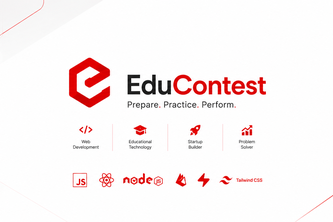
EduContest is an AI-powered platform for educators, as described by its author. The project was submitted to the OpenAI 2026 hackathon and is built with Next.js, React, Supabase, and OpenAI APIs. It allows teachers to generate quizzes, exams, and assessments using AI, with features such as automatic grading, question bank organization, and editing controls. The platform claims to reduce assessment creation time from hours to seconds.
The author states that the tool integrates OpenAI models (including GPT-5) to assist in generating curriculum-aligned content, but does not provide evidence of revenue, customer adoption, or actual usage. The description is self-reported and unverified — no third-party validation exists for its claims or performance.
The single most important open question
Is there any evidence that teachers are using this platform, or that it has been adopted in real classroom settings?
What The Product Actually Is
The description states that EduContest is an AI-powered assessment platform for educators, built with:
- Frontend: Next.js, React, Tailwind CSS
- Backend: Supabase (with PostgreSQL and Auth)
- AI integration: OpenAI API (GPT models)
- Deployment: Vercel
It enables teachers to:
- Generate quiz and exam questions.
- Create multiple-choice, true/false, and open-ended questions.
- Automatically produce explanations and answer keys.
- Save and organize question banks.
- Review and edit AI-generated content before publishing.
The author notes that the platform uses OpenAI to assist in generating educational content, improving question quality, and supporting personalized assessments.
Inference The tool is a web-based SaaS product designed for teachers, integrating AI for content creation and editing workflows. It is not described as a marketplace or a platform for students, but rather a productivity tool for educators.
Positioning & Claim Evolution
The author positions EduContest as an AI-powered assistant that helps teachers:
- Generate assessments quickly.
- Maintain control over final output.
- Reduce time spent on preparation.
It is described as a tool that:
- “Reduces assessment creation from hours to seconds.”
- “Keeps full control over the final result.”
- “Integrates OpenAI into a real classroom workflow.”
The author also states that AI works best as a collaborative assistant, not a replacement, and emphasizes prompt engineering, UX design, and user feedback.
Inference The positioning is centered on time-saving for educators, with an emphasis on AI as a productivity tool rather than a fully autonomous system. It reflects early-stage product thinking focused on usability and teacher collaboration.
Target Customer & ICP
The description states that EduContest is built for teachers, who spend significant time creating quizzes, exams, and assignments.
It is implied that the primary user base consists of:
- Educators in K-12 or higher education.
- Teachers seeking tools to automate repetitive tasks like question creation.
No further segmentation or targeting details are provided — no mention of grade levels, subject areas, or institutional types.
Inference The ICP appears to be teachers or educators who want to reduce time spent on assessment creation and improve efficiency. No evidence of specific customer personas or institutional adoption is present.
Business Model & Pricing Evidence
The description does not contain any information about:
- Revenue model
- Pricing structure
- Monetization strategy
- Subscription plans or usage fees
It only describes the platform’s functionality and how it integrates AI to assist teachers.
Inference No evidence of a business model is present. The project appears to be in early development, possibly as a prototype or hackathon submission.
Technical & Delivery Signals
The project was built using:
- Frontend: Next.js, React, Tailwind CSS
- Backend: Supabase (PostgreSQL + Auth)
- AI: OpenAI API (GPT models)
- Deployment: Vercel
It is described as a serverless application with:
- RESTful APIs
- Responsive UI
- Markdown support
- Prompt engineering for AI generation
The author mentions challenges around prompt design, content reliability, and balancing creativity with curriculum accuracy.
Inference The technical stack suggests a modern SaaS product built with open-source and cloud-native tools. It is likely scalable but lacks evidence of production deployment or performance metrics.
Traction & Maturity Signals
There is no evidence of:
- Revenue
- Customers
- User adoption
- Product usage data
- Market traction
- Product maturity beyond prototype stage
The project was submitted to a hackathon and is described as a working prototype. The author notes that it was built in a short timeframe, with challenges around reliability and consistency.
Inference No traction or maturity signals are evident. It is likely an early-stage product, possibly a proof-of-concept or MVP.
Competitive Context
The description does not mention:
- Competitors
- Market analysis
- Differentiation from existing tools
- Competitive positioning
It only states that “existing tools are often slow, repetitive, and lack intelligent assistance,” implying a gap in the market. However, no specific competitors are named or analyzed.
Inference The competitive landscape is not described. It is unclear whether EduContest is addressing an underserved niche or competing with existing edtech platforms.
Open Questions & Risks
- No revenue or customer data: The platform has no demonstrated traction.
- Unverified claims: All features and benefits are self-reported without external validation.
- Prototype nature: Built for a hackathon, not production-ready.
- AI reliability concerns: Challenges around content consistency and accuracy are noted.
- Lack of monetization strategy: No evidence of how the product will generate revenue.
- Single founder: The team is described as one person, which may limit execution capacity.
Inference Risks include unproven market demand, technical limitations in AI integration, and lack of scalability or business model clarity.
Questions the description leaves open
- What specific educational content has the platform generated? Can you show examples?
- How do you validate the accuracy of AI-generated questions?
- Have you tested this with actual teachers or schools?
- What is your plan for monetization and scaling beyond a prototype?
- How do you handle privacy and data security for student information?
- What are the main technical challenges that remain unresolved?
- Are there any partnerships or integrations planned with LMS platforms?
Overall Assessment
The description states that EduContest is an AI-powered platform for educators, built as a hackathon submission. It has no demonstrated traction, revenue, or customer adoption.
It is described as a prototype with potential in the edtech space but lacks evidence of viability or scalability.
Assessment Not ready for investment or partnership at this stage. The project shows early-stage innovation and user intent but lacks key signals of product-market fit or commercial readiness.
Confidence Level Low — based entirely on self-reported, unverified information.
User Stories BotA demo video on every pull request
Get a demo video on every new feature
GitHub App that watches your pull requests and records a narrated, captioned demo.
Save time on demo prep and make informed decisions faster with a video walkthrough of every new feature.
Source
Submitted to the OpenAI 2026 hackathon on Devpost. Project home on Devpost. Back to the full gallery on Devpost.
This competitive analysis was produced by top-founders.com (opens in a new tab)
Generated by a language model from this project's public Devpost page — its tagline, the author's own write-up and any built-with tags listed there — as captured in August 2026. Short quotations are the author's words. It is an opinion on the idea as a business, not on the people behind it, and it reflects the description as published then. If the project has moved on, request a correction below. The analysis is not independent research and contains no verified traction, revenue or customer data.
An independent guide by KFG International LLC — not affiliated with, endorsed by, or connected to Devpost or OpenAI.