

Archive position — measured, not model output
1 like on Devpost
505 of the 7,850 archived projects have more likes, and 1,758 share exactly 1 — so this project's #996 place in the like-ranked listing is a tie-break inside that group, not a ranking.
Projects (log scale)
Likes on Devpost. ▲ marks this project's group.
Show the figures
| Likes | Projects | Share of archive |
|---|---|---|
| 0 | 5,587 | 71.2% |
| 1 | 1,758 | 22.4% |
| 2 | 284 | 3.6% |
| 3–4 | 132 | 1.7% |
| 5–9 | 75 | 1.0% |
| 10+ | 14 | 0.2% |
 User Stories BotA demo video on every pull request
Get a demo video on every new feature
GitHub App that watches your pull requests and records a narrated, captioned demo.
Save time on demo prep and make informed decisions faster with a video walkthrough of every new feature.
Executive Summary
What the company appears to be
EduPath AI is a self-reported, prototype-level education and career navigator designed for students who are uncertain about their future paths. It aims to provide personalized roadmaps that consider interests, financial constraints, location preferences, and learning availability. The system uses a hybrid architecture combining natural language understanding via AI (e.g., OpenAI API) with deterministic recommendation engines for career, education, funding, and peer matching.
What changed
The author describes the evolution from an initial idea of career recommendations into a full journey navigator that includes education options, scholarships, funding plans, and adaptive recalculations when circumstances change. This shift indicates a move toward a more holistic student support system rather than just one-dimensional guidance.
Single most important open question — the commercial due-diligence read
Is there evidence of real-world usage or traction to validate that students are actively using this tool and finding value in its personalized recommendations? The description contains no data on user engagement, adoption rates, or feedback from actual users beyond the author’s own account.
What The Product Actually Is
The description states that EduPath AI is a personalized education and career navigator designed to help students move from uncertainty to an actionable path. It includes features such as:
- Career path recommendations with explainable match scores
- Personalized roadmaps from current position to career goals
- Identification of skills, projects, and education routes to explore
- Peer matching through PathBuddy using anonymized student journeys
- Ranking of education programs based on career fit and constraints
- Matching scholarship opportunities
- Estimated funding plans
- Adaptive recalculation when life circumstances change
The system is built using a hybrid architecture where AI interprets human stories and context, while purpose-built recommendation engines handle structured matching and ranking.
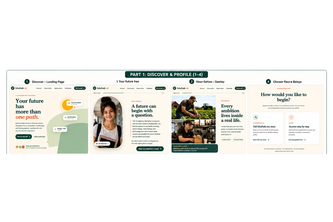
Not evidenced: No information about actual product functionality beyond the author’s description. No screenshots, live demos, or user interfaces are provided.
Positioning & Claim Evolution
The author claims EduPath AI helps students navigate complex decisions involving interests, finances, location, and time constraints, aiming to turn uncertainty into a personalized roadmap.
It positions itself as more than just a career recommendation engine; it evolves into a connected journey that includes education options, funding, and peer support. The key claim is that it supports students in understanding not only what they might want but also what is realistically possible given their constraints.
Inferred: The positioning reflects an intent to address systemic gaps in educational guidance for under-resourced students — particularly those from low-income backgrounds or with limited access to career counseling.
Not evidenced: No market research, competitive analysis, or customer validation data supports the claims made about effectiveness or differentiation.
Target Customer & ICP
The description states that EduPath AI targets students who are ambitious but lack clarity on available paths, especially those from disadvantaged backgrounds — such as Sabrina, a student whose father works on a farm and whose mother works in food service.
It also mentions students who may be constrained by:
- Family finances
- Relocation limitations
- Time availability for study
- Lack of awareness about career or education options
The ICP appears to be under-resourced high school or college-age students, particularly those navigating complex personal and financial realities.
Not evidenced: No segmentation data, demographic breakdowns, or user personas beyond the fictional example of Sabrina.
Business Model & Pricing Evidence
There is no evidence in the description of a business model or pricing strategy. The project is described as a prototype submitted to a hackathon, with no mention of monetization plans, subscription models, partnerships, or revenue streams.
Inferred: If this were to scale, potential monetization could involve:
- Subscription tiers for enhanced features
- Partnerships with universities or scholarship organizations
- Data insights (anonymized) for educational institutions
Not evidenced: No indication of how the product would generate revenue or whether any commercial relationships exist.
Technical & Delivery Signals
The system is built using:
- Frontend: Next.js, React, TypeScript, Tailwind CSS
- Backend/Infrastructure: Node.js, Vercel
- AI Layer: OpenAI API, Codex (used for engineering and integration)
- Recommendation Engines:
- K-nearest neighbors (KNN) inspired with cosine similarity for PathBuddy
- Custom algorithms for career alignment, education ranking, scholarship matching, and funding estimation
Key technical decisions include:
- Separating AI understanding from deterministic recommendation logic
- Using explainable match scores instead of opaque LLM outputs
- Implementing adaptive recalculations without altering core user attributes
Not evidenced: No details on scalability, data pipelines, or production deployment beyond the prototype stage.
Traction & Maturity Signals
The project is described as a prototype submitted to the OpenAI 2026 hackathon. There is no evidence of:
- Real users or active adoption
- Revenue or funding rounds
- Customer feedback or retention metrics
- Product maturity beyond initial development
Inferred: The author has built a working version that demonstrates core functionality, including:
- Career recommendation engine
- PathBuddy matching system
- Funding and scholarship integration
Not evidenced: No real-world usage data, user engagement stats, or performance benchmarks.
Competitive Context
The description does not provide any information about existing competitors or similar products in the space of education guidance or career navigation tools. It also lacks insight into:
- Market size or growth trends
- Competitive advantages or differentiators
- Industry benchmarks or market positioning
Inferred: The product may compete with general career guidance platforms, university admissions services, or scholarship search engines, but no comparison is made.
Not evidenced: No competitive landscape analysis or differentiation strategy provided.
Open Questions & Risks
- Prototype-only status: The system is described as a hackathon prototype with no evidence of real-world usage or traction.
- Lack of verified data: All claims are self-reported, and there is no independent validation of performance or impact.
- Unclear monetization path: No business model or revenue strategy is evident.
- Dependence on external APIs: Heavy reliance on OpenAI API and Codex raises concerns about dependency risks and cost scaling.
- Privacy implications: While PathBuddy is described as privacy-first, the mechanism for anonymizing data and ensuring opt-in participation is not detailed.
Not evidenced: No risk assessments or mitigation strategies are mentioned.
Questions the description leaves open
- What specific user feedback have you received from students who tested the prototype?
- How do you plan to validate that your recommendation engines actually improve student outcomes?
- Are there any partnerships with schools, universities, or educational organizations already in place?
- What are the key assumptions behind your hybrid AI-deterministic architecture, and how do they hold up under real-world usage?
- How will you scale beyond a single developer’s capacity to build and maintain the system?
- What is your long-term vision for monetization and sustainability?
- Can you share any anonymized data or case studies showing how students used the tool and changed their paths?
Overall Assessment
This is a self-reported prototype submitted as part of a hackathon, with no evidence of traction, revenue, or customer validation.
While the idea shows promise in addressing a real need for personalized educational guidance, especially among under-resourced students, the lack of verified usage, performance metrics, or business model makes it difficult to assess its viability for investment or partnership.
Confidence Level: Low
The description provides a coherent narrative and technical architecture, but all claims remain unverified. Any potential investment or strategic interest should be contingent upon further validation through pilot testing, user feedback, and demonstration of real-world impact.
User Stories BotA demo video on every pull request
Get a demo video on every new feature
GitHub App that watches your pull requests and records a narrated, captioned demo.
Save time on demo prep and make informed decisions faster with a video walkthrough of every new feature.
Source
Submitted to the OpenAI 2026 hackathon on Devpost. Project home on Devpost. Back to the full gallery on Devpost.
This competitive analysis was produced by top-founders.com (opens in a new tab)
Generated by a language model from this project's public Devpost page — its tagline, the author's own write-up and any built-with tags listed there — as captured in August 2026. Short quotations are the author's words. It is an opinion on the idea as a business, not on the people behind it, and it reflects the description as published then. If the project has moved on, request a correction below. The analysis is not independent research and contains no verified traction, revenue or customer data.
An independent guide by KFG International LLC — not affiliated with, endorsed by, or connected to Devpost or OpenAI.