

Archive position — measured, not model output
0 likes on Devpost
2,263 of the 7,850 archived projects have more likes, and 5,587 share exactly 0 — so this project's #4,922 place in the like-ranked listing is a tie-break inside that group, not a ranking.
Projects (log scale)
Likes on Devpost. ▲ marks this project's group.
Show the figures
| Likes | Projects | Share of archive |
|---|---|---|
| 0 | 5,587 | 71.2% |
| 1 | 1,758 | 22.4% |
| 2 | 284 | 3.6% |
| 3–4 | 132 | 1.7% |
| 5–9 | 75 | 1.0% |
| 10+ | 14 | 0.2% |
 User Stories BotA demo video on every pull request
Get a demo video on every new feature
GitHub App that watches your pull requests and records a narrated, captioned demo.
Save time on demo prep and make informed decisions faster with a video walkthrough of every new feature.
Executive Summary
What the company appears to be
LearnLoop is a self-reported AI learning coach designed to guide students through educational content using a multi-agent system powered by GPT-5.6, built as a hackathon project with no verified revenue, customers or traction.
What changed
The project description states that it was built in one continuous Codex session over a hackathon week, and that the team is now working to extend its functionality beyond the hackathon scope.
Single most important open question
Is there any evidence of actual user testing, adoption or feedback from students or educators beyond the author's own account?
What The Product Actually Is
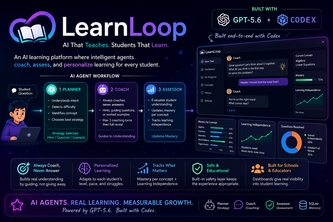
The description states that LearnLoop is an AI learning coach made of three agents:
- Planner: decides how to teach each question (hint, question, worked example, or next step)
- Coach: gives responses without caving even if the student pushes for a direct answer
- Assessor: checks understanding and updates progress
The system uses GPT-5.6 to power these agents, with a chat interface built in Streamlit and a database using SQLite. It tracks whether students solve problems independently or need full answers, feeding data into dashboards for both students and instructors.
Evidence The author's own write-up describes the architecture and functionality.
Inference The system appears to be a prototype built during a hackathon, not a production-ready product.
Positioning & Claim Evolution
The description states that LearnLoop is positioned as an AI coach that "guides students with hints and questions" rather than just answering directly. It claims to address a 2025 MIT study finding that AI use weakens learning and memory, by using the same AI to coach instead of answer.
Evidence The author's own write-up includes the claim about the MIT study and the shift from blocking AI to coaching with it.
Inference This positioning reflects an attempt to solve a perceived problem in education technology — over-reliance on AI for direct answers — but there is no evidence that this approach has been validated or tested beyond the hackathon context.
Target Customer & ICP
The description states that LearnLoop targets students who are learning, with dashboards for both students and instructors. It also mentions that it tracks real independence over time and shows which topics need support.
Evidence The author's own write-up describes the intended users as students and instructors.
Inference There is no evidence of a defined ICP beyond general student/instructor roles; no specific segment or persona has been identified.
Business Model & Pricing Evidence
Not evidenced. The description does not mention any pricing model, monetization strategy, or business model.
Technical & Delivery Signals
The system was built using:
- Codex (for building the agents)
- GPT-5.6 (to power Planner, Coach, and Assessor)
- Streamlit (for UI)
- SQLite (for database)
- Python (programming language)
It was developed in one continuous Codex session over a hackathon week.
Evidence The author's own write-up details the tech stack and development process.
Inference This is a prototype built quickly, not a scalable or production-ready system. The team used a single developer and limited tools.
Traction & Maturity Signals
Not evidenced. There is no mention of users, customers, revenue, or any form of traction beyond the author's own account.
Competitive Context
Not evidenced. No information is provided about competitors or market context.
Open Questions & Risks
- Unverified claims: The MIT study cited is not independently verified.
- No traction or users: The project is described as a hackathon prototype with no evidence of adoption or feedback.
- Single developer: Only one team member is mentioned, which raises questions about scalability and depth of development.
- Prototype nature: The system was built in a week-long hackathon and has not been tested beyond that scope.
Questions the description leaves open
- What specific feedback have you received from students or educators using this tool?
- Have you conducted any user testing beyond the hackathon environment?
- How do you plan to scale beyond a single developer and a hackathon prototype?
- Is there any evidence of interest from schools, institutions, or educational platforms?
- What are your plans for monetization or business model?
Overall Assessment
Not evidenced. No financials, revenue, or traction data are available to assess the viability or potential for investment or partnership.
User Stories BotA demo video on every pull request
Get a demo video on every new feature
GitHub App that watches your pull requests and records a narrated, captioned demo.
Save time on demo prep and make informed decisions faster with a video walkthrough of every new feature.
Source
Submitted to the OpenAI 2026 hackathon on Devpost. Project home on Devpost. Back to the full gallery on Devpost.
This competitive analysis was produced by top-founders.com (opens in a new tab)
Generated by a language model from this project's public Devpost page — its tagline, the author's own write-up and any built-with tags listed there — as captured in August 2026. Short quotations are the author's words. It is an opinion on the idea as a business, not on the people behind it, and it reflects the description as published then. If the project has moved on, request a correction below. The analysis is not independent research and contains no verified traction, revenue or customer data.
An independent guide by KFG International LLC — not affiliated with, endorsed by, or connected to Devpost or OpenAI.