

Archive position — measured, not model output
0 likes on Devpost
2,263 of the 7,850 archived projects have more likes, and 5,587 share exactly 0 — so this project's #4,917 place in the like-ranked listing is a tie-break inside that group, not a ranking.
Projects (log scale)
Likes on Devpost. ▲ marks this project's group.
Show the figures
| Likes | Projects | Share of archive |
|---|---|---|
| 0 | 5,587 | 71.2% |
| 1 | 1,758 | 22.4% |
| 2 | 284 | 3.6% |
| 3–4 | 132 | 1.7% |
| 5–9 | 75 | 1.0% |
| 10+ | 14 | 0.2% |
 User Stories BotA demo video on every pull request
Get a demo video on every new feature
GitHub App that watches your pull requests and records a narrated, captioned demo.
Save time on demo prep and make informed decisions faster with a video walkthrough of every new feature.
Executive Summary
What the company appears to be
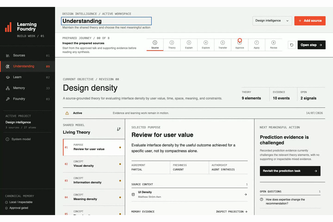
Learning Foundry is a desktop application built as a hackathon project that aims to create a "local-first shared understanding environment." The author describes it as an environment where humans and AI agents can learn from the same approved sources while maintaining distinct learning states. It uses a provenance-preserving pipeline for evidence, generates a "Living Theory" of concepts and claims, and supports constrained interactive micro-worlds for learning.
What changed
The project is described as a self-contained hackathon submission with no prior traction or commercial activity. The author emphasizes that this is not a product in the market yet but an experimental prototype built using Electron, React, TypeScript, and Codex (with GPT-5.6). It is not evidenced to have launched, monetized, or gained users.
Single most important open question
Is there evidence of any real-world use case or user feedback that would validate the need for such a system, or is this purely a conceptual prototype?
What The Product Actually Is
The description states:
- Learning Foundry is a desktop application built with Electron, React, TypeScript, Vite, Zod, and an append-only JSONL evidence ledger.
- It accepts local and approved online sources through one provenance-preserving pipeline.
- It synthesizes these into a "Living Theory" of concepts, claims, relationships, assumptions, boundaries, decisions, contradictions, and open questions.
- The same theory generates explainers, understanding checks, transfer tasks, and constrained interactive micro-worlds for the human.
- It grounds versioned Codex capabilities with explicit boundaries, evaluations, failures, and approval gates.
- Practical results return as append-only evidence, allowing corrections to trigger targeted reviews or capability revisions without overwriting original sources.
Inference The system appears to be a hybrid human-AI learning environment that attempts to separate human memory from agent memory while maintaining traceability of all actions and decisions.
Positioning & Claim Evolution
The description states:
- The product is positioned as a "local-first shared understanding environment."
- It aims to make differences between epistemic states (human confidence, source-backed knowledge, agent synthesis, validated behavior) inspectable.
- It seeks to avoid collapsing learning into chat history or mastery scores.
- It uses the term “Codex capabilities” and integrates with GPT-5.6 in development.
Inference The positioning is conceptual and not yet validated by market feedback. The author frames it as a tool for inspectable, traceable learning that separates human cognition from AI behavior — a niche idea that may appeal to educators or researchers but lacks evidence of demand.
Target Customer & ICP
The description states:
- No explicit customer segment is named.
- The system supports “human” and “agent” learning states, suggesting it targets users who work with AI tools in educational or research contexts.
- It includes a “prepared design-density journey,” which implies a structured experience for learners.
Inference The ICP may include educators, researchers, or knowledge workers who want to manage the interaction between human and AI learning in a traceable way. However, no evidence of actual users or personas is provided.
Business Model & Pricing Evidence
The description states:
- There is no mention of pricing, monetization, or business model.
- The project is described as a hackathon submission with no commercial activity.
Inference No evidence of any business model or pricing structure exists in the description.
Technical & Delivery Signals
The description states:
- Built with Electron, React, TypeScript, Vite, Zod, and an append-only JSONL evidence ledger.
- Canonical events are replayed into projections like human-memory, agent-memory, shared-theory, etc.
- Uses a constrained micro-world for learners to predict, manipulate, and record observations.
- Includes optional live Codex adapter with bounded prompt context and fallback behavior.
- Demonstrates deterministic replay and approval gates.
Inference The technical stack suggests a desktop application with strong emphasis on traceability and reproducibility. The use of append-only logs and projections implies a system designed for auditability and learning state separation — but no evidence of production deployment or scalability.
Traction & Maturity Signals
The description states:
- This is a hackathon project submitted to the OpenAI 2026 hackathon.
- It includes a “prepared design-density journey” and runs offline.
- The system is described as a prototype, not a product in the market.
Inference There is no evidence of traction, revenue, customers, or adoption beyond its status as a hackathon submission. No data on usage, retention, or user feedback exists.
Competitive Context
The description states:
- No mention of competitors or existing solutions in this space.
- The author references AI tools like Codex and GPT-5.6 but does not compare Learning Foundry to them or other systems.
Inference No evidence of competitive positioning or awareness of similar tools is provided. This may be a novel idea, but there is no indication that it addresses an existing market need or fills a gap in current offerings.
Open Questions & Risks
The description states:
- The project is a hackathon submission with no commercial activity.
- It does not claim to measure cognition or solve cognitive debt — but also does not clearly define its value proposition beyond theory.
- It resists false precision, which may indicate a lack of measurable outcomes.
Inference
Key risks include:
- Lack of real-world validation or user feedback.
- Conceptual nature without demonstrated utility.
- No evidence of scalability or production readiness.
- Unclear commercial viability or path to market.
Questions the description leaves open
- What specific problem are you trying to solve, and how does this system address it?
- Have you tested this with any users or in real-world learning environments?
- How do you plan to transition from a prototype to a scalable product?
- What is the intended user persona, and what evidence supports that they need this tool?
- Are there any existing tools or systems that attempt to solve similar problems?
- What are the key assumptions in your approach, and how might they fail?
Overall Assessment
The description states:
- This is a hackathon project with no commercial activity or traction.
- It is described as an experimental prototype, not a product.
Inference At this stage, there is no evidence to support investment or partnership interest. The idea is conceptually interesting but lacks validation, market demand, or any indication of progress beyond the prototype phase. Any future value would depend on whether the founders can demonstrate real-world utility and traction.
User Stories BotA demo video on every pull request
Get a demo video on every new feature
GitHub App that watches your pull requests and records a narrated, captioned demo.
Save time on demo prep and make informed decisions faster with a video walkthrough of every new feature.
Source
Submitted to the OpenAI 2026 hackathon on Devpost. Project home on Devpost. Back to the full gallery on Devpost.
This competitive analysis was produced by top-founders.com (opens in a new tab)
Generated by a language model from this project's public Devpost page — its tagline, the author's own write-up and any built-with tags listed there — as captured in August 2026. Short quotations are the author's words. It is an opinion on the idea as a business, not on the people behind it, and it reflects the description as published then. If the project has moved on, request a correction below. The analysis is not independent research and contains no verified traction, revenue or customer data.
An independent guide by KFG International LLC — not affiliated with, endorsed by, or connected to Devpost or OpenAI.