

Archive position — measured, not model output
0 likes on Devpost
2,263 of the 7,850 archived projects have more likes, and 5,587 share exactly 0 — so this project's #4,918 place in the like-ranked listing is a tie-break inside that group, not a ranking.
Projects (log scale)
Likes on Devpost. ▲ marks this project's group.
Show the figures
| Likes | Projects | Share of archive |
|---|---|---|
| 0 | 5,587 | 71.2% |
| 1 | 1,758 | 22.4% |
| 2 | 284 | 3.6% |
| 3–4 | 132 | 1.7% |
| 5–9 | 75 | 1.0% |
| 10+ | 14 | 0.2% |
 User Stories BotA demo video on every pull request
Get a demo video on every new feature
GitHub App that watches your pull requests and records a narrated, captioned demo.
Save time on demo prep and make informed decisions faster with a video walkthrough of every new feature.
Executive Summary
What the company appears to be
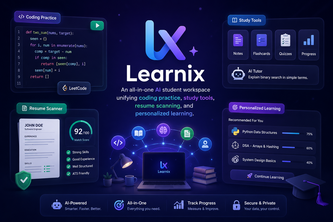
Learnix is a self-reported, single-person project (as of submission) that describes itself as an AI-powered student ecosystem for computer science students. It integrates multiple tools into one platform—such as DSA coding labs, resume scanning, mock interviews, and academic progress tracking—using a modular full-stack architecture with multiple LLMs.
What changed
The author states this was built as part of the OpenAI 2026 hackathon submission. No prior version or evolution is described; it is presented as a new product concept.
Single most important open question
Is there any evidence of actual usage, revenue, or customer traction beyond the author’s own description?
What The Product Actually Is
The description states that Learnix is a web-based student ecosystem integrating 12 modules into one workspace. These include:
- Dashboard & Attendance
- Learning Hub & Active Recall
- Career & Placement Hub
- Mock Interview Prep
- Coding Mentor & DSA Playground
- Developer Roadmaps
- Project Lab
- Competitive & Test Prep
- Research Assistant
- Gamification & Rewards
- Community Study Rooms
- Financial Hub
It is built using React 18, Vite, Node.js/Express, MongoDB, and integrates multiple LLMs (OpenAI GPT-4o, Groq Llama 3.3, Google Gemini Flash) for various tasks.
The product is described as a modular full-stack web application, with no mention of mobile app or enterprise features beyond stated future plans.
Claim: Learnix is an integrated student platform combining multiple tools.
Evidence: Author's own write-up.
Positioning & Claim Evolution
The author positions Learnix as a unified workspace for computer science students who are currently using 5+ separate tools (e.g., LeetCode, ChatGPT, Notion, ATS tools). The goal is to reduce context switching and centralize academic and career prep.
There is no indication of prior versions or evolution in positioning. This appears to be a first-time product launch, presented as a hackathon submission.
Claim: Learnix reduces context switching by combining 5+ tools into one.
Evidence: Author’s own write-up.
Target Customer & ICP
The author states that Learnix is designed for computer science students preparing for exams, placements, and coding interviews. It targets users who are currently using multiple platforms for different aspects of their studies.
No segmentation beyond this broad category is described. No mention of specific demographics (age, location), or use cases beyond academic prep.
Claim: Target customer is computer science students.
Evidence: Author’s own write-up.
Business Model & Pricing Evidence
There is no evidence in the description of any pricing model, monetization strategy, or business model. The author does not mention subscriptions, freemium tiers, B2B sales, or any commercial structure.
Claim: No pricing or business model described.
Evidence: Author’s own write-up.
Technical & Delivery Signals
The product is built with:
- Frontend: React 18 + Vite, custom CSS, HTML5 Canvas, SVGs, Web Speech API
- Backend: Node.js + Express.js, REST controllers
- Database: MongoDB Cloud with Mongoose ODM
- AI Infrastructure: Multiple LLMs (GPT-4o, Groq Llama 3.3, Google Gemini Flash), selected based on latency vs. reasoning requirements
The author mentions challenges such as:
- Handling multiple AI APIs with varying rate limits and latencies
- Cross-module state synchronization
- Rendering dynamic SVG paths for roadmaps
They also describe accomplishments like achieving sub-second AI responses via Groq integration.
Claim: Modular full-stack architecture with multi-LLM integration.
Evidence: Author’s own write-up.
Traction & Maturity Signals
There is no evidence of any traction, user base, or adoption metrics. The project is described as a single-person hackathon submission with no mention of users, revenue, or growth.
Claim: No traction or maturity signals.
Evidence: Author’s own write-up.
Competitive Context
The author does not reference any existing competitors or market positioning in relation to other platforms like LeetCode, Notion, or ATS tools. The competitive landscape is not discussed.
Claim: No competitive context provided.
Evidence: Author’s own write-up.
Open Questions & Risks
- Single-person team: Only one member listed (G Mokshitha Reddy), which raises concerns about scalability and execution capability.
- No commercial traction or revenue: The project is described as a hackathon submission with no evidence of monetization or user adoption.
- Unverified claims: All descriptions are self-reported, unverified, and lack independent corroboration.
- Limited scope for future growth: The author mentions only future plans (mobile app, WebSocket integration), not current product-market fit.
Inference: Lack of team size and traction suggests high risk in execution.
Evidence: Author’s own write-up.
Questions the description leaves open
- What is the actual user base or pilot group for Learnix?
- How do you plan to monetize this product, if at all?
- Are there any existing partnerships or integrations with educational institutions or platforms?
- What are the key assumptions behind your product design and feature set?
- How do you intend to scale beyond a single developer?
Inference: These questions aim to uncover unverified claims and validate commercial viability.
Evidence: Author’s own write-up.
Overall Assessment
There is no evidence of any revenue, customer traction, or business model. The project is described as a hackathon submission by one individual with no prior version or commercial activity.
This is an early-stage concept with no demonstrated market validation or commercial readiness.
Inference: Not suitable for investment or partnership at this stage.
Evidence: Author’s own write-up.
User Stories BotA demo video on every pull request
Get a demo video on every new feature
GitHub App that watches your pull requests and records a narrated, captioned demo.
Save time on demo prep and make informed decisions faster with a video walkthrough of every new feature.
Source
Submitted to the OpenAI 2026 hackathon on Devpost. Project home on Devpost. Back to the full gallery on Devpost.
This competitive analysis was produced by top-founders.com (opens in a new tab)
Generated by a language model from this project's public Devpost page — its tagline, the author's own write-up and any built-with tags listed there — as captured in August 2026. Short quotations are the author's words. It is an opinion on the idea as a business, not on the people behind it, and it reflects the description as published then. If the project has moved on, request a correction below. The analysis is not independent research and contains no verified traction, revenue or customer data.
An independent guide by KFG International LLC — not affiliated with, endorsed by, or connected to Devpost or OpenAI.