

Archive position — measured, not model output
0 likes on Devpost
2,263 of the 7,850 archived projects have more likes, and 5,587 share exactly 0 — so this project's #6,881 place in the like-ranked listing is a tie-break inside that group, not a ranking.
Projects (log scale)
Likes on Devpost. ▲ marks this project's group.
Show the figures
| Likes | Projects | Share of archive |
|---|---|---|
| 0 | 5,587 | 71.2% |
| 1 | 1,758 | 22.4% |
| 2 | 284 | 3.6% |
| 3–4 | 132 | 1.7% |
| 5–9 | 75 | 1.0% |
| 10+ | 14 | 0.2% |
 User Stories BotA demo video on every pull request
Get a demo video on every new feature
GitHub App that watches your pull requests and records a narrated, captioned demo.
Save time on demo prep and make informed decisions faster with a video walkthrough of every new feature.
Executive Summary
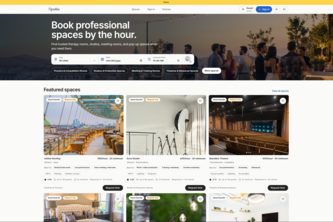
Spatia is a self-reported marketplace platform designed to turn underused professional spaces into bookable venues. The author describes it as a multi-sided platform connecting customers, space owners, service providers, and administrators, with integrated booking, communication, and operations features. It supports English and Greek languages and uses a tech stack including Next.js, React, Supabase, PostgreSQL, PostGIS, Stripe Connect, and Tailwind CSS.
The description states that Spatia is a hackathon project built in a short timeframe, with no evidence of revenue, customers, or traction. The author claims the platform addresses marketplace complexity through role-specific workflows, privacy controls, and operational clarity. However, there is no independent verification of these claims or any demonstration of real-world usage.
The single most important open question
Is there any evidence that Spatia has moved beyond a prototype or hackathon demo to achieve product-market fit or early customer traction?
What The Product Actually Is
The description states that Spatia is a marketplace platform for professional spaces, allowing users to discover and book venues while integrating services, bookings, communication, and operations.
It supports multiple user roles:
- Customers: can discover, request bookings, track progress, save favorites, and communicate.
- Owners/Providers: receive dedicated workspaces for managing listings, availability, requests, clients, payments, and tasks.
- Administrators: can moderate reports, manage categories, locations, and audit trails.
The platform is described as combining a customer-facing marketplace with operational dashboards for different roles. It includes features such as booking request tracking, multi-participant workflows, and support for both English and Greek languages.
Not evidenced No details on actual functionality beyond the self-reported scope, or whether it has been tested in production or used by real users.
Positioning & Claim Evolution
The author positions Spatia as a platform that "unites services, bookings, and operations in one trusted marketplace." The tagline reinforces this: “Spatia turns underused professional spaces into bookable venues.”
The description indicates that Spatia is not just about discovery but also about managing the full lifecycle of a booking — from request to completion. It emphasizes trust through clear statuses, communication, privacy controls, and predictable workflows.
It also claims to be an operations product, not merely a discovery experience, suggesting a shift in focus from user-facing features to backend functionality.
Inference The positioning implies a move toward solving complex marketplace coordination problems rather than just offering a listing tool.
Target Customer & ICP
The description identifies four main user types:
- Customers: Users seeking to book professional spaces and services.
- Owners/Providers: Individuals or entities who own or operate the spaces being booked.
- Administrators: Moderators or operators managing supply, categories, locations, and audits.
There is no explicit segmentation beyond these roles. The author does not define specific personas or buyer profiles for any of the user types.
Not evidenced No evidence of target customer segments, usage patterns, or whether these roles are distinct in practice or overlap.
Business Model & Pricing Evidence
The description states that Spatia uses Stripe Connect to support marketplace payments and provider payouts. It also mentions that it supports “production payment support” as a future goal.
There is no mention of pricing tiers, commission structures, subscription models, or monetization strategies beyond the use of Stripe for transactions.
Not evidenced No evidence of revenue model, pricing plans, or any financial details about how the platform intends to make money.
Technical & Delivery Signals
The project was built using:
- Frontend: Next.js, React, TypeScript, Tailwind CSS
- Backend: Node.js, Supabase, PostgreSQL, PostGIS
- APIs: REST API, Row-level security
- Payment: Stripe Connect
- Testing/Dev Tools: Playwright, Zod
The system supports:
- Role-specific dashboards with permission-aware workflows
- Multi-language support (English and Greek)
- Location-aware data via PostGIS
- Responsive design for mobile devices
- A seeded local runtime for safe demonstration without production credentials
Not evidenced No evidence of scalability, performance metrics, or deployment architecture beyond the development stack.
Traction & Maturity Signals
The project is described as a hackathon submission to the OpenAI 2026 hackathon. The author notes that the GitHub repository is currently private but can be opened upon request.
There is no evidence of:
- Revenue
- Customers or users
- Product-market fit
- Any traction beyond the prototype stage
The description mentions future goals such as expanding payment support, improving supplier onboarding, and adding analytics — indicating this is a work-in-progress rather than a mature product.
Not evidenced No data on adoption, retention, usage frequency, or any form of user engagement.
Competitive Context
The description does not mention competitors or the broader marketplace landscape. It does not reference similar platforms or how Spatia differentiates itself from existing solutions in the professional space booking or marketplace domains.
Not evidenced No competitive analysis, differentiation strategy, or market positioning relative to other tools.
Open Questions & Risks
- Prototype Risk: The platform is described as a hackathon project with no evidence of real-world usage or traction.
- Privacy and Authorization Risk: The description notes challenges in maintaining role-specific access across pages and APIs — this could be a significant risk if not properly implemented.
- Monetization Uncertainty: No clear indication of how the platform will generate revenue or sustain itself beyond initial development.
- Limited Scope: The platform appears to be focused on one specific vertical (professional spaces) with no evidence of expansion plans or broader applicability.
Inference The lack of traction and business model clarity raises concerns about viability as a commercial product.
Questions the description leaves open
- What is the actual problem you are solving, and how did you validate that it exists?
- Are there any early adopters or pilot users who have tested this platform?
- How do you plan to scale beyond the current prototype?
- What is your go-to-market strategy for reaching space owners and service providers?
- Can you explain how you will handle disputes or conflicts between participants in a booking?
- What are the key assumptions behind your product design, and how have they been tested?
- How do you intend to monetize this platform, and what is your revenue model?
- What are the biggest technical challenges still unresolved?
Overall Assessment
The description indicates that Spatia is a self-reported hackathon project, with no evidence of traction, revenue, or customer adoption. It is described as a multi-sided marketplace for professional spaces, but there is no indication that it has progressed beyond a prototype.
There is no evidence of:
- Revenue streams
- Customers or user base
- Product-market fit
- Scalable business model
Given the lack of independent verification and the absence of any commercial data, this project appears to be in an early conceptual or prototyping phase. It cannot be evaluated for investment or partnership potential without further evidence of traction, market validation, or product development.
Assessment Not evidenced as a viable commercial opportunity at this time.
User Stories BotA demo video on every pull request
Get a demo video on every new feature
GitHub App that watches your pull requests and records a narrated, captioned demo.
Save time on demo prep and make informed decisions faster with a video walkthrough of every new feature.
Source
Submitted to the OpenAI 2026 hackathon on Devpost. Project home on Devpost. Back to the full gallery on Devpost.
This competitive analysis was produced by top-founders.com (opens in a new tab)
Generated by a language model from this project's public Devpost page — its tagline, the author's own write-up and any built-with tags listed there — as captured in August 2026. Short quotations are the author's words. It is an opinion on the idea as a business, not on the people behind it, and it reflects the description as published then. If the project has moved on, request a correction below. The analysis is not independent research and contains no verified traction, revenue or customer data.
An independent guide by KFG International LLC — not affiliated with, endorsed by, or connected to Devpost or OpenAI.