

Archive position — measured, not model output
1 like on Devpost
505 of the 7,850 archived projects have more likes, and 1,758 share exactly 1 — so this project's #1,956 place in the like-ranked listing is a tie-break inside that group, not a ranking.
Projects (log scale)
Likes on Devpost. ▲ marks this project's group.
Show the figures
| Likes | Projects | Share of archive |
|---|---|---|
| 0 | 5,587 | 71.2% |
| 1 | 1,758 | 22.4% |
| 2 | 284 | 3.6% |
| 3–4 | 132 | 1.7% |
| 5–9 | 75 | 1.0% |
| 10+ | 14 | 0.2% |
 User Stories BotA demo video on every pull request
Get a demo video on every new feature
GitHub App that watches your pull requests and records a narrated, captioned demo.
Save time on demo prep and make informed decisions faster with a video walkthrough of every new feature.
Executive Summary
What the company appears to be
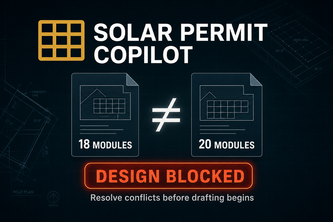
Solar Permit Copilot is a self-reported AI-powered pre-design intake gate for solar permit teams. The author describes it as a tool that identifies missing inputs and conflicting revisions in solar permit packages, then allows a human to resolve them before drafting begins.
What changed
The project evolved from an initial idea of submitting a sanitized version of a private production system into a focused, testable workflow with clear boundaries between AI reasoning and human decision-making. It became a deterministic gate that requires explicit human input for resolution, rather than an automated summary or suggestion engine.
Single most important open question
Is there evidence of real-world usage or traction beyond the author’s own experience and synthetic demo? The description states no revenue, customers, or adoption data are available — only a self-reported prototype with no live deployment or customer feedback.
What The Product Actually Is
The description states that Solar Permit Copilot is:
- A source-traceable pre-design intake gate for solar permit teams.
- It accepts inputs in formats including PDF, DOCX, XLSX, text, structured-data, and image.
- It uses GPT-5.6 Sol to extract only document-supported facts.
- It normalizes equipment names against a controlled catalog.
- It identifies missing inputs and prioritizes design blockers.
- It detects contradictions between revisions and retains every source value.
- It shows short source excerpts so the designer can verify evidence.
- It displays a deterministic DESIGN BLOCKED or READY FOR DESIGN gate.
- It allows a human to choose the current source instead of allowing the model to decide.
- It recalculates derived fields and updates blocker count after a human decision.
- It exports results as JSON, Markdown, or PDF.
The author also states that it is built as a standalone Python and Streamlit application, using the OpenAI Responses API with gpt-5.6-sol, strict JSON Schema structured output, and store=False.
Inference The product is described as a workflow tool that sits before CAD drafting to prevent errors caused by discrepancies in permit packages. It is not a general-purpose AI assistant but a specific gate for solar permit intake.
Positioning & Claim Evolution
The author states:
- The tool addresses a real-world problem in solar permit design: expensive drafting errors begin before anyone opens CAD.
- It answers the question: “Is this package ready for design—and if not, exactly what is blocking it?”
- The positioning evolved from a generic AI summary tool to a human-in-the-loop operational gate.
- The author explicitly chose to isolate one workflow instead of exposing unrelated production logic and customer data.
- It was built with the goal of trustworthiness, ensuring that contradictions remain visible and human judgment remains in control.
Inference The positioning is narrow, focused on solar permit intake. The evolution shows a deliberate shift from a broad AI assistant to a specific, deterministic tool designed for safety and auditability.
Target Customer & ICP
The description states:
- The target audience is solar permit teams, specifically those who design solar permit packages.
- It is intended for use by solo solar permit designers or small teams.
- The author has personal experience working remotely as a solo designer, producing over 3,000 U.S. permit plan sets since 2019.
Inference The ICP appears to be solar permit designers, particularly those working in small or remote environments. No evidence of broader market segmentation or customer personas is provided.
Business Model & Pricing Evidence
The description states:
- There is no mention of pricing, subscriptions, or monetization.
- The public demo requires no account, API key, file upload, OpenAI API call, or payment.
- It is a standalone Python and Streamlit application, with no indication of cloud-based services or SaaS components.
Inference No evidence of a business model or pricing structure is provided. The tool appears to be a prototype or proof-of-concept, not a commercial product.
Technical & Delivery Signals
The description states:
- Built with Python and Streamlit.
- Uses the OpenAI Responses API with gpt-5.6-sol.
- Supports inputs in PDF, DOCX, XLSX, text, structured-data, and image formats.
- Uses strict JSON Schema structured output.
- Operates in-memory, with file-size limits.
- Includes 12 network-free automated tests covering API contract, document extraction, report generation, demo restrictions, and human-reviewed gate behavior.
- The public demo uses a precomputed GPT-5.6 result to avoid requiring credentials or paid usage.
Inference The technical stack is lightweight and self-contained. It shows an awareness of security and testability but lacks evidence of scalability or production deployment.
Traction & Maturity Signals
The description states:
- The author has 3,000+ U.S. permit plan sets produced since 2019.
- The tool is a standalone prototype, not yet deployed in production.
- It includes a public interactive demo that reproduces the full workflow without requiring credentials or payment.
- There is no evidence of revenue, customers, or adoption beyond the author’s own experience and synthetic files.
Inference No traction or maturity signals are evident. The project is described as a prototype with no live usage or customer feedback.
Competitive Context
The description states:
- It is built for solar permit intake, not general document processing.
- It is positioned to prevent errors in the pre-design phase of solar projects.
- It uses AI for fact extraction and conflict detection, but requires human decision-making.
- No mention of competitors or market positioning beyond its own use case.
Inference The competitive context is limited to the niche of solar permit intake. No evidence of existing tools or competitors in this space is provided.
Open Questions & Risks
The description states:
- The tool is not yet deployed in production, and no live usage or feedback exists.
- It uses a precomputed GPT-5.6 result for its public demo, not real-time processing.
- It is a standalone prototype, not a scalable SaaS product.
- The author’s own experience is the only evidence of real-world application.
Inference Key risks include lack of real-world usage, no commercial viability, and limited scalability. The tool may be a proof-of-concept rather than a viable product.
Questions the description leaves open
- What is the actual adoption rate or usage beyond the author’s own experience?
- Has there been any feedback from solar permit designers on the prototype?
- Are there plans to move beyond the prototype into production use?
- How does the tool integrate with existing solar permit design workflows?
- What are the technical and operational limitations of the current implementation?
- Is there a plan for monetization or commercial deployment?
Overall Assessment
The description states:
- The project is a self-reported prototype submitted to a hackathon.
- It has no evidence of revenue, customers, or traction.
- It is not yet deployed in production.
- It is built as a standalone tool with no commercial infrastructure.
Inference There is no evidence of commercial viability or traction. The project appears to be a prototype or proof-of-concept, not a product ready for investment or partnership. The author’s experience provides context but does not substantiate market demand or scalability.
User Stories BotA demo video on every pull request
Get a demo video on every new feature
GitHub App that watches your pull requests and records a narrated, captioned demo.
Save time on demo prep and make informed decisions faster with a video walkthrough of every new feature.
Source
Submitted to the OpenAI 2026 hackathon on Devpost. Project home on Devpost. Back to the full gallery on Devpost.
This competitive analysis was produced by top-founders.com (opens in a new tab)
Generated by a language model from this project's public Devpost page — its tagline, the author's own write-up and any built-with tags listed there — as captured in August 2026. Short quotations are the author's words. It is an opinion on the idea as a business, not on the people behind it, and it reflects the description as published then. If the project has moved on, request a correction below. The analysis is not independent research and contains no verified traction, revenue or customer data.
An independent guide by KFG International LLC — not affiliated with, endorsed by, or connected to Devpost or OpenAI.