

Archive position — measured, not model output
0 likes on Devpost
2,263 of the 7,850 archived projects have more likes, and 5,587 share exactly 0 — so this project's #3,919 place in the like-ranked listing is a tie-break inside that group, not a ranking.
Projects (log scale)
Likes on Devpost. ▲ marks this project's group.
Show the figures
| Likes | Projects | Share of archive |
|---|---|---|
| 0 | 5,587 | 71.2% |
| 1 | 1,758 | 22.4% |
| 2 | 284 | 3.6% |
| 3–4 | 132 | 1.7% |
| 5–9 | 75 | 1.0% |
| 10+ | 14 | 0.2% |
 User Stories BotA demo video on every pull request
Get a demo video on every new feature
GitHub App that watches your pull requests and records a narrated, captioned demo.
Save time on demo prep and make informed decisions faster with a video walkthrough of every new feature.
Executive Summary
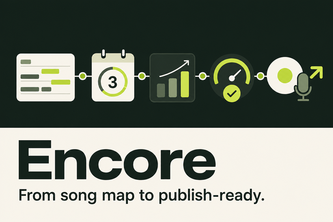
What the company appears to be: Encore is a self-reported one-song countdown studio for independent cover artists, built as a prototype for the OpenAI 2026 hackathon. It uses AI (specifically GPT-5.6) to generate structured practice plans and captions, while maintaining deterministic logic for readiness decisions and user agency.
What changed: The project is described as a v1.0.0 release with a defined workflow from lyric-free Song Map input to practice logging, mastery inspection, recording decision, and caption generation. It includes a public demo that simulates AI behavior without live API keys, and uses Codex for development.
Single most important open question: Is there any evidence of real-world usage or traction beyond the author’s own prototype?
What The Product Actually Is
The description states that Encore is a one-song countdown studio. It turns a lyric-free Song Map into a structured practice workflow. The tool supports generating a plan, logging confidence by section, inspecting mastery trends, making recording decisions, and creating a Making Of caption.
It is built with Next.js 16, TypeScript, React, Zod, the OpenAI Responses API, localStorage persistence, Vitest, Playwright, and Vercel. The system uses GPT-5.6 for generating structured outputs (practice plan and Making Of caption) under strict server boundaries, with a Lyric Firewall checking inputs and outputs.
The public demo returns deterministic fixtures instead of live AI responses when no OpenAI API key is present. Practice logs are stored in versioned localStorage, and the final recording decision is made by the user based on application logic rather than AI prediction.
Evidence: The author's own write-up.
Inference: The tool appears to be a prototype for a creative workflow management system, not a commercial product.
Positioning & Claim Evolution
The description positions Encore as a one-song countdown studio that supports independent cover artists in practicing and publishing their covers. It emphasizes the use of AI for generating structured practice plans and captions while keeping decision-making transparent and user-driven.
It claims to be a “practice map to published cover” tool, suggesting it bridges the gap between preparation and publication.
Evidence: The author’s own write-up.
Inference: The positioning is narrow and focused on a specific creative lifecycle for one song. No indication of broader market expansion or product evolution beyond this scope.
Target Customer & ICP
The description states that Encore targets independent cover artists. It assumes users have access to a lyric-free Song Map and are looking for structured practice support.
There is no explicit segmentation or targeting beyond the type of user (cover artist) or use case (practice-to-publish workflow).
Evidence: The author’s own write-up.
Inference: No evidence of customer personas, market research, or early adopter feedback. The ICP is inferred from the product's narrow focus.
Business Model & Pricing Evidence
There is no mention of pricing, monetization, or business model in the description. The tool stores data locally and publishes externally; there are no integrations or payment flows described.
Evidence: Not evidenced.
Inference: No indication of a commercial model beyond the prototype's self-contained nature.
Technical & Delivery Signals
Encore is built with Next.js 16, TypeScript, React, Zod, Playwright, Vitest, and Vercel. It uses GPT-5.6 via the OpenAI Responses API under strict server boundaries, with a Lyric Firewall for input/output validation.
The system returns deterministic fixtures when no API key is present, and all model interactions are validated using Zod schemas.
It includes 140 unit and integration tests across 23 files, one Chromium golden-path flow, linting, TypeScript checking, and a production build. GitHub Actions and Vercel passed on the public main-branch merge.
Evidence: The author's own write-up.
Inference: The project shows strong engineering discipline in its prototype form, but no evidence of scaling or production deployment beyond the demo.
Traction & Maturity Signals
The description states that this is a v1.0.0 release with a defined workflow and tests. It includes a public repository, reproducibility guide, and MIT license.
There is no mention of users, customers, revenue, or adoption data.
Evidence: The author’s own write-up.
Inference: No evidence of traction or maturity beyond the prototype stage.
Competitive Context
The description does not provide any information about competitors or market positioning. It does not reference similar tools or platforms in the creative workflow or music practice space.
Evidence: Not evidenced.
Inference: No competitive analysis or differentiation strategy is evident.
Open Questions & Risks
- No traction or user data: The tool is described as a prototype with no evidence of real-world usage.
- Limited scope: It supports only one song at a time and does not include multi-song support or publishing integrations.
- No monetization model: No indication of how the product would be monetized or scaled.
- Prototype-only delivery: The public demo is mocked, suggesting no live AI integration in the current version.
Evidence: The author’s own write-up.
Questions the description leaves open
- What inspired the creation of Encore? Was there a specific problem you observed among cover artists?
- How did you validate that this workflow addresses real needs, or was it based on assumptions?
- Are there any plans to expand beyond one-song workflows or integrate with publishing platforms?
- What are your thoughts on scaling this into a commercial product or platform?
- How do you plan to handle user data privacy and storage in a production environment?
Overall Assessment
This is a self-reported prototype for the OpenAI 2026 hackathon, built with strong engineering discipline but no evidence of traction, revenue, or customer adoption.
Confidence: Low. The description provides no independent verification of commercial viability or real-world usage.
Assessment: Not ready for investment or partnership at this stage. It is a proof-of-concept with limited evidence of market demand or product-market fit.
User Stories BotA demo video on every pull request
Get a demo video on every new feature
GitHub App that watches your pull requests and records a narrated, captioned demo.
Save time on demo prep and make informed decisions faster with a video walkthrough of every new feature.
Source
Submitted to the OpenAI 2026 hackathon on Devpost. Project home on Devpost. Back to the full gallery on Devpost.
This competitive analysis was produced by top-founders.com (opens in a new tab)
Generated by a language model from this project's public Devpost page — its tagline, the author's own write-up and any built-with tags listed there — as captured in August 2026. Short quotations are the author's words. It is an opinion on the idea as a business, not on the people behind it, and it reflects the description as published then. If the project has moved on, request a correction below. The analysis is not independent research and contains no verified traction, revenue or customer data.
An independent guide by KFG International LLC — not affiliated with, endorsed by, or connected to Devpost or OpenAI.