

Archive position — measured, not model output
0 likes on Devpost
2,263 of the 7,850 archived projects have more likes, and 5,587 share exactly 0 — so this project's #5,882 place in the like-ranked listing is a tie-break inside that group, not a ranking.
Projects (log scale)
Likes on Devpost. ▲ marks this project's group.
Show the figures
| Likes | Projects | Share of archive |
|---|---|---|
| 0 | 5,587 | 71.2% |
| 1 | 1,758 | 22.4% |
| 2 | 284 | 3.6% |
| 3–4 | 132 | 1.7% |
| 5–9 | 75 | 1.0% |
| 10+ | 14 | 0.2% |
 User Stories BotA demo video on every pull request
Get a demo video on every new feature
GitHub App that watches your pull requests and records a narrated, captioned demo.
Save time on demo prep and make informed decisions faster with a video walkthrough of every new feature.
Executive Summary
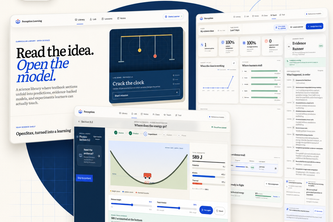
What the company appears to be: Perception Learning is a self-reported educational technology project that aims to make learner reasoning visible during learning, with a focus on real-time feedback and adaptive instruction. It was submitted as a hackathon project by one individual developer (Aditya Das) for the OpenAI 2026 hackathon.
What changed: The project is in an early stage — it's a hackathon submission, not a product in production or with any demonstrated traction. There are no claims of revenue, customers, or adoption beyond what the author states.
Single most important open question: Is there evidence that this concept can be scaled into a viable educational SaaS product with real-world impact?
Analysis basis: This report is based entirely on the self-reported project description provided by the caller. No external verification, archived data, or third-party sources are available. All claims in the description are treated as stated by the author and not independently confirmed.
What The Product Actually Is
The description states that Perception Learning is a system designed to make learner reasoning visible while it can still change. It includes functionality for generating lessons, questions, answers, and simulations using AI tools, but also emphasizes deterministic simulations and learner evidence flow.
- The product appears to be a prototype or proof-of-concept built as part of a hackathon.
- It integrates with Cloudflare Workers, Cloudflare D1, React, TypeScript, Vite, and various AI models (e.g., Codex, GPT-5.6, NVIDIA NIM).
- The system supports both model-backed actions (which are currently unavailable due to API credit exhaustion) and deterministic reference modes.
- It includes a public interface deployed via Cloudflare Workers.
Evidence: Based on the project write-up and technology stack listed by the author.
Positioning & Claim Evolution
The tagline “Make learner reasoning visible while it can still change” suggests a focus on formative assessment and real-time feedback in learning environments. The author positions this as an educational tool that helps educators understand how learners think during instruction, potentially enabling adaptive teaching strategies.
- The project is positioned as a tool for enhancing learning through visibility into cognitive processes.
- It implies integration with AI to generate content dynamically but also supports deterministic simulations — indicating flexibility in implementation approaches.
- No indication of prior positioning or evolution from earlier versions; this is a new submission.
Evidence: Tagline and project write-up. The claim is self-reported and unverified.
Target Customer & ICP
The description does not explicitly identify target customers or personas. However, the focus on learner reasoning and adaptive instruction implies potential use cases in education settings such as schools, universities, or corporate training programs.
- The system could be aimed at educators, instructional designers, or learning platform developers.
- It may appeal to institutions seeking tools that support personalized learning or real-time feedback mechanisms.
- No specific customer segments or ICPs are named.
Evidence: Inferred from the stated purpose and use case implications in the write-up. Not directly evidenced.
Business Model & Pricing Evidence
There is no evidence of a business model, pricing strategy, monetization approach, or revenue streams mentioned in the description.
- No mention of licensing, subscriptions, usage fees, or other commercial structures.
- The project appears to be a prototype without any indication of how it would generate value for users beyond its demonstration.
Evidence: Not evidenced. The author does not describe any business model.
Technical & Delivery Signals
The project is built using modern web technologies including React, TypeScript, Vite, and Cloudflare Workers. It integrates with several AI services such as Codex, GPT-5.6, NVIDIA NIM, and others.
- The system uses serverless architecture via Cloudflare Workers.
- It includes a deterministic simulation mode that does not require API credits, suggesting some level of offline capability or fallback logic.
- The public repository contains local setup instructions, indicating openness to replication or further development.
Evidence: Technology stack and deployment details provided by the author.
Traction & Maturity Signals
There is no evidence of traction, adoption, or maturity beyond the hackathon submission. The project is described as a prototype with limited functionality due to API credit limitations.
- No data on user engagement, retention, or performance metrics.
- No indication of product-market fit or customer feedback.
- The system is not in production; it's a demonstration-only version.
Evidence: Not evidenced. The author states the system is a hackathon submission and that some features are currently unavailable due to API limitations.
Competitive Context
The description does not include any information about competitors or market positioning relative to existing solutions in the educational technology space.
- No mention of similar products, platforms, or tools.
- No indication of competitive advantages or differentiation strategies.
Evidence: Not evidenced. The author does not reference the competitive landscape.
Open Questions & Risks
Several key risks and open questions emerge from the lack of evidence:
- No traction or validation: This is a hackathon project with no demonstrated adoption or usage.
- Limited functionality: Many features are currently broken due to API credit exhaustion, suggesting instability or incomplete development.
- Single-person team: With only one member (Aditya Das), there may be limited capacity for scaling or long-term maintenance.
- Unproven concept: The idea of making learner reasoning visible is not backed by any real-world testing or data.
Inference: These risks are inferred from the lack of evidence and the nature of a hackathon submission.
Questions the description leaves open
- What specific educational outcomes does this system aim to improve, and how would you measure success?
- How do you plan to scale beyond the current prototype and API limitations?
- Are there any early adopters or pilot users who have tested this system?
- What is your roadmap for monetization or commercial viability?
- How do you intend to integrate with existing learning platforms or LMS systems?
Inference: These questions are based on the lack of evidence and the speculative nature of the project.
Overall Assessment
At this stage, there is insufficient evidence to support an investment or partnership decision. The project is a hackathon submission with no demonstrated traction, revenue, or customer base. While the concept may have potential, it lacks validation and maturity.
Inference: Based on the absence of any commercial or operational data beyond the self-reported description.
User Stories BotA demo video on every pull request
Get a demo video on every new feature
GitHub App that watches your pull requests and records a narrated, captioned demo.
Save time on demo prep and make informed decisions faster with a video walkthrough of every new feature.
Source
Submitted to the OpenAI 2026 hackathon on Devpost. Project home on Devpost. Back to the full gallery on Devpost.
This competitive analysis was produced by top-founders.com (opens in a new tab)
Generated by a language model from this project's public Devpost page — its tagline, the author's own write-up and any built-with tags listed there — as captured in August 2026. Short quotations are the author's words. It is an opinion on the idea as a business, not on the people behind it, and it reflects the description as published then. If the project has moved on, request a correction below. The analysis is not independent research and contains no verified traction, revenue or customer data.
An independent guide by KFG International LLC — not affiliated with, endorsed by, or connected to Devpost or OpenAI.