

Archive position — measured, not model output
1 like on Devpost
505 of the 7,850 archived projects have more likes, and 1,758 share exactly 1 — so this project's #1,958 place in the like-ranked listing is a tie-break inside that group, not a ranking.
Projects (log scale)
Likes on Devpost. ▲ marks this project's group.
Show the figures
| Likes | Projects | Share of archive |
|---|---|---|
| 0 | 5,587 | 71.2% |
| 1 | 1,758 | 22.4% |
| 2 | 284 | 3.6% |
| 3–4 | 132 | 1.7% |
| 5–9 | 75 | 1.0% |
| 10+ | 14 | 0.2% |
 User Stories BotA demo video on every pull request
Get a demo video on every new feature
GitHub App that watches your pull requests and records a narrated, captioned demo.
Save time on demo prep and make informed decisions faster with a video walkthrough of every new feature.
Executive Summary
What the company appears to be
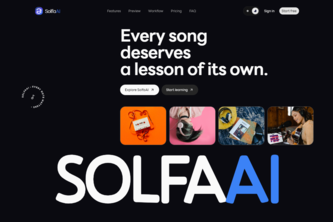
SolfaAi is a self-reported AI-powered music learning platform that transforms audio recordings into structured musical materials — including sheet music (MusicXML), tonic sol-fa notation, musical analysis, and AI-generated lessons. It was built as a prototype for the OpenAI 2026 hackathon by one developer, Oluwatimilehin Iseyemi.
What changed
The project is described as an early-stage prototype with no evidence of commercial traction or product-market fit. The author states it's “the first step toward making music learning more accessible and automated,” but there is no indication of user adoption, revenue, or monetization.
Single most important open question
Is there a viable market need for this type of tool, and can the prototype scale beyond a single developer’s vision?
Note: This analysis is based entirely on the self-reported project description provided by the author. No external verification, funding, customers, revenue or traction data are available.
What The Product Actually Is
The description states that SolfaAi:
- Accepts audio uploads from users.
- Converts uploaded songs into MIDI format using Spotify Basic Pitch.
- Generates sheet music in MusicXML.
- Transforms melodies into movable-do tonic sol-fa notation.
- Performs musical analysis such as key and tempo detection.
- Creates AI-powered lessons to help users understand and practice pieces.
It is built with Next.js, React, TypeScript, Tailwind CSS, Supabase (for auth/storage), PostgreSQL, OpenAI models (GPT-5.6 and Codex), and uses Spotify Basic Pitch for transcription.
Inference: The product appears to be a music transcription and learning tool that leverages AI for automation of tasks typically done manually by musicians or educators.
Positioning & Claim Evolution
The author claims:
- SolfaAi helps musicians learn songs by converting them into structured materials.
- It aims to reduce time and effort required to learn songs by ear.
- The platform is designed for students, teachers, instrumentalists, choirs, and general music learners.
- It seeks to make music education more accessible and automated.
Claim vs Fact: These are self-stated intentions. There is no evidence of actual market validation or user feedback that supports these claims.
Target Customer & ICP
The description states:
- The platform targets students, teachers, instrumentalists, choirs, and anyone interested in learning music.
- It is intended for use by individuals who want to learn songs by ear.
Inference: Based on the self-reported write-up, the ICP seems to be amateur musicians or educators looking for tools to simplify music learning. However, no segmentation or targeting data is provided.
Business Model & Pricing Evidence
There is no evidence of:
- A defined business model.
- Pricing strategy.
- Revenue streams.
- Monetization plans.
Not evidenced: The author does not describe how the product would be monetized or whether any revenue-generating mechanisms exist.
Technical & Delivery Signals
The project is built using:
- Frontend: Next.js, React, TypeScript, Tailwind CSS
- Backend: Supabase (authentication, database, file storage)
- AI/ML tools: OpenAI GPT-5.6 and Codex
- Audio processing pipeline: Spotify Basic Pitch for MIDI generation
Inference: The technical stack suggests a modern web application with cloud-based infrastructure and AI-assisted development. However, no performance metrics or scalability data are reported.
Traction & Maturity Signals
The description states:
- This is a prototype built for a hackathon.
- It works as a proof-of-concept but requires further refinement.
- Challenges include improving transcription accuracy and key detection.
- No mention of users, customers, or usage metrics.
Not evidenced: There is no evidence of traction, adoption, or product maturity beyond the initial prototype stage.
Competitive Context
No competitive landscape is described. The author does not reference existing tools in this space, nor does the project description indicate awareness of competitors.
Not evidenced: No information on direct or indirect competition is available.
Open Questions & Risks
- Single-founder model: Only one team member is listed.
- Prototype-only status: No production-ready features or user base.
- Unverified AI outputs: The use of GPT-5.6 and Codex for development implies reliance on uncontrolled generative AI, which may introduce inconsistency.
- Lack of commercial viability: No evidence of market demand, pricing, or monetization strategy.
- Technical limitations: Challenges in transcription accuracy and key detection suggest potential scalability issues.
Inference: The project lacks commercial readiness and faces significant risks related to execution, scalability, and market validation.
Questions the description leaves open
- What specific problems are you solving for your target users?
- How do you plan to validate demand for this tool before scaling?
- Are there any existing tools in the market that solve similar problems? If so, how does SolfaAi differ?
- What is your roadmap for improving transcription accuracy and supporting more song types?
- Do you have any early adopters or pilot users who can provide feedback?
- How do you intend to monetize this platform?
- What are the key technical challenges that remain unresolved?
Overall Assessment
This is a preliminary prototype submitted as part of a hackathon, with no evidence of commercial traction or product-market fit.
Confidence Level: Low — due to lack of verified data on users, revenue, customers, or market validation.
Assessment: Not ready for investment or partnership at this stage. The idea shows promise in addressing a niche but underserved segment (music education), but the current version is unproven and requires substantial development before any commercial viability can be assessed.
User Stories BotA demo video on every pull request
Get a demo video on every new feature
GitHub App that watches your pull requests and records a narrated, captioned demo.
Save time on demo prep and make informed decisions faster with a video walkthrough of every new feature.
Source
Submitted to the OpenAI 2026 hackathon on Devpost. Project home on Devpost. Back to the full gallery on Devpost.
This competitive analysis was produced by top-founders.com (opens in a new tab)
Generated by a language model from this project's public Devpost page — its tagline, the author's own write-up and any built-with tags listed there — as captured in August 2026. Short quotations are the author's words. It is an opinion on the idea as a business, not on the people behind it, and it reflects the description as published then. If the project has moved on, request a correction below. The analysis is not independent research and contains no verified traction, revenue or customer data.
An independent guide by KFG International LLC — not affiliated with, endorsed by, or connected to Devpost or OpenAI.