

Archive position — measured, not model output
1 like on Devpost
505 of the 7,850 archived projects have more likes, and 1,758 share exactly 1 — so this project's #1,946 place in the like-ranked listing is a tie-break inside that group, not a ranking.
Projects (log scale)
Likes on Devpost. ▲ marks this project's group.
Show the figures
| Likes | Projects | Share of archive |
|---|---|---|
| 0 | 5,587 | 71.2% |
| 1 | 1,758 | 22.4% |
| 2 | 284 | 3.6% |
| 3–4 | 132 | 1.7% |
| 5–9 | 75 | 1.0% |
| 10+ | 14 | 0.2% |
 User Stories BotA demo video on every pull request
Get a demo video on every new feature
GitHub App that watches your pull requests and records a narrated, captioned demo.
Save time on demo prep and make informed decisions faster with a video walkthrough of every new feature.
Executive Summary
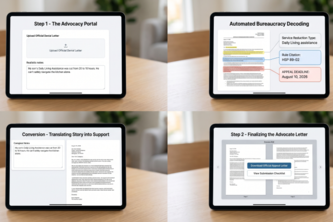
The company appears to be a solo-built tool designed to help caregivers draft formal appeal letters when state benefits are cut. The author states it uses Google Workspace tools and OpenAI's vision API to process government letters and generate structured legal documents.
What changed
The project was submitted as part of the OpenAI 2026 hackathon, indicating an early-stage prototype or proof-of-concept.
Single most important open question
Is there any evidence of actual user adoption or traction beyond the author's own account?
Analysis basis
Self-reported only. This is a solo builder project with no independent verification of usage, revenue, customers or market validation.
What The Product Actually Is
The description states:
- A tool that turns everyday caregiver stories into professional appeal letters
- Users upload a photo or document of an official denial or service reduction letter
- Users type out what is happening in plain English
- The tool reads agency rules, pulls out deadlines, and translates user input into structured appeal letters ready to print
- Built using Google Workspace tools and OpenAI's vision API
Inference The tool appears to be a document processing application that leverages AI for text extraction and generation within the Google ecosystem.
Positioning & Claim Evolution
The description states:
- Positions itself as helping "exhausted caregivers" facing "confusing paperwork"
- Claims to "level the playing field" between bureaucratic systems and real people
- Describes itself as bridging "rigid government bureaucracy and real people"
- States it makes "a highly complex, intimidating legal process" accessible through a "straightforward, two-step action that takes less than five minutes"
Inference The positioning has evolved from a simple document processing tool to a solution for empowering vulnerable populations in legal processes.
Target Customer & ICP
The description states:
- Primary users are "exhausted caregivers" facing benefit cuts
- Specifically targets families dealing with "state agency suddenly cuts essential home health benefits or daily living assistance"
- Focuses on people who receive "official denial or service reduction letters"
Inference The target customer is likely a specific demographic of caregivers, but no evidence of segmentation beyond this.
Business Model & Pricing Evidence
Not evidenced. The description does not contain any information about pricing, monetization strategy, or business model.
Technical & Delivery Signals
The description states:
- Built with: google-apps-script, google-workspace-tools, html, javascript, openai-api
- Uses OpenAI's vision capabilities to read and extract text from standard agency templates
- Processes documents through a simple interface where users can drop in documents and notes
- Generates structured output from raw conversational feedback
Inference The tool is built on a relatively simple stack using Google Workspace integration and AI APIs, suggesting it may be a lightweight prototype.
Traction & Maturity Signals
Not evidenced. There is no mention of:
- Users or customers
- Revenue or monetization
- Usage metrics
- Product adoption
- Market validation
Competitive Context
Not evidenced. The description does not contain any information about:
- Competitors
- Market size
- Existing solutions in the space
- Competitive advantages
Open Questions & Risks
Open question
Solo builder with no evidence of traction or customers.
Open question
No revenue, pricing or monetization strategy described.
Open question
The tool appears to be a prototype built for a hackathon, not a commercial product.
Inference The project may be at an early stage with limited market validation.
Questions the description leaves open
- What is the actual user base beyond the author's own experience?
- How many users are currently using this tool?
- What is the monetization strategy for this tool?
- Have you conducted any user research or testing?
- What are the technical limitations of the current approach?
- How do you plan to scale beyond a single developer?
- Are there any legal or compliance considerations with generating formal appeal letters?
Overall Assessment
Not evidenced. No information is provided about:
- Financials
- Revenue
- Customer base
- Market opportunity
- Team strength
- Product-market fit
- Scalability
The description indicates this is a solo-built hackathon project with no evidence of commercial traction or validation. The author's own account suggests it was built quickly and simply, without any indication of business development or market validation beyond personal experience.
User Stories BotA demo video on every pull request
Get a demo video on every new feature
GitHub App that watches your pull requests and records a narrated, captioned demo.
Save time on demo prep and make informed decisions faster with a video walkthrough of every new feature.
Source
Submitted to the OpenAI 2026 hackathon on Devpost. Project home on Devpost. Back to the full gallery on Devpost.
This competitive analysis was produced by top-founders.com (opens in a new tab)
Generated by a language model from this project's public Devpost page — its tagline, the author's own write-up and any built-with tags listed there — as captured in August 2026. Short quotations are the author's words. It is an opinion on the idea as a business, not on the people behind it, and it reflects the description as published then. If the project has moved on, request a correction below. The analysis is not independent research and contains no verified traction, revenue or customer data.
An independent guide by KFG International LLC — not affiliated with, endorsed by, or connected to Devpost or OpenAI.