

Archive position — measured, not model output
0 likes on Devpost
2,263 of the 7,850 archived projects have more likes, and 5,587 share exactly 0 — so this project's #3,909 place in the like-ranked listing is a tie-break inside that group, not a ranking.
Projects (log scale)
Likes on Devpost. ▲ marks this project's group.
Show the figures
| Likes | Projects | Share of archive |
|---|---|---|
| 0 | 5,587 | 71.2% |
| 1 | 1,758 | 22.4% |
| 2 | 284 | 3.6% |
| 3–4 | 132 | 1.7% |
| 5–9 | 75 | 1.0% |
| 10+ | 14 | 0.2% |
 User Stories BotA demo video on every pull request
Get a demo video on every new feature
GitHub App that watches your pull requests and records a narrated, captioned demo.
Save time on demo prep and make informed decisions faster with a video walkthrough of every new feature.
Executive Summary
What the company appears to be
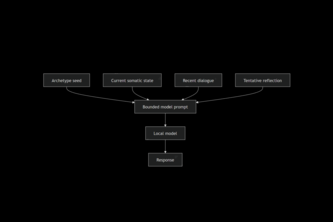
Emberfinch is a self-reported local-first AI agent built in Python using llama.cpp, designed for research into context handling mechanisms. It operates on Windows and Termux environments and supports switching between GGUF models. The project is described as a wrapper around a local LLM that explores three bounded context mechanisms: archetype seed, somatic state, and ambient reflection.
What changed
The author describes an evolution from a monolithic wrapper into a modular system with separate concerns for configuration, memory, telemetry, and orchestration. This suggests architectural refinement during development.
Single most important open question — the commercial due-diligence read
Is there any evidence of product-market fit or traction beyond the author's own research? The description contains no mention of customers, revenue, usage metrics, or adoption; it is entirely self-reported and unverified.
What The Product Actually Is
The description states that Emberfinch is a local-first Python agent, built using llama.cpp, which runs on both Windows PCs and Termux Android environments. It supports switching between multiple GGUF models to allow flexibility in experimentation.
It is described as more than just an agent wrapper—it is a home for research, exploring three bounded context mechanisms:
- Archetype seed (fixed system prefix)
- Somatic state (device telemetry translated into canonical labels)
- Ambient reflection (toggleable feature prompting model to reflect on recent turns)
These components are intended to form a way of holding context without collapsing into illusion or static memory.
Evidence
- The project is built in Python and uses llama.cpp.
- It supports Windows and Termux environments.
- It can switch between GGUF models.
- It implements three bounded context mechanisms: archetype seed, somatic state, and ambient reflection.
Inference The system appears to be a prototype or research tool rather than a commercial product. There is no indication of production deployment or user-facing features beyond the author’s own use case.
Positioning & Claim Evolution
The description states that Emberfinch was inspired by a desire for an agent that feels coherent and companionable without pretending its words are lived experience. It aims to avoid confusion between memory and myth, or telemetry and truth.
It positions itself as a tool for research, not a general-purpose AI assistant. The author emphasizes that it is not trying to simulate human-like behavior but instead explores how dialogue, state, and reflection can coexist without collapsing into illusion.
Evidence
- The tagline: “An auditable local AI agent combining bounded archetype context, symbolic device state, and reflection—then testing honestly where those mechanisms help or fail.”
- The author explicitly states that it is a place to test how dialogue, state, and reflection can sit together without collapsing into illusion.
- It is described as a research tool, not a commercial product.
Inference The positioning has evolved from a simple wrapper into a structured research platform. However, there is no evidence of shifting toward broader market appeal or commercial viability.
Target Customer & ICP
Not evidenced.
The description does not identify any specific customer segments or personas. It focuses on the author’s personal research goals and internal experimentation rather than external users or buyers.
Evidence
- No mention of target customers.
- No indication of buyer personas or use cases beyond the author's own testing.
Business Model & Pricing Evidence
Not evidenced.
There is no information provided about pricing, monetization strategies, or business model assumptions. The project is described as a research tool with no commercial intent stated.
Evidence
- No mention of revenue streams.
- No indication of pricing models or customer acquisition plans.
Technical & Delivery Signals
The description indicates that Emberfinch:
- Runs on Windows and Termux.
- Uses llama.cpp to run GGUF models locally.
- Supports Qwen2.5 3B Instruct with a 16,384-token context window and GPU offload.
- Was built modularly, separating concerns like configuration, memory, telemetry, and orchestration.
- Includes features for prompt budgeting, tool policy, HTTP transport, and model profiles.
It also mentions that the author used GPT-5.6 Sol to assist in inspection, implementation, testing, and documentation.
Evidence
- Built with Python and llama.cpp.
- Runs on Windows and Termux.
- Supports Qwen2.5 3B Instruct.
- Modular architecture with separation of concerns.
- Uses GPT-5.6 Sol for assistance.
Inference The technical stack reflects a developer-focused, local-first approach suitable for experimentation or research. It does not suggest scalability or enterprise-grade infrastructure.
Traction & Maturity Signals
Not evidenced.
There is no mention of users, customers, revenue, or adoption metrics. The project is described as a personal experiment and research effort with no external validation or traction indicators.
Evidence
- No data on user base.
- No evidence of revenue or monetization.
- No signs of product-market fit or market traction.
Competitive Context
Not evidenced.
The description does not reference competitors, existing tools in the space, or how Emberfinch compares to other local AI agents or research platforms.
Evidence
- No mention of competing products or services.
- No discussion of market positioning relative to others.
Open Questions & Risks
- No commercial traction or evidence of product-market fit: The project is described as a personal research tool with no external adoption or revenue.
- Single-founder operation: Only one team member (St john Rutherford) is listed, which may limit scalability and execution capacity.
- Research-focused, not product-oriented: The emphasis on experimentation and ablation studies suggests the project is not yet focused on delivering value to end users.
- No public-facing documentation or API: There is no indication of an accessible interface or developer tools beyond the author’s own use case.
Evidence
- No mention of customers, revenue, or usage data.
- Single-person team.
- Focused on internal research rather than external product delivery.
- No public-facing interfaces or APIs mentioned.
Questions the description leaves open
- What is the intended path from this research tool to a commercial product?
- Are there any plans for monetization or customer acquisition beyond personal experimentation?
- How does this project align with current market needs or gaps in local AI agent development?
- Has the author considered how to scale beyond the current prototype and modular structure?
- What are the long-term goals for the three context mechanisms (archetype seed, somatic state, ambient reflection)?
- Is there any plan to open-source or publish the tool more broadly?
Overall Assessment
Not evidenced.
There is no evidence of revenue, traction, or market validation that would support an investment or partnership decision. The project appears to be a personal research effort with no commercial readiness or external validation.
Evidence
- No financials.
- No customer data.
- No signs of product-market fit.
- No indication of commercial intent or scalability.
Inference At this stage, the project is not suitable for investment or partnership consideration unless further development and traction are demonstrated.
User Stories BotA demo video on every pull request
Get a demo video on every new feature
GitHub App that watches your pull requests and records a narrated, captioned demo.
Save time on demo prep and make informed decisions faster with a video walkthrough of every new feature.
Source
Submitted to the OpenAI 2026 hackathon on Devpost. Project home on Devpost. Back to the full gallery on Devpost.
This competitive analysis was produced by top-founders.com (opens in a new tab)
Generated by a language model from this project's public Devpost page — its tagline, the author's own write-up and any built-with tags listed there — as captured in August 2026. Short quotations are the author's words. It is an opinion on the idea as a business, not on the people behind it, and it reflects the description as published then. If the project has moved on, request a correction below. The analysis is not independent research and contains no verified traction, revenue or customer data.
An independent guide by KFG International LLC — not affiliated with, endorsed by, or connected to Devpost or OpenAI.