

Archive position — measured, not model output
0 likes on Devpost
2,263 of the 7,850 archived projects have more likes, and 5,587 share exactly 0 — so this project's #3,911 place in the like-ranked listing is a tie-break inside that group, not a ranking.
Projects (log scale)
Likes on Devpost. ▲ marks this project's group.
Show the figures
| Likes | Projects | Share of archive |
|---|---|---|
| 0 | 5,587 | 71.2% |
| 1 | 1,758 | 22.4% |
| 2 | 284 | 3.6% |
| 3–4 | 132 | 1.7% |
| 5–9 | 75 | 1.0% |
| 10+ | 14 | 0.2% |
 User Stories BotA demo video on every pull request
Get a demo video on every new feature
GitHub App that watches your pull requests and records a narrated, captioned demo.
Save time on demo prep and make informed decisions faster with a video walkthrough of every new feature.
Executive Summary
Company: EmberTrace
Self-reported basis: The analysis is based entirely on the author-supplied project description, tagline, write-up and technology tags — all self-reported and unverified.
What it appears to be: A prototype tool for fire incident reporting that uses AI to draft reports while maintaining traceability of claims and requiring human review. It is built as a local Node.js application with simulated data and an AI adapter that can optionally connect to GPT-5.6.
What changed: The project was submitted to the OpenAI 2026 hackathon, indicating it is in early development or prototyping phase.
Single most important open question: Is there a viable market need for this type of evidence-based drafting tool in public safety agencies, and how does the team plan to transition from simulation to real-world deployment?
What The Product Actually Is
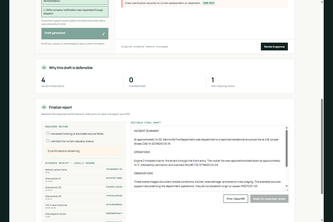
The description states that EmberTrace is a prototype application built with Node.js and JavaScript. It cross-checks simulated fire incident data (from camera, radio, photo, CAD sources) and generates a draft incident report.
- Every claim in the draft is linked to its source.
- If a fact is not supported, it remains marked as "REVIEW REQUIRED".
- A SHA-256 fingerprint of the evidence is generated locally.
- Two human approvals are required before submission.
- The system does not auto-submit, determine origin/cause, or replace agency policy.
The prototype runs offline and uses simulated data. It includes an AI adapter that can optionally connect to GPT-5.6 for structured drafting when configured with an OpenAI key on a server — the browser never receives the key.
Inference: The product is not yet a production-ready SaaS offering but a proof-of-concept or hackathon prototype.
Positioning & Claim Evolution
The description states that EmberTrace explores a safer way to reduce administrative burden after fire incidents, without asking an AI to make operational, medical, or legal decisions.
- It is positioned as a tool for evidence-grounded reporting, not for replacing human judgment.
- The system emphasizes defensibility over fluent text generation.
- It is described as a guided workflow that makes uncertainty visible and preserves source links.
Claim: The product is built to be "evidence-first" and "human judgment out".
Inference: This positioning reflects an awareness of the risks in AI-assisted safety documentation, where opacity or overconfidence can be dangerous.
Target Customer & ICP
The description implies that EmberTrace targets fire departments or emergency services.
- It is designed for use after fire incidents.
- The system handles data from sources like helmet cameras, radio traffic, scene photos, dispatch records, and follow-up notes.
- It is intended to reduce administrative burden in public safety workflows.
Claim: The tool is for emergency response agencies.
Not evidenced: No specific customer segments, use cases or agency sizes are mentioned.
Business Model & Pricing Evidence
The description does not contain any information about pricing, monetization, or business model.
- It describes a prototype that runs locally and uses simulated data.
- The AI adapter can optionally connect to GPT-5.6 via server-side API keys, but no cost structure is described.
Not evidenced: No pricing, revenue model, or customer acquisition strategy are stated.
Technical & Delivery Signals
The system is built as a dependency-free Node.js static application.
- It uses JavaScript for evidence selection, rule-based drafting, citations, review states, and SHA-256 fingerprinting.
- Simulated assets are bundled for offline use.
- The AI adapter can be configured to use GPT-5.6 on the server side, with no key exposure in the browser.
Claim: The system is designed to be secure and defensible by design.
Inference: This suggests a focus on safety-critical environments where data integrity and traceability are paramount.
Traction & Maturity Signals
The project was submitted to the OpenAI 2026 hackathon, indicating it is in an early stage of development.
- It is described as a prototype.
- No real-world deployment, customer feedback, or usage metrics are mentioned.
- The system uses simulated data and does not yet integrate with live emergency services.
Not evidenced: No traction, revenue, customers, or adoption data.
Competitive Context
The description does not mention any competitors.
- It is a hackathon submission, so no market analysis or competitive positioning is provided.
- The focus on traceability and human review in safety-critical workflows may align with tools for incident reporting or compliance management, but no direct comparison is made.
Not evidenced: No competitive landscape or existing solutions are described.
Open Questions & Risks
- Prototype only: The system is a hackathon prototype, not yet proven in real-world use.
- No real data integration: It uses simulated data, so it's unclear how it would function with actual emergency service systems.
- Limited scalability: The local, offline nature of the demo may not scale to agency-wide deployment.
- Unclear adoption path: No evidence of how the tool would be adopted by agencies or integrated into existing workflows.
Inference: The lack of real-world testing and integration points raises questions about viability for production use.
Questions the description leaves open
- What specific fire departments or emergency services have expressed interest in this tool?
- How does the team plan to transition from simulation to real-world deployment with live data?
- Are there any existing partnerships or pilot programs with public safety agencies?
- What are the technical and legal barriers to integrating this into current emergency response workflows?
- How will the system handle variability in data formats from different agencies or jurisdictions?
Overall Assessment
The project is a hackathon prototype that shows early-stage thinking around AI-assisted, evidence-based reporting in public safety.
- It is not yet a product with traction, revenue, or customers.
- The idea has potential for a niche market — particularly in agencies seeking defensible, traceable documentation.
- However, the lack of real-world testing and integration plans raises significant risk.
Assessment: Not ready for investment or partnership at this stage.
Inference: If the team can demonstrate early traction with a pilot agency or prove scalability to live data, it may warrant further evaluation.
User Stories BotA demo video on every pull request
Get a demo video on every new feature
GitHub App that watches your pull requests and records a narrated, captioned demo.
Save time on demo prep and make informed decisions faster with a video walkthrough of every new feature.
Source
Submitted to the OpenAI 2026 hackathon on Devpost. Project home on Devpost. Back to the full gallery on Devpost.
This competitive analysis was produced by top-founders.com (opens in a new tab)
Generated by a language model from this project's public Devpost page — its tagline, the author's own write-up and any built-with tags listed there — as captured in August 2026. Short quotations are the author's words. It is an opinion on the idea as a business, not on the people behind it, and it reflects the description as published then. If the project has moved on, request a correction below. The analysis is not independent research and contains no verified traction, revenue or customer data.
An independent guide by KFG International LLC — not affiliated with, endorsed by, or connected to Devpost or OpenAI.