

Archive position — measured, not model output
0 likes on Devpost
2,263 of the 7,850 archived projects have more likes, and 5,587 share exactly 0 — so this project's #3,910 place in the like-ranked listing is a tie-break inside that group, not a ranking.
Projects (log scale)
Likes on Devpost. ▲ marks this project's group.
Show the figures
| Likes | Projects | Share of archive |
|---|---|---|
| 0 | 5,587 | 71.2% |
| 1 | 1,758 | 22.4% |
| 2 | 284 | 3.6% |
| 3–4 | 132 | 1.7% |
| 5–9 | 75 | 1.0% |
| 10+ | 14 | 0.2% |
 User Stories BotA demo video on every pull request
Get a demo video on every new feature
GitHub App that watches your pull requests and records a narrated, captioned demo.
Save time on demo prep and make informed decisions faster with a video walkthrough of every new feature.
Executive Summary
What the company appears to be
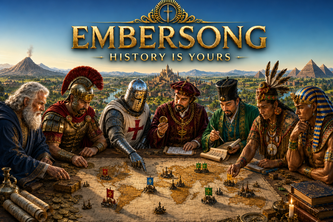
Embersong: History Is Yours is a self-developed single-player historical 4X strategy game for macOS, built by one developer (Mark Huthmaker). The description states it blends roguelike mechanics with an archenemy system that adapts across playthroughs. It features eight eras from prehistory to the future, 18 unique civilizations, and modular gameplay design.
What changed
The author reports building a complete playable game using AI tools like ChatGPT/Codex, GDScript, Godot, and Suno for audio. The project was submitted to the OpenAI 2026 hackathon on Devpost.
Single most important open question — the commercial due-diligence read
Is there any evidence of a sustainable business model or path to monetization beyond the initial alpha release? The description does not state whether the game will be sold, offered as freemium, or supported by in-game purchases. There is no mention of revenue, pricing, or customer acquisition.
What The Product Actually Is
The description states that Embersong: History Is Yours is a single-player historical 4X strategy game for macOS. It includes:
- A diamond-grid map layout, similar to Civilization 2.
- Gameplay spanning eight eras: from prehistory to the future.
- 18 unique civilizations, including 12 historical and 6 mythical ones.
- Roguelike elements through an archenemy system that adapts across playthroughs.
- A dynamic rules engine with modifiers like doctrines, traits, and religions.
- Modular design using JSON data structures for content.
- AI-generated art and audio, including sprites, terrain, portraits, and music.
The author claims the game was built entirely within the ChatGPT/Codex desktop app using Godot 4.7 and GDScript. The project is described as a native macOS alpha with full campaign meta-layer functionality.
Note: This is self-reported by the author; no external verification or evidence of actual gameplay, sales, or user metrics exists.
Positioning & Claim Evolution
The author positions Embersong as a 4X strategy game that reimagines player identity and persistence across playthroughs. Key claims include:
- The game allows players to shape their civilization's culture through early actions, rather than choosing fixed attributes.
- Each run alters the future via an archenemy system that pursues the player across games.
- The game aims to deliver a "one more turn" feeling, with rapid tempo and replayability.
- It incorporates historical accuracy in its narrative elements, leader voices, and epigraphs.
The positioning evolves from a personal passion project (developed over nearly 30 years of playing 4X games) into a modular, AI-assisted game engine that supports deep customization and immersion.
Inference: The author’s long-standing interest in 4X strategy games suggests this is not just a one-off experiment but an evolution of prior experience. However, no evidence indicates how the product differentiates from existing 4X titles or whether it has achieved traction or adoption beyond its creator.
Target Customer & ICP
The description states that Embersong targets players who enjoy historical 4X strategy games, particularly those looking for:
- A deep but accessible experience.
- Replayability through persistent gameplay elements like the archenemy system.
- An emphasis on cultural identity shaping and narrative immersion.
It is designed for single-player macOS users, with no mention of multiplayer or cross-platform support at this stage.
Not evidenced: There is no indication of specific demographics, user personas, or market segmentation. No evidence of target audience size, engagement metrics, or monetization strategy.
Business Model & Pricing Evidence
The description does not provide any information about:
- Pricing structure
- Monetization model (e.g., paid download, freemium, DLCs)
- Revenue streams
- Customer acquisition costs
It only mentions that the author plans to release a notarized, signed macOS build, and possibly on Steam, with future multiplayer support.
Inference: If the game is released via Steam or as a paid download, it may follow traditional indie game pricing models. However, no evidence supports this assumption.
Technical & Delivery Signals
The author reports:
- Development using Godot 4.7, GDScript, and ChatGPT/Codex.
- AI tools used for:
- Art generation (using Image2)
- Code auditing
- UI refinement
- Audio creation (Suno)
- Modular design principles to isolate gameplay changes.
- Automated testing including:
- Kernel determinism checks
- Replay integrity tests
- UI smoke tests at seven viewport sizes
- AI-vs-AI arena self-play for performance budget enforcement
Not evidenced: No details on scalability, technical architecture beyond modular JSON, or long-term maintenance plans. No evidence of production-ready infrastructure or team size beyond one developer.
Traction & Maturity Signals
The description states:
- The game is a native macOS alpha.
- It includes all eight eras, all victory paths, and a working campaign meta-layer.
- The author conducted human playtesting and balance calibration.
- There are no user reviews or metrics mentioned.
Not evidenced: No evidence of:
- User engagement
- Sales figures
- Customer feedback
- Retention rates
- Active user base
Competitive Context
The description does not reference any direct competitors. However, the genre of historical 4X strategy games includes titles such as:
- Civilization series
- Total War series
- Endless Legend
- Age of Wonders
These are typically developed by studios with large teams and significant funding.
Inference: Given that Embersong is a one-person project, it likely operates in a niche space or serves a specific subset of players who value personal development, modularity, and AI-assisted creation. No evidence indicates how it competes with established franchises.
Open Questions & Risks
- Single developer: The entire project was built by one person (Mark Huthmaker), which raises concerns about scalability, long-term maintenance, and ability to iterate quickly.
- AI dependency: Heavy reliance on AI tools like ChatGPT/Codex for development may introduce instability or inconsistency in output quality.
- No monetization strategy: No clear indication of how the game will be sold or supported financially.
- Limited platform support: Currently only available on macOS; no mention of iOS, web, or console versions.
- Unverified claims: All information is self-reported and unverified. No external validation exists for gameplay, performance, or design decisions.
Questions the description leaves open
- What is the current monetization strategy for Embersong?
- How does the archenemy system affect replayability and long-term player retention?
- Are there plans to expand beyond macOS (iOS, web, Steam)?
- Has the game undergone any third-party testing or QA beyond human playtesting?
- What are the key technical challenges that remain unresolved in the current build?
- How does the modular design impact future updates and content additions?
Overall Assessment
Not evidenced.
There is no evidence of revenue, ARR, funding rounds, headcount, or customer data to assess viability for investment or partnership.
Inference: While the project shows creativity and technical execution using AI tools, its commercial potential remains unclear without further evidence of traction, monetization, or scalability. The single-developer nature and lack of financial metrics make it difficult to evaluate as a viable business opportunity at this stage.
User Stories BotA demo video on every pull request
Get a demo video on every new feature
GitHub App that watches your pull requests and records a narrated, captioned demo.
Save time on demo prep and make informed decisions faster with a video walkthrough of every new feature.
Source
Submitted to the OpenAI 2026 hackathon on Devpost. Project home on Devpost. Back to the full gallery on Devpost.
This competitive analysis was produced by top-founders.com (opens in a new tab)
Generated by a language model from this project's public Devpost page — its tagline, the author's own write-up and any built-with tags listed there — as captured in August 2026. Short quotations are the author's words. It is an opinion on the idea as a business, not on the people behind it, and it reflects the description as published then. If the project has moved on, request a correction below. The analysis is not independent research and contains no verified traction, revenue or customer data.
An independent guide by KFG International LLC — not affiliated with, endorsed by, or connected to Devpost or OpenAI.