

Archive position — measured, not model output
0 likes on Devpost
2,263 of the 7,850 archived projects have more likes, and 5,587 share exactly 0 — so this project's #6,739 place in the like-ranked listing is a tie-break inside that group, not a ranking.
Projects (log scale)
Likes on Devpost. ▲ marks this project's group.
Show the figures
| Likes | Projects | Share of archive |
|---|---|---|
| 0 | 5,587 | 71.2% |
| 1 | 1,758 | 22.4% |
| 2 | 284 | 3.6% |
| 3–4 | 132 | 1.7% |
| 5–9 | 75 | 1.0% |
| 10+ | 14 | 0.2% |
 User Stories BotA demo video on every pull request
Get a demo video on every new feature
GitHub App that watches your pull requests and records a narrated, captioned demo.
Save time on demo prep and make informed decisions faster with a video walkthrough of every new feature.
Executive Summary
What the company appears to be
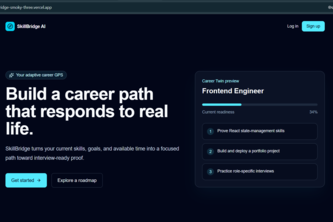
SkillBridge AI is a self-reported, AI-powered career guidance platform designed for students. The author describes it as an "Adaptive Career GPS" that builds a "living Career Twin" based on real-world evidence like resumes, GitHub repositories, projects, and assessments. It uses GPT-5.6 and Codex to generate structured outputs, which are then validated by deterministic systems before influencing the user's career roadmap.
What changed
The project is presented as a novel approach to career planning that adapts dynamically to student progress — rather than offering static roadmaps, it reroutes based on new data such as failed assessments or completed projects. It positions itself as an intelligent system that evolves with the learner.
Single most important open question
Is there any evidence of actual usage, traction, or adoption by students? The description contains no mention of users, customers, revenue, or product-market fit beyond its own claims and a hackathon submission.
What The Product Actually Is
The description states that SkillBridge AI is an Adaptive Career GPS. It builds a "living Career Twin" using data from:
- Resumes
- GitHub repositories
- Projects
- Assessments
- Interviews
It performs functions including:
- Resume analysis to distinguish claimed vs demonstrated skills.
- GitHub evidence interpretation to connect projects with technical skills.
- Skill gap identification and readiness scoring.
- Milestone-based roadmap generation.
- Dynamic adaptation of the roadmap when new information is added.
- Portfolio project generation tailored to skill gaps.
- AI mock interviews for role-specific evaluation.
The system uses GPT-5.6 as an intelligent reasoning layer, with Codex assisting in development. Outputs from AI agents are structured and validated using Zod before being used by deterministic engines that update the Career Twin.
Inference This is a full-stack application built around AI agents and event-driven logic, intended to support student career navigation through adaptive learning paths.
Positioning & Claim Evolution
The author positions SkillBridge AI as a career guidance tool that behaves like a GPS, continuously adapting to user progress. The tagline says:
"SkillBridge AI is your adaptive Career GPS—building a living Career Twin, identifying skill gaps, creating personalized projects, and continuously rerouting your journey to make you truly job-ready."
The core claim is that traditional career roadmaps are static but SkillBridge AI is adaptive, changing in response to real-time evidence.
Inference This represents an evolution from generic career advice tools toward a more dynamic, personalized system. However, the description does not indicate whether this positioning has been tested or validated with users.
Target Customer & ICP
The author states that SkillBridge AI is designed for students who know their desired career path but lack clarity on how to get there.
It also implies use by individuals preparing for roles like "Frontend Engineer".
There is no mention of other personas, such as professionals transitioning careers or employers using the tool.
Inference The primary ICP appears to be students seeking structured, adaptive career guidance. No evidence suggests targeting broader audiences or enterprise clients.
Business Model & Pricing Evidence
The description does not contain any information about pricing, monetization, or business model.
It does not state whether SkillBridge AI is free, subscription-based, or offered as a B2B service.
Not evidenced
Technical & Delivery Signals
The system is built using:
- Frontend: Next.js, React, Tailwind CSS
- Backend: Node.js, Supabase, PostgreSQL
- AI Tools: GPT-5.6, OpenAI API, Codex, GitHub API
- Architecture: Event-driven, adaptive-systems, REST API, Zod validation
- Development Process: AI-powered development via Codex
The architecture is described as:
"AI proposes → Deterministic engines decide → Zod validates → Database updates → Career Twin evolves"
This suggests a hybrid approach combining AI reasoning with deterministic logic for reliability and explainability.
Inference The technical stack indicates a modern, full-stack SaaS-style product built with AI integration. The separation of AI from decision-making systems shows awareness of safety and scalability concerns.
Traction & Maturity Signals
There is no evidence of traction or maturity beyond the hackathon submission.
No mention of:
- Users
- Customers
- Revenue
- Product-market fit
- Adoption metrics
- Beta testing
- Real-world usage data
The project was submitted to the OpenAI 2026 hackathon, indicating it's a prototype or proof-of-concept, not yet a commercial product.
Not evidenced
Competitive Context
The description does not reference competitors or existing solutions in the career guidance space.
It does not describe how SkillBridge AI differs from platforms like Coursera, Udemy, LinkedIn Learning, or other career planning tools.
No evidence of competitive analysis or differentiation strategy is provided.
Not evidenced
Open Questions & Risks
- Unverified claims: All features and functionality are self-reported without external validation.
- No traction or usage data: The product exists only as a hackathon submission; no real-world adoption is evident.
- Unclear monetization strategy: No indication of how the platform will generate revenue.
- Over-reliance on AI agents: While structured outputs and validation are mentioned, there’s no evidence that these safeguards have been tested at scale or in production.
- Limited target audience: Focused solely on students; unclear if it can expand beyond this niche.
Inference The risk of misalignment between stated capabilities and actual performance is high due to lack of independent verification. The product may not yet be ready for commercial deployment.
Questions the description leaves open
- What specific data sources are used to build the Career Twin? Are these verified or self-reported?
- How does the system validate that AI-generated outputs are accurate and safe for use in career decisions?
- Has the platform been tested with real students? If so, what were the results?
- What is the plan for monetization and scaling beyond a hackathon prototype?
- Can you provide examples of how the roadmap adapts when a student changes their target career or adds new skills?
- How does SkillBridge AI handle edge cases where AI agents fail to interpret inputs correctly?
Overall Assessment
SkillBridge AI is presented as an innovative concept for adaptive career guidance, built using modern AI and full-stack technologies.
However, the description contains no evidence of traction, revenue, or customer adoption. It is a self-reported hackathon submission with no external validation.
The system shows promise in terms of architecture and design but lacks commercial viability indicators.
Confidence Level: Low
This project is best viewed as an early-stage idea or prototype — not yet ready for investment or partnership unless further development and evidence of traction are demonstrated.
User Stories BotA demo video on every pull request
Get a demo video on every new feature
GitHub App that watches your pull requests and records a narrated, captioned demo.
Save time on demo prep and make informed decisions faster with a video walkthrough of every new feature.
Source
Submitted to the OpenAI 2026 hackathon on Devpost. Project home on Devpost. Back to the full gallery on Devpost.
This competitive analysis was produced by top-founders.com (opens in a new tab)
Generated by a language model from this project's public Devpost page — its tagline, the author's own write-up and any built-with tags listed there — as captured in August 2026. Short quotations are the author's words. It is an opinion on the idea as a business, not on the people behind it, and it reflects the description as published then. If the project has moved on, request a correction below. The analysis is not independent research and contains no verified traction, revenue or customer data.
An independent guide by KFG International LLC — not affiliated with, endorsed by, or connected to Devpost or OpenAI.