

Archive position — measured, not model output
1 like on Devpost
505 of the 7,850 archived projects have more likes, and 1,758 share exactly 1 — so this project's #852 place in the like-ranked listing is a tie-break inside that group, not a ranking.
Projects (log scale)
Likes on Devpost. ▲ marks this project's group.
Show the figures
| Likes | Projects | Share of archive |
|---|---|---|
| 0 | 5,587 | 71.2% |
| 1 | 1,758 | 22.4% |
| 2 | 284 | 3.6% |
| 3–4 | 132 | 1.7% |
| 5–9 | 75 | 1.0% |
| 10+ | 14 | 0.2% |
 User Stories BotA demo video on every pull request
Get a demo video on every new feature
GitHub App that watches your pull requests and records a narrated, captioned demo.
Save time on demo prep and make informed decisions faster with a video walkthrough of every new feature.
Executive Summary
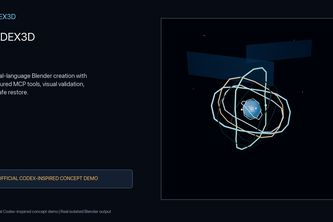
What the company appears to be: Codex3D is a self-reported local-first natural-language 3D agent for Blender, built as a hackathon project. It allows users to describe 3D scenes in ordinary language and iteratively refine them within Blender using GPT-5.6 and Codex tools. The system uses an authenticated localhost bridge to interact with Blender’s main thread, supports multi-turn feedback, and includes safety mechanisms like snapshotting and validation.
What changed: This is a demo project submitted for the OpenAI 2026 hackathon. It represents an experimental concept rather than a commercial product or service. No evidence of prior development, funding, or customer adoption exists in the description.
Single most important open question: Is there any indication that this project will evolve into a viable product or business beyond its current demo state?
Analysis basis: The entire analysis is based on the self-reported project description provided by the author. No external verification, traction data, revenue figures, or customer information are available.
What The Product Actually Is
The description states that Codex3D is a local-first natural-language 3D agent for Blender. It translates user intent into typed MCP tools using Codex and GPT-5.6. The system interacts with Blender via an authenticated localhost bridge, enabling structured actions in Blender’s main thread while returning inspection, validation, and snapshot results.
Key technical components include:
- Use of Blender 5.1.1
- Integration with Codex, GPT-5.6, ffmpeg, and model-context-protocol
- A local STDIO MCP adapter that queues actions for Blender
- Support for 23 allowlisted MCP tools
- Session-bound snapshots and fingerprint-verified restore
Inference: The product is described as a Blender extension or tool, not a standalone SaaS offering.
Positioning & Claim Evolution
The author positions Codex3D as a way to simplify 3D creation for beginners, allowing them to describe ideas in natural language and see them appear progressively in Blender. It supports iterative refinement without breaking approved structures.
It claims to:
- Enable progressive creation of geometry, materials, lights, cameras, world, and animation
- Allow multi-turn visual follow-up
- Provide safe recovery mechanisms through snapshots and UUIDs
- Offer render validation and composition checks
Claim vs. Fact: These are self-reported claims about functionality and user experience. No evidence of actual usage or adoption is provided.
Target Customer & ICP
The description implies the target audience includes:
- Beginner 3D artists
- Users who want to describe scenes in natural language
- People working with Blender
There is no explicit segmentation beyond "beginners" and "Blender users". No indication of enterprise or professional use cases, nor any evidence of a defined ICP (Ideal Customer Profile).
Not evidenced: No data on customer personas, buyer types, or specific market segments.
Business Model & Pricing Evidence
The project is described as an unofficial demo submitted to a hackathon. There is no mention of:
- Revenue model
- Pricing strategy
- Monetization plans
- Subscription tiers or usage-based billing
Not evidenced: No business model or pricing information.
Technical & Delivery Signals
Key technical elements include:
- Use of Blender 5.1.1
- Integration with Codex, GPT-5.6, and model-context-protocol
- Local-first architecture using localhost bridge
- MCP (Model Context Protocol) tools for structured interaction
- 23 allowlisted MCP tools; no arbitrary execution allowed
- Snapshot-based recovery and UUID persistence
- Validation checks for render quality, composition, and visibility
Inference: The system is designed to be secure, local, and non-intrusive.
Traction & Maturity Signals
The project is described as a hackathon submission. Evidence of maturity includes:
- 177 passing automated tests
- A synthetic test with 100% pass rate over nine turns
- Real-world validation of snapshot restore, UUID persistence, and animation verification
- Public MIT-licensed repository and prebuilt release
However, the description makes clear that:
- This is a demo, not a production-ready product
- It does not include a Web UI
- Full Scene IR reconciliation is not implemented
- The synthetic test shows repeatable functionality but not human usability research
Not evidenced: No customer base, revenue, or adoption metrics.
Competitive Context
No direct competitors are named in the description. However, it implies a space involving:
- Natural-language 3D tools
- Blender automation
- AI-assisted creative workflows
It is not clear whether Codex3D competes with existing Blender plugins, AI-powered design tools, or other creative AI platforms.
Not evidenced: No competitive landscape or market positioning beyond self-description.
Open Questions & Risks
Key risks and open questions include:
- The project is a demo, not a commercial product
- No evidence of traction, revenue, or customers
- Limited to Blender 5.1.1
- No Web UI or broader platform support
- Not endorsed by OpenAI or any major AI company
- No indication of scalability beyond hackathon-level execution
Inference: The project may not be suitable for commercial investment or partnership without further development.
Questions the description leaves open
- What is the path from this demo to a production-ready product?
- Are there plans to support other 3D platforms beyond Blender?
- How does Codex3D intend to monetize or scale beyond the hackathon?
- Is there any internal or external testing beyond the synthetic test cases?
- What are the long-term technical dependencies and risks (e.g., GPT-5.6, Blender updates)?
- Has the team considered user feedback from real 3D artists?
Overall Assessment
Assessment: This is a conceptual demo submitted for a hackathon. There is no evidence of commercial traction, revenue, or customer adoption.
Confidence level: Low — based entirely on self-reported description with no external validation or data.
Investment/Partnership recommendation: Not suitable for investment or partnership at this stage. The project lacks the maturity, traction, and business model to justify further due diligence unless there is a clear path to product-market fit and commercial viability.
User Stories BotA demo video on every pull request
Get a demo video on every new feature
GitHub App that watches your pull requests and records a narrated, captioned demo.
Save time on demo prep and make informed decisions faster with a video walkthrough of every new feature.
Source
Submitted to the OpenAI 2026 hackathon on Devpost. Project home on Devpost. Back to the full gallery on Devpost.
This competitive analysis was produced by top-founders.com (opens in a new tab)
Generated by a language model from this project's public Devpost page — its tagline, the author's own write-up and any built-with tags listed there — as captured in August 2026. Short quotations are the author's words. It is an opinion on the idea as a business, not on the people behind it, and it reflects the description as published then. If the project has moved on, request a correction below. The analysis is not independent research and contains no verified traction, revenue or customer data.
An independent guide by KFG International LLC — not affiliated with, endorsed by, or connected to Devpost or OpenAI.