

Archive position — measured, not model output
1 like on Devpost
505 of the 7,850 archived projects have more likes, and 1,758 share exactly 1 — so this project's #853 place in the like-ranked listing is a tie-break inside that group, not a ranking.
Projects (log scale)
Likes on Devpost. ▲ marks this project's group.
Show the figures
| Likes | Projects | Share of archive |
|---|---|---|
| 0 | 5,587 | 71.2% |
| 1 | 1,758 | 22.4% |
| 2 | 284 | 3.6% |
| 3–4 | 132 | 1.7% |
| 5–9 | 75 | 1.0% |
| 10+ | 14 | 0.2% |
 User Stories BotA demo video on every pull request
Get a demo video on every new feature
GitHub App that watches your pull requests and records a narrated, captioned demo.
Save time on demo prep and make informed decisions faster with a video walkthrough of every new feature.
Executive Summary
What the company appears to be
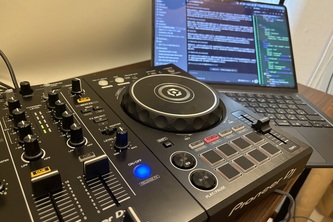
CodexDDJ is a self-reported software project that repurposes a DJ controller (specifically the DDJ-400) as a physical interface for controlling tasks, agents, and workflows within OpenAI's Codex environment. It maps physical controls on the DJ hardware to conceptual elements like "Main task", "Aux lane", "Side/Subagent", and "Skills". The author states it is built using Swift and designed for use with an app-server that drives thread, turn, goal, status, approval, and agent state.
What changed
The project description does not indicate any prior version or evolution; it appears to be a new development submitted to the OpenAI 2026 hackathon. The author describes its functionality in detail but offers no evidence of prior iterations or changes over time.
Single most important open question — the commercial due-diligence read
Is there any evidence that CodexDDJ has been adopted by users beyond its author, and if so, how is it being used in practice? The description contains extensive technical detail but no indication of real-world usage, revenue, or customer data.
What The Product Actually Is
The description states that CodexDDJ is a software application written in Swift. It turns a DJ controller (DDJ-400) into a physical interface for interacting with OpenAI's Codex system. It implements specific mappings between the controller’s hardware elements and conceptual components of Codex, such as:
- Left deck = Main task
- Right deck = Aux lane
- Crossfader selects conversation scroll targets
- Pads and buttons are mapped to actions like “approval”, “forking a side agent”, “delegation request”, etc.
The system uses MIDI input/output from the DDJ-400, integrates with an app-server for thread management, and supports features such as:
- Task switching
- Subagent creation and interaction
- Approval workflows
- Goal-deferred forks
- HUD display and LED feedback
It also includes configuration options via JSON files and can be installed at login.
Evidence The description states this is a software project built with Swift, designed to work with the DDJ-400 MIDI controller, and implements specific mappings between physical controls and Codex concepts.
Inference This appears to be a developer tool or prototype for interacting with AI agent workflows via a familiar DJ hardware interface. It is not described as a commercial product or platform.
Positioning & Claim Evolution
The author positions CodexDDJ as a way to "turn DJ controller into Codex controller". The tagline says: “I turned DJ controller into Codex controller. DJ controller is designed to control the state of tracks. So I thought it would be a perfect tool to control the state of agents.”
There is no evidence of prior positioning or claims made before this submission. The project description does not reference any marketing, branding, or prior versions.
Evidence The tagline and opening paragraph describe the motivation behind the project — using familiar DJ hardware to interact with AI agent workflows.
Inference This suggests a niche use case focused on developers or power users who are comfortable with both DJ controllers and AI tools. It is not positioned as a general-purpose tool or platform.
Target Customer & ICP
The description does not identify specific customer segments or personas. However, based on the technical implementation and the fact that it uses OpenAI's Codex system, it seems aimed at:
- Developers working with AI agents
- Power users familiar with both DJ hardware and AI workflows
- Early adopters of experimental tools in the AI agent space
There is no mention of end-user targeting, pricing models, or segmentation strategies.
Evidence The project is described as a tool for interacting with Codex systems using a DJ controller. No explicit target audience is named.
Inference It likely targets niche users who are technically proficient and interested in novel interfaces for AI agent control.
Business Model & Pricing Evidence
There is no evidence of any business model or pricing structure described in the project write-up. The author does not mention monetization, licensing, subscriptions, or any revenue-generating mechanism.
Evidence No information about how CodexDDJ would generate value or income is provided.
Inference It appears to be a personal or hackathon project without a defined commercial model.
Technical & Delivery Signals
CodexDDJ is built using Swift and uses MIDI communication with the DDJ-400 controller. It integrates with an app-server for managing threads, goals, approvals, and agent states. Key technical features include:
- Use of MIDI normalization
- Support for app-server RPCs (thread/settings/update, thread/goal/set, etc.)
- Native handling of transcripts and attention panels
- LED and VU meter feedback using temporal carrier techniques
- Configuration via JSON files
- Installation and uninstallation scripts
The system supports version migration from v1 to v2 and includes self-tests.
Evidence The description provides a detailed breakdown of the architecture, including modules like CodexDDJCore and CodexDDJApp, and describes how it handles MIDI input/output, app-server integration, and configuration.
Inference It is a technically sophisticated tool that leverages existing APIs and hardware to provide a novel interface for AI agent interaction. It likely requires some level of technical expertise to install and configure.
Traction & Maturity Signals
There is no evidence of traction or adoption beyond the author’s own development. No customers, users, or usage metrics are mentioned. The project appears to be a standalone submission to a hackathon.
Evidence The description states that this was submitted to the OpenAI 2026 hackathon and includes no data on real-world deployment or user engagement.
Inference It is early-stage and lacks any signs of market traction or product maturity.
Competitive Context
No competitive landscape is described. The author does not reference other tools, platforms, or interfaces for controlling AI agents or workflows.
Evidence There is no mention of competitors or similar products in the description.
Inference It seems to be a unique concept within the context of the hackathon and may not have direct competition outside of the broader AI agent tooling ecosystem.
Open Questions & Risks
- Lack of traction: No evidence of adoption, customers, or usage beyond the author.
- Limited scope: Designed for one specific controller (DDJ-400), limiting its applicability.
- High technical barrier: Requires installation and configuration, likely limiting accessibility to non-developers.
- Unclear commercial viability: No business model or monetization strategy is evident.
- Unverified claims: All descriptions are self-reported and unverified.
Evidence None of the above points are contradicted by the description; they are inferred from its lack of real-world data, scope limitations, and absence of commercial elements.
Questions the description leaves open
- What is your intended user base for CodexDDJ?
- Have you tested or deployed this in any real-world scenarios beyond personal use?
- Are there plans to support other controllers or platforms?
- How does CodexDDJ integrate with existing workflows or tools in the AI agent space?
- Is there a plan for ongoing maintenance, updates, or community support?
Overall Assessment
Not evidenced.
Evidence There is no indication of any investment interest, partnership discussions, or commercial traction related to CodexDDJ.
Inference Given the lack of evidence for adoption, revenue, or strategic partnerships, there is insufficient basis to assess whether this project warrants further investment or partnership consideration. It remains a speculative prototype with unclear commercial potential.
User Stories BotA demo video on every pull request
Get a demo video on every new feature
GitHub App that watches your pull requests and records a narrated, captioned demo.
Save time on demo prep and make informed decisions faster with a video walkthrough of every new feature.
Source
Submitted to the OpenAI 2026 hackathon on Devpost. Project home on Devpost. Back to the full gallery on Devpost.
This competitive analysis was produced by top-founders.com (opens in a new tab)
Generated by a language model from this project's public Devpost page — its tagline, the author's own write-up and any built-with tags listed there — as captured in August 2026. Short quotations are the author's words. It is an opinion on the idea as a business, not on the people behind it, and it reflects the description as published then. If the project has moved on, request a correction below. The analysis is not independent research and contains no verified traction, revenue or customer data.
An independent guide by KFG International LLC — not affiliated with, endorsed by, or connected to Devpost or OpenAI.