

Archive position — measured, not model output
0 likes on Devpost
2,263 of the 7,850 archived projects have more likes, and 5,587 share exactly 0 — so this project's #2,816 place in the like-ranked listing is a tie-break inside that group, not a ranking.
Projects (log scale)
Likes on Devpost. ▲ marks this project's group.
Show the figures
| Likes | Projects | Share of archive |
|---|---|---|
| 0 | 5,587 | 71.2% |
| 1 | 1,758 | 22.4% |
| 2 | 284 | 3.6% |
| 3–4 | 132 | 1.7% |
| 5–9 | 75 | 1.0% |
| 10+ | 14 | 0.2% |
 User Stories BotA demo video on every pull request
Get a demo video on every new feature
GitHub App that watches your pull requests and records a narrated, captioned demo.
Save time on demo prep and make informed decisions faster with a video walkthrough of every new feature.
Executive Summary
What the company appears to be
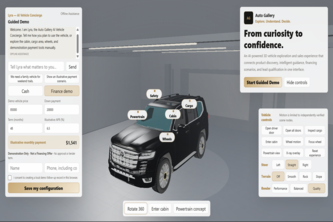
Auto Gallery is a self-reported 3D vehicle discovery experience built using AI-assisted engineering tools (Codex, GPT-5.6), React, Three.js, and static web deployment. It aims to transform static online car listings into an immersive, interactive showroom where users can explore features, evaluate affordability, and express interest without leaving the platform.
What changed
The project evolved from a conceptual idea — “What if an online vehicle listing could guide a customer like a real showroom consultant?” — into a functional prototype that demonstrates 3D vehicle interaction, guided demos, offline assistance, and illustrative financing. It was built in hours using AI tools and optimized for browser delivery.
Single most important open question
Is there evidence of traction, revenue, or customer adoption beyond the author's own development and submission to a hackathon?
What The Product Actually Is
The description states that Auto Gallery is an interactive 3D vehicle discovery and sales-assistance experience led by Lyra, an AI Vehicle Concierge concept. It allows users to:
- Explore and rotate a 3D vehicle.
- Open and close doors.
- Enter and inspect the cabin.
- Observe steering and wheel demonstrations.
- Inspect off-road mode, cargo area, and conceptual powertrain.
- Calculate illustrative monthly payments.
- Save demo configurations locally.
- Run a Guided Demo.
- Receive rule-based offline assistance.
It is built with React, Vite, Three.js, JavaScript, glTF assets, Meshopt optimization, and deployed as a static web application. The original model was reduced from 1.89 GB to 14.4 MB for performance.
Inference The product is not a full-fledged CRM or inventory system but a front-end experience layer focused on user engagement and education within the vehicle sales funnel.
Positioning & Claim Evolution
The author claims Auto Gallery turns static car listings into an AI-guided 3D showroom, aiming to help customers explore features, understand vehicles, and evaluate affordability in one immersive journey.
It positions itself as a digital transformation of traditional online vehicle browsing, moving away from "a digital brochure" toward a more engaging, guided experience.
Inference The positioning reflects an intent to improve customer engagement and decision-making during the pre-purchase phase. However, there is no evidence that this has been tested in real-world sales environments or validated with actual users beyond the hackathon submission.
Target Customer & ICP
The description states that Auto Gallery targets customers who are shopping for vehicles online, particularly those who currently move between static images, specification tables, finance calculators, and contact forms.
It is designed to help users explore features, understand vehicle capabilities, and evaluate affordability — suggesting a focus on potential buyers in the early stages of vehicle selection.
Inference The ICP likely includes car dealerships or online car marketplaces, though no specific customer names or use cases are mentioned. The product is positioned to support sales follow-up and education, not direct sales conversion.
Business Model & Pricing Evidence
There is no evidence of pricing, revenue models, or monetization strategies in the description.
The author mentions that future versions may connect to CRM systems, lender data, and analytics — but no current business model is described.
Inference The project appears to be a proof-of-concept prototype, not yet monetized. The business model remains unestablished.
Technical & Delivery Signals
Auto Gallery was built using:
- Frontend stack: React, Vite, Three.js, JavaScript, WebGL
- AI tools: Codex, GPT-5.6
- Asset handling: glTF, Meshopt optimization
- Deployment: Static web deployment (Cloudflare Pages)
- Performance: Reduced model size from 1.89 GB to 14.4 MB
It uses a deterministic Guided Demo and rule-based offline assistance, avoiding live API dependencies due to reliability concerns.
Inference The technical approach is lightweight, optimized for browser delivery, and relies on AI for architecture and interaction logic. It avoids external dependencies for stability.
Traction & Maturity Signals
There is no evidence of traction, customers, or adoption beyond the author’s own development and hackathon submission.
The project was built in hours using AI tools, passed 22 automated tests, and underwent security scans — but no real-world usage data, user feedback, or performance metrics are provided.
Inference This is a prototype, not a product with market traction. The maturity level is early-stage development.
Competitive Context
The author does not provide any information about competitors or the competitive landscape.
No mention of existing 3D vehicle visualization tools, CRM integrations, or digital showroom platforms is included.
Inference There is no evidence of competitive analysis or positioning against other players in the automotive digital experience space.
Open Questions & Risks
- No revenue or customer data: The project is unproven in a commercial context.
- Prototype-only: No evidence of production use, scaling, or long-term viability.
- AI dependency with limited reliability: While AI was used to accelerate development, the final product uses deterministic logic due to live API unreliability — suggesting a lack of robustness in real-world deployment.
- No monetization strategy: The business model is undefined.
- Self-reported only: All claims are unverified and based on author’s own account.
Inference The project is at a very early stage, with no evidence of commercial traction or sustainable business model. It may be a useful experiment but lacks commercial viability indicators.
Questions the description leaves open
- What is the intended use case for Auto Gallery beyond the hackathon prototype?
- Has there been any testing with real users or dealerships?
- Are there plans to integrate with CRM, inventory systems, or financing platforms?
- How does the team plan to monetize this product?
- What are the long-term technical and business scalability considerations?
- Is there a roadmap for moving from deterministic demos to live AI integrations?
Overall Assessment
Not evidenced: There is no evidence of revenue, customers, or traction beyond the author’s own development.
The project is described as a proof-of-concept prototype, built quickly using AI tools and optimized for browser delivery. It has not been validated in real-world use cases or commercial environments.
Confidence level: Low — based on self-reported, unverified evidence only.
Assessment:
Auto Gallery is an early-stage idea with potential for further development but lacks any commercial due-diligence signals. It should be considered a conceptual experiment, not a product ready for investment or partnership.
User Stories BotA demo video on every pull request
Get a demo video on every new feature
GitHub App that watches your pull requests and records a narrated, captioned demo.
Save time on demo prep and make informed decisions faster with a video walkthrough of every new feature.
Source
Submitted to the OpenAI 2026 hackathon on Devpost. Project home on Devpost. Back to the full gallery on Devpost.
This competitive analysis was produced by top-founders.com (opens in a new tab)
Generated by a language model from this project's public Devpost page — its tagline, the author's own write-up and any built-with tags listed there — as captured in August 2026. Short quotations are the author's words. It is an opinion on the idea as a business, not on the people behind it, and it reflects the description as published then. If the project has moved on, request a correction below. The analysis is not independent research and contains no verified traction, revenue or customer data.
An independent guide by KFG International LLC — not affiliated with, endorsed by, or connected to Devpost or OpenAI.