

Archive position — measured, not model output
0 likes on Devpost
2,263 of the 7,850 archived projects have more likes, and 5,587 share exactly 0 — so this project's #6,742 place in the like-ranked listing is a tie-break inside that group, not a ranking.
Projects (log scale)
Likes on Devpost. ▲ marks this project's group.
Show the figures
| Likes | Projects | Share of archive |
|---|---|---|
| 0 | 5,587 | 71.2% |
| 1 | 1,758 | 22.4% |
| 2 | 284 | 3.6% |
| 3–4 | 132 | 1.7% |
| 5–9 | 75 | 1.0% |
| 10+ | 14 | 0.2% |
 User Stories BotA demo video on every pull request
Get a demo video on every new feature
GitHub App that watches your pull requests and records a narrated, captioned demo.
Save time on demo prep and make informed decisions faster with a video walkthrough of every new feature.
Executive Summary
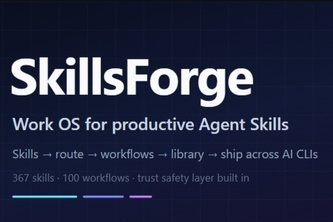
SkillsForge is described as an AI CLI plugin that acts as a "Work OS for Agent Skills", aiming to improve agent productivity by routing skills and workflows, shrinking context, and enabling multi-host installation across various AI CLIs (e.g., Claude, Cursor, Codex). It includes a local skill library with 499 skills, 28 packs, and 100 dry-run workflows, along with compact CLI operators like sf map, sf slim, and sf digest. The system supports validation, packaging, and receipts to enhance safety and trust. It is built as a Node.js 20 ESM developer tool with a local HTML UI and MCP server.
The description states that SkillsForge is not just another prompt folder but a structured system for managing agent skills and workflows. It emphasizes local-first design, no cloud dependencies, and cross-host compatibility. The project was submitted to the OpenAI 2026 hackathon by one developer (Tlkh201313).
Key open question: Is there evidence of real-world usage or adoption of SkillsForge beyond its author's claims? The description does not indicate any revenue, customers, or traction.
What The Product Actually Is
The description states that SkillsForge is a Work OS for Agent Skills, designed to help AI agents:
- Pick the right skill or workflow for a task
- Use a local skill library with 499 skills, 28 packs, 11 profiles, and 100 dry-run workflows
- Reduce noisy terminal output using compact CLI commands (
sf map,sf slim,sf digest, etc.) - Operate across multiple AI CLIs (Codex, Claude, Code, Cursor, OpenCode, ZCode, Hermes, Gemini)
- Stay safer with validation, packaging, and receipts
- Access a local HTML library UI and AI-readable index
It is built as a Node.js 20 ESM developer tool, including:
- A bundled CLI skill catalog
- Workflow engine
- Local library UI
- MCP server
- Multi-host installer
The system uses skillsforge.json sidecars for routing capability and trust metadata, and supports local library building that indexes repo skills, user skills, plugin-cache, and host-specific roots.
Inference: The product is a developer tool aimed at improving AI agent workflows through structured skill management and context reduction. It is not a commercial SaaS offering but a CLI-based system for developers to use in their own environments.
Positioning & Claim Evolution
The description states that SkillsForge was built because "agent productivity isn’t just about throwing more prompts at the model". The author positions it as an alternative to existing tools like Claude, Code, or Superpowers-style plugins, which they claim "just dump more skills into one host."
The core positioning is:
- A cross-CLI Work OS
- A system that routes the right skill and workflow
- A tool that shrinks context with map/slim/digest
- A system that ships with validate→package→receipts
It is described as a local-first, no-cloud dependency solution that enables agents to be faster without blowing up prompts or wasting tokens.
Inference: The positioning evolved from a hackathon project into a structured tool for agent productivity, but the description does not indicate any prior version or evolution beyond this self-reported iteration.
Target Customer & ICP
The description states that SkillsForge is built for AI developers and agent users, particularly those working with AI CLIs like Claude, Cursor, Codex, etc. It targets:
- Developers who use AI coding agents
- Users who want to improve agent performance by reducing context noise and increasing skill routing accuracy
- Teams or individuals looking for safer, reusable, and organized skill packs
It is described as a developer tool, not a commercial product for end-users.
Inference: The ICP is likely early-stage AI developers or advanced users of AI agents who are interested in systematizing their workflows. No evidence of specific personas or customer segments beyond this general description.
Business Model & Pricing Evidence
The description does not provide any information about pricing, monetization, or business model.
Not evidenced
Technical & Delivery Signals
The project is built using:
- Node.js 20 ESM
- A bundled CLI skill catalog
- A workflow engine
- A local library UI
- An MCP server
- A multi-host installer
It supports:
- Local-first design
- No heavy frontend framework
- No cloud dependencies
- A single-file local HTML dashboard plus JSON index
The system includes:
- 499 skills, 28 packs, 11 profiles
- 100 dry-run workflows
- Compact CLI operators (
sf map,sf slim,sf digest, etc.) - Trust layer with validation, packaging, and receipts
- A thin MCP server for routing, lookup, settings, quality checks, and workflows
Inference: The technical stack is minimal and developer-focused. It appears to be a prototype or early-stage tool, not a commercial-grade product.
Traction & Maturity Signals
The description states that:
- It was submitted to the OpenAI 2026 hackathon
- It includes 499 skills, 28 packs, 11 profiles, and 100 dry-run workflows
- It has a local HTML library UI and an AI-readable index
- It supports multi-host install with clear fidelity boundaries
- It has 98 specialist agent roles and 135 command shims
However, there is no evidence of revenue, customers, user adoption, or traction beyond the hackathon submission.
Not evidenced
Competitive Context
The description states that SkillsForge is not like existing tools such as Claude Code or Superpowers-style plugins, which it claims "just dump more skills into one host."
It positions itself as a system that:
- Routes skills and workflows
- Shrinks context
- Provides safety gates
- Enables multi-host compatibility
No specific competitors are named, but the author implies that current tools lack structure, trust, or cross-platform support.
Inference: The competitive landscape is not clearly defined. It appears to be a niche tool for developers working with AI agents, and there is no indication of direct competition beyond general agent tooling.
Open Questions & Risks
- No evidence of traction or adoption: The project was submitted to a hackathon and has no known users or customers.
- Unverified claims: All features and capabilities are self-reported without independent validation.
- Single developer team: Only one member (Tlkh201313) is listed, which may limit scalability or long-term maintenance.
- No commercial model: No indication of how the tool will be monetized or distributed beyond its current form.
- Unclear user value proposition: While described as improving agent performance, no real-world data or use cases are provided.
Questions the description leaves open
- What is the actual utility of SkillsForge in real AI coding sessions? Is there any evidence of improved agent performance?
- How does it handle trust and validation in practice? Are there any real-world examples of skills being validated or rejected?
- What are the limitations of multi-host support, and how do they impact usability?
- Has there been any feedback from users beyond the author’s own testing?
- Is there a plan to scale beyond the current hackathon prototype, and what would that look like?
Overall Assessment
The description states that SkillsForge is a developer tool for AI agents, built as a Node.js CLI plugin with local-first design and multi-host support. It is described as a system that routes skills, shrinks context, and improves safety through validation and receipts.
However, the project has:
- No revenue
- No customers
- No traction or adoption beyond its hackathon submission
- No commercial model or monetization strategy
Assessment: The project is an early-stage prototype with strong technical ambition but no demonstrated commercial viability or market traction. It may be a promising idea for future development, but it is not ready for investment or partnership at this stage.
User Stories BotA demo video on every pull request
Get a demo video on every new feature
GitHub App that watches your pull requests and records a narrated, captioned demo.
Save time on demo prep and make informed decisions faster with a video walkthrough of every new feature.
Source
Submitted to the OpenAI 2026 hackathon on Devpost. Project home on Devpost. Back to the full gallery on Devpost.
This competitive analysis was produced by top-founders.com (opens in a new tab)
Generated by a language model from this project's public Devpost page — its tagline, the author's own write-up and any built-with tags listed there — as captured in August 2026. Short quotations are the author's words. It is an opinion on the idea as a business, not on the people behind it, and it reflects the description as published then. If the project has moved on, request a correction below. The analysis is not independent research and contains no verified traction, revenue or customer data.
An independent guide by KFG International LLC — not affiliated with, endorsed by, or connected to Devpost or OpenAI.