

Archive position — measured, not model output
0 likes on Devpost
2,263 of the 7,850 archived projects have more likes, and 5,587 share exactly 0 — so this project's #2,815 place in the like-ranked listing is a tie-break inside that group, not a ranking.
Projects (log scale)
Likes on Devpost. ▲ marks this project's group.
Show the figures
| Likes | Projects | Share of archive |
|---|---|---|
| 0 | 5,587 | 71.2% |
| 1 | 1,758 | 22.4% |
| 2 | 284 | 3.6% |
| 3–4 | 132 | 1.7% |
| 5–9 | 75 | 1.0% |
| 10+ | 14 | 0.2% |
 User Stories BotA demo video on every pull request
Get a demo video on every new feature
GitHub App that watches your pull requests and records a narrated, captioned demo.
Save time on demo prep and make informed decisions faster with a video walkthrough of every new feature.
Executive Summary
What the company appears to be
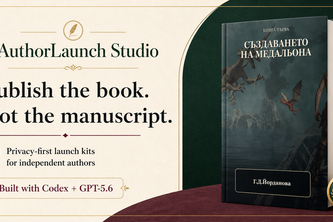
AuthorLaunch Studio is a self-reported tool for publishing books, with a focus on transforming manuscripts into publishable content. It is presented as a solution for authors who want to streamline their publishing journey, particularly in the transition from draft to final book.
What changed
The project was submitted to the OpenAI 2026 hackathon and is described as a tool built using AI technologies such as Codex, GPT, and Next.js. The author states that it aims to help authors publish books, not manuscripts — suggesting an emphasis on content refinement or automation.
Single most important open question
What specific functionality does AuthorLaunch Studio offer for transforming manuscripts into published books? The description lacks clarity on how the tool works, what it automates, or how it differs from existing publishing platforms.
What The Product Actually Is
The description states that AuthorLaunch Studio is a tool for publishing books. It is described as a solution that helps authors "publish the book. Not the manuscript." This implies a focus on transforming raw content into a final, publishable format.
However, there is no evidence of what specific features or processes are involved in this transformation. The author does not describe how the tool works, what it automates, or what output it produces.
Evidence
- The project name and tagline suggest a publishing tool.
- No further detail on functionality is provided.
Inference The product appears to be AI-powered, given the use of technologies like GPT and Codex. However, this is an inference from technology tags and not a stated feature.
Positioning & Claim Evolution
The tagline “Publish the book. Not the manuscript.” is a self-reported claim about the tool’s purpose. It positions AuthorLaunch Studio as a service that helps authors move beyond writing to publishing — implying a focus on content refinement or automation.
There is no evidence of prior positioning, evolution of claims, or marketing history. The description only includes the tagline and no narrative around how the product’s value proposition has developed.
Evidence
- Tagline: “Publish the book. Not the manuscript.”
- No additional claim evolution or branding history provided.
Target Customer & ICP
The author states that AuthorLaunch Studio is for authors who want to publish books. The description does not specify whether it targets self-published authors, traditional publishers, or a specific genre or audience.
There is no evidence of customer segmentation, buyer personas, or ideal customer profile (ICP) beyond the general category of “authors.”
Evidence
- The tool is described as for authors.
- No further detail on target customer type or segment.
Business Model & Pricing Evidence
The description does not include any information about pricing, monetization strategy, or business model. There is no mention of whether the tool is free, subscription-based, one-time purchase, or offered via another revenue mechanism.
Evidence
- No pricing or business model details provided.
Technical & Delivery Signals
The author declares that the project was built using technologies such as:
- Codex
- GPT (version 5.6)
- JSON-LD
- Next.js
- OpenAI Sites
- Python
- React
- Schema.org
- TypeScript
- Vinext
These technologies suggest an AI-powered, web-based tool with a frontend built in React and backend or automation using OpenAI tools.
Evidence
- Technology stack is listed by the author.
- No evidence of delivery mechanism (e.g., SaaS, API, CLI) or deployment details.
Traction & Maturity Signals
There is no evidence of traction, such as:
- Customers
- Revenue
- Usage metrics
- Product adoption
- User feedback
- Product maturity indicators
The project was submitted to a hackathon and has no other signs of development or market presence.
Evidence
- Submitted to OpenAI 2026 hackathon.
- No evidence of product use, customers, or revenue.
Competitive Context
There is no evidence of competitive analysis or awareness of existing publishing tools. The description does not mention competitors or how AuthorLaunch Studio differentiates itself from them.
Evidence
- No mention of competitors or market positioning.
- No indication of differentiation strategy.
Open Questions & Risks
- Lack of clarity on functionality: The tool’s purpose and features are not clearly defined.
- No traction or product maturity: Submitted to a hackathon, no evidence of real-world use or development.
- Unverified claims: All descriptions are self-reported and unverified.
- Unclear business model: No indication of how the product will generate revenue.
Evidence
- Thin description with no functional or commercial detail.
- No evidence of prior development or customer validation.
Questions the description leaves open
- What specific transformation does AuthorLaunch Studio perform on manuscripts to turn them into publishable books?
- How does the tool use AI (e.g., Codex, GPT) in its process?
- Who are your target users, and how do you plan to reach them?
- What is your monetization strategy or business model?
- Are there any existing customers or early adopters of this product?
- How does AuthorLaunch Studio differ from other publishing tools or platforms?
Overall Assessment
Not evidenced.
There is no evidence to support a conclusion on whether AuthorLaunch Studio is a viable investment or partnership opportunity. The description lacks key commercial signals such as revenue, traction, customer validation, or clear product functionality.
The project appears to be in an early stage, possibly a hackathon prototype, with no indication of product-market fit or scalability.
Evidence
- No evidence of revenue, customers, or market traction.
- No clear commercial viability or business model.
- Product is described as a concept, not a functioning tool.
User Stories BotA demo video on every pull request
Get a demo video on every new feature
GitHub App that watches your pull requests and records a narrated, captioned demo.
Save time on demo prep and make informed decisions faster with a video walkthrough of every new feature.
Source
Submitted to the OpenAI 2026 hackathon on Devpost. Project home on Devpost. Back to the full gallery on Devpost.
This competitive analysis was produced by top-founders.com (opens in a new tab)
Generated by a language model from this project's public Devpost page — its tagline and any built-with tags listed there, since the author published no write-up — as captured in August 2026. Short quotations are the author's words. It is an opinion on the idea as a business, not on the people behind it, and it reflects the description as published then. If the project has moved on, request a correction below. The analysis is not independent research and contains no verified traction, revenue or customer data.
An independent guide by KFG International LLC — not affiliated with, endorsed by, or connected to Devpost or OpenAI.