

Archive position — measured, not model output
0 likes on Devpost
2,263 of the 7,850 archived projects have more likes, and 5,587 share exactly 0 — so this project's #6,741 place in the like-ranked listing is a tie-break inside that group, not a ranking.
Projects (log scale)
Likes on Devpost. ▲ marks this project's group.
Show the figures
| Likes | Projects | Share of archive |
|---|---|---|
| 0 | 5,587 | 71.2% |
| 1 | 1,758 | 22.4% |
| 2 | 284 | 3.6% |
| 3–4 | 132 | 1.7% |
| 5–9 | 75 | 1.0% |
| 10+ | 14 | 0.2% |
 User Stories BotA demo video on every pull request
Get a demo video on every new feature
GitHub App that watches your pull requests and records a narrated, captioned demo.
Save time on demo prep and make informed decisions faster with a video walkthrough of every new feature.
Executive Summary
Company: SkillForge
Self-reported basis: The description is entirely self-reported and unverified; it comes from a Devpost submission for the OpenAI 2026 hackathon. No external corroboration exists.
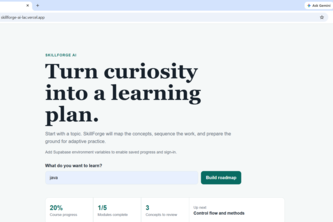
What it appears to be: A learning platform that generates AI-powered educational roadmaps, quizzes, and tutoring for programming languages, using GPT-5.6 and Next.js.
What changed: The project was built as a hackathon submission with no evidence of prior development or traction.
Commercial due-diligence read: The author states the product is functional but not yet persistent; it is unclear whether this is a prototype or a working MVP. The lack of revenue, customers, or adoption data makes it impossible to assess commercial viability.
What The Product Actually Is
The description states that SkillForge:
- Takes in a programming language (e.g., C) and generates a roadmap.
- Includes a dashboard, weakspot analysis, quiz, and AI tutor.
- Uses GPT-5.6 via the OpenAI API to generate structured content.
- Is built with Next.js, TypeScript, and Codex (GPT-5.6).
- Has three separate API calls to GPT-5.6: one for roadmap generation, one for quiz creation, and one for AI tutoring.
- Provides mock data fallback in case of API errors.
Inference: The product appears to be a proof-of-concept or prototype built as part of a hackathon. It is not evidenced to have any production features or persistent storage.
Positioning & Claim Evolution
The author states:
- Tagline: “Turn curiosity into a learning plan.”
- Inspiration: To provide users with a roadmap, quiz, and weakspot analysis.
- The product claims to offer a full-cycle learning experience from roadmap to AI tutor.
Inference: This is a self-positioned educational tool for programming learners. It does not appear to have evolved from an earlier version or market-tested idea; it is presented as a new concept built in a short timeframe.
Target Customer & ICP
The description states:
- The product targets users learning programming languages.
- It generates content based on input like “C” language.
- It includes dashboard, quiz, and AI tutor features.
Inference: The target customer is likely self-taught or beginner-to-intermediate programmers seeking structured learning paths. No evidence of segmentation or specific persona data.
Business Model & Pricing Evidence
The description does not state:
- Any pricing model.
- Revenue streams.
- Monetization strategy.
- Subscription or usage-based models.
Not evidenced: There is no indication of how the product would generate revenue or whether it has a business model in place.
Technical & Delivery Signals
The description states:
- Built with Next.js (App Router), TypeScript, and GPT-5.6.
- Uses OpenAI API with JSON-schema output formatting.
- Three separate API calls for roadmap, quiz, and tutor.
- Graceful degradation to mock data on API failure.
- Uses Codex (GPT-5.6 Terra) for development assistance.
- Supabase schema is scaffolded but not enabled.
Inference: The technical stack suggests a modern web application with AI integration. However, the product is presented as a prototype or demo and lacks persistent storage or full functionality.
Traction & Maturity Signals
The description states:
- It was built for a hackathon.
- No evidence of revenue, customers, or adoption.
- Supabase persistence is scaffolded but disabled.
- The team size is 1 (arsabashir Bashir).
Not evidenced: There are no signs of traction, user engagement, or product maturity beyond the hackathon submission.
Competitive Context
The description does not state:
- Any competitors.
- Market positioning relative to existing tools.
- How SkillForge differentiates from other learning platforms or AI tutors.
Not evidenced: No competitive analysis is provided. The author does not reference similar products or market gaps.
Open Questions & Risks
- Prototype only: The product is described as a hackathon submission with no evidence of production readiness.
- No persistence: Supabase integration is scaffolded but disabled, suggesting the app is non-persistent.
- Unverified claims: All features are self-reported and untested in real-world conditions.
- Single founder: One-person team may limit development velocity or scalability.
- AI dependency: Heavy reliance on GPT-5.6 and OpenAI API introduces risk of rate limits, cost, or availability.
Questions the description leaves open
- What is the current state of the product beyond the hackathon demo?
- Are there any plans to enable persistent storage (e.g., Supabase)?
- How does the team plan to monetize this product?
- Has the product been tested with real users or in a production environment?
- What are the long-term plans for scaling or expanding beyond the current features?
Overall Assessment
The description states that SkillForge is a hackathon submission with no evidence of traction, revenue, or customer adoption.
Assessment: Not evidenced as a viable investment or partnership opportunity at this stage. It is a prototype with no demonstrated commercial potential or market validation. The product’s functionality is limited to a demo and lacks persistence, monetization, or scalability features.
User Stories BotA demo video on every pull request
Get a demo video on every new feature
GitHub App that watches your pull requests and records a narrated, captioned demo.
Save time on demo prep and make informed decisions faster with a video walkthrough of every new feature.
Source
Submitted to the OpenAI 2026 hackathon on Devpost. Project home on Devpost. Back to the full gallery on Devpost.
This competitive analysis was produced by top-founders.com (opens in a new tab)
Generated by a language model from this project's public Devpost page — its tagline, the author's own write-up and any built-with tags listed there — as captured in August 2026. Short quotations are the author's words. It is an opinion on the idea as a business, not on the people behind it, and it reflects the description as published then. If the project has moved on, request a correction below. The analysis is not independent research and contains no verified traction, revenue or customer data.
An independent guide by KFG International LLC — not affiliated with, endorsed by, or connected to Devpost or OpenAI.