

Archive position — measured, not model output
0 likes on Devpost
2,263 of the 7,850 archived projects have more likes, and 5,587 share exactly 0 — so this project's #6,731 place in the like-ranked listing is a tie-break inside that group, not a ranking.
Projects (log scale)
Likes on Devpost. ▲ marks this project's group.
Show the figures
| Likes | Projects | Share of archive |
|---|---|---|
| 0 | 5,587 | 71.2% |
| 1 | 1,758 | 22.4% |
| 2 | 284 | 3.6% |
| 3–4 | 132 | 1.7% |
| 5–9 | 75 | 1.0% |
| 10+ | 14 | 0.2% |
 User Stories BotA demo video on every pull request
Get a demo video on every new feature
GitHub App that watches your pull requests and records a narrated, captioned demo.
Save time on demo prep and make informed decisions faster with a video walkthrough of every new feature.
Executive Summary
Project: Skein
Self-reported basis: The description is entirely from the author's own submission to the OpenAI 2026 hackathon on Devpost. It is unverified and contains no third-party corroboration.
Commercial due-diligence read: Skein appears to be a personal productivity tool that uses AI to help users organize scattered interests into actionable next steps. The author describes it as a solo project built during a hackathon, with no evidence of revenue, customers or traction. The positioning is aspirational and unproven. The single most important open question is whether the core value proposition—helping overwhelmed individuals move from paralysis to action—is compelling enough to drive adoption and retention in a crowded personal productivity space.
What The Product Actually Is
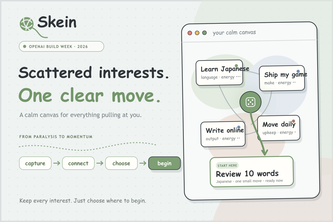
The description states that Skein is a tool that helps users turn scattered interests into one clear next move. It allows users to brain-dump their interests, which are then organized into related categories. When users want to act on an interest, the system helps them define where they want to go, understand their current position, and create a roadmap of achievable steps. The system includes a “decide for me” feature that recommends one meaningful next move based on user inputs like interests, progress, time, energy, and mood.
The author describes it as a visual canvas for parallel interests, with AI (GPT-5.6) working in the background to untangle brain-dumps, recognize relationships between interests, and suggest manageable actions. The product is built using Next.js, Supabase, TailwindCSS, and GPT-5.6.
Evidence: Author's own write-up
Confidence: Low — no independent verification of functionality or user experience
Positioning & Claim Evolution
The author positions Skein as a solution for people overwhelmed by too many meaningful options. It is described as helping users move from paralysis to action, using AI to create clarity without overwhelming them.
The claim evolution appears to be:
- Initial claim: Help people organize their scattered interests into a coherent plan.
- Refined claim: Help people move from decision paralysis to actionable next steps.
- Future claim (inferred): Become a sustainable product with a freemium model.
The author does not reference any competitors or market positioning beyond the general category of personal productivity tools.
Evidence: Author's own write-up
Confidence: Low — no external validation, no competitive differentiation stated
Target Customer & ICP
The description states that Skein is for “multi-passionate people” who are overwhelmed by too many meaningful options. It is designed to help users who want to learn new skills, build products, write online, or improve their health but struggle with decision fatigue.
It is not clear if the author has identified a specific ICP beyond this broad category of individuals feeling overwhelmed by choices.
Evidence: Author's own write-up
Confidence: Low — no segmentation or customer validation
Business Model & Pricing Evidence
The author mentions that Skein could become a sustainable product through a freemium model. The core local canvas would remain accessible, while paid features might include cloud sync, richer AI guidance, and advanced context materials.
There is no evidence of pricing tiers, monetization strategy, or revenue model beyond this speculative future state.
Evidence: Author's own write-up
Confidence: Low — no actual pricing or monetization data
Technical & Delivery Signals
Skein was built solo during OpenAI Build Week using Codex as a product, design, and engineering partner. The technology stack includes GPT-5.6, Next.js, Supabase, and TailwindCSS.
The author notes that the biggest technical challenge was designing an experience for overwhelmed users without making the product itself overwhelming. They simplified the interface, shortened language, and used progressive interactions to reduce cognitive load.
Evidence: Author's own write-up
Confidence: Low — no independent verification of delivery or technical architecture
Traction & Maturity Signals
There is no evidence of traction, revenue, customers, or adoption beyond the author’s own description. The project was submitted as a hackathon entry and has not yet been released to the public.
The author states that the next step is to release Skein as a public beta, but no timeline or progress toward this is given.
Evidence: Author's own write-up
Confidence: Very low — no traction data
Competitive Context
The description does not mention any competitors or existing solutions in the personal productivity space. The author does not reference similar tools or how Skein differentiates from them.
Evidence: Author's own write-up
Confidence: Low — no competitive analysis
Open Questions & Risks
- Unproven value proposition: The core idea of helping people move from paralysis to action is untested and lacks evidence of market demand.
- Solo development: The project was built by a single person, which raises questions about scalability, long-term maintenance, and feature depth.
- No monetization strategy: While the author speculates about freemium, there is no concrete plan or evidence of revenue generation.
- Lack of customer validation: No evidence of user testing, feedback, or real-world usage beyond the author’s own experience.
- AI dependency: The product relies heavily on GPT-5.6, which may not be available or reliable in a production environment.
Evidence: Author's own write-up
Confidence: Low — no external validation
Questions the description leaves open
- What specific user problems are you solving, and how do you know these problems are significant?
- How many people have you tested this with, and what feedback did you get?
- What is your plan for monetization beyond the freemium model?
- How do you intend to scale beyond solo development?
- What are the key assumptions in your product design, and how will you test them?
Overall Assessment
Assessment: Not evidenced — no data on traction, revenue, or customer validation exists. The project is described as a hackathon submission with no commercial evidence.
The author’s own description indicates that Skein is a personal productivity tool built to help users move from decision paralysis to action. It is not clear whether this idea has sufficient market demand or if the product can be scaled beyond a solo developer. The lack of any revenue, customer data, or competitive analysis makes it difficult to assess its viability as an investment or partnership opportunity.
Confidence: Very low — no evidence of commercial traction or validation
User Stories BotA demo video on every pull request
Get a demo video on every new feature
GitHub App that watches your pull requests and records a narrated, captioned demo.
Save time on demo prep and make informed decisions faster with a video walkthrough of every new feature.
Source
Submitted to the OpenAI 2026 hackathon on Devpost. Project home on Devpost. Back to the full gallery on Devpost.
This competitive analysis was produced by top-founders.com (opens in a new tab)
Generated by a language model from this project's public Devpost page — its tagline, the author's own write-up and any built-with tags listed there — as captured in August 2026. Short quotations are the author's words. It is an opinion on the idea as a business, not on the people behind it, and it reflects the description as published then. If the project has moved on, request a correction below. The analysis is not independent research and contains no verified traction, revenue or customer data.
An independent guide by KFG International LLC — not affiliated with, endorsed by, or connected to Devpost or OpenAI.