

Archive position — measured, not model output
0 likes on Devpost
2,263 of the 7,850 archived projects have more likes, and 5,587 share exactly 0 — so this project's #6,733 place in the like-ranked listing is a tie-break inside that group, not a ranking.
Projects (log scale)
Likes on Devpost. ▲ marks this project's group.
Show the figures
| Likes | Projects | Share of archive |
|---|---|---|
| 0 | 5,587 | 71.2% |
| 1 | 1,758 | 22.4% |
| 2 | 284 | 3.6% |
| 3–4 | 132 | 1.7% |
| 5–9 | 75 | 1.0% |
| 10+ | 14 | 0.2% |
 User Stories BotA demo video on every pull request
Get a demo video on every new feature
GitHub App that watches your pull requests and records a narrated, captioned demo.
Save time on demo prep and make informed decisions faster with a video walkthrough of every new feature.
Executive Summary
What the company appears to be
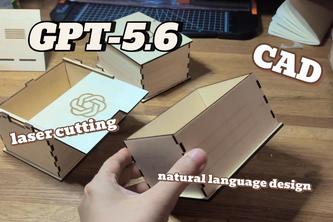
SketchyCut is a self-reported tool that interprets written descriptions and 1–3 reference images to generate SVG cut files for laser-cutting 3D structures. It uses GPT-5.6 for semantic interpretation and deterministic software for precision fabrication planning.
What changed
The author states they built this during OpenAI Build Week, using Codex and GPT-5.6. The project evolved from a conceptual idea into a working prototype that generates both interactive 3D previews and physical cut files — though it currently withholds some exports due to validation concerns.
Single most important open question
Is there any evidence of traction, revenue, or customer adoption beyond the author’s own use case?
Note: This analysis is based entirely on the self-reported project description provided by the caller. No external verification, archived data, or third-party sources are available. All claims are treated as stated by the author and not proven.
What The Product Actually Is
- The description states that SketchyCut turns a written idea and up to three images into an SVG cut file for laser cutting.
- It is described as a system where GPT-5.6 interprets intent, and deterministic code handles precision in fabrication.
- The tool produces:
- Interactive 3D previews
- Exact parts and sheet layouts
- Editable dimensions, material thickness, fit, and decorative treatments
- Bill of materials and assembly instructions
- SVG sheets for laser cutting
- Handoff to xTool Studio
Claim: The system uses AI for interpretation and deterministic software for precision.
Evidence: Described in the "How I built it" section.
Positioning & Claim Evolution
- The author positions SketchyCut as a bridge between idea and physical construction, helping users move from “I wish I could build that” to something they can inspect, cut, and assemble.
- It is framed as solving a gap in existing tools — which can turn images into 2D files but not interpret custom ideas into 3D structures.
- The author emphasizes the combination of generative AI (for interpretation) and deterministic engineering (for precision), calling it a complementary approach.
Claim: SketchyCut helps makers go from idea to physical build.
Evidence: Stated in both inspiration and what-it-does sections.
Target Customer & ICP
- The author describes the target as someone who has bought a laser cutter and wants to make things but lacks CAD experience or joinery knowledge.
- It is implied that users are hobbyists, makers, or DIY enthusiasts with access to laser-cutting tools.
- No explicit segmentation beyond this general user type.
Claim: The tool targets makers with laser cutters who want to build 3D structures without CAD skills.
Evidence: Stated in the inspiration and what-it-does sections.
Business Model & Pricing Evidence
- Not evidenced. There is no mention of pricing, monetization strategy, or business model in the description.
Finding: No evidence of a business model or pricing structure.
Technical & Delivery Signals
- Built with:
- GPT-5.6 (Ultra and Extra High reasoning)
- Codex
- Redis
- TypeScript
- Vercel
- xTool-M2
- The architecture separates AI interpretation from deterministic code.
- Uses a registry of reusable parametric construction operators.
- Geometry is handled with integer-micrometre precision, strict schemas, and deterministic hashes.
- Generates one canonical design document from which all outputs are projected.
Claim: The system uses a hybrid AI-deterministic architecture.
Evidence: Described in "How I built it".
Traction & Maturity Signals
- Not evidenced. No mention of users, customers, revenue, or adoption metrics.
- The author says they are working on physical validation and testing.
- The project is described as a prototype, not yet fully validated for all use cases.
Finding: No traction or maturity signals available.
Competitive Context
- Not evidenced. No mention of competitors or market positioning beyond the stated gap in existing tools.
Finding: No competitive context provided.
Open Questions & Risks
- The system withholds some fabrication exports due to validation concerns (e.g., Hinged and Sliding constructions).
- It is unclear whether the tool is production-ready or still under development.
- The author notes that physical builds exposed limitations in software validation, suggesting a gap between digital and real-world performance.
- No evidence of scalability, API access, or integration capabilities.
Inference: The project may not yet be suitable for commercial or widespread use due to incomplete validation and lack of production readiness.
Questions the description leaves open
- What is the current state of physical testing for the designs generated?
- Are there any plans to expand beyond laser-cutting into other fabrication methods?
- How does the system handle edge cases or ambiguous inputs?
- Is there a roadmap for monetization or commercial deployment?
- Has the author considered how to scale beyond a single-person development effort?
Overall Assessment
- Not evidenced. No financials, traction, or strategic fit data are provided.
- The project is described as a prototype with potential but not yet proven in market or at scale.
Assessment: Based on the self-reported description alone, there is insufficient evidence to assess commercial viability or investment potential. This appears to be an early-stage personal project with no demonstrated traction or business model.
User Stories BotA demo video on every pull request
Get a demo video on every new feature
GitHub App that watches your pull requests and records a narrated, captioned demo.
Save time on demo prep and make informed decisions faster with a video walkthrough of every new feature.
Source
Submitted to the OpenAI 2026 hackathon on Devpost. Project home on Devpost. Back to the full gallery on Devpost.
This competitive analysis was produced by top-founders.com (opens in a new tab)
Generated by a language model from this project's public Devpost page — its tagline, the author's own write-up and any built-with tags listed there — as captured in August 2026. Short quotations are the author's words. It is an opinion on the idea as a business, not on the people behind it, and it reflects the description as published then. If the project has moved on, request a correction below. The analysis is not independent research and contains no verified traction, revenue or customer data.
An independent guide by KFG International LLC — not affiliated with, endorsed by, or connected to Devpost or OpenAI.