

Archive position — measured, not model output
1 like on Devpost
505 of the 7,850 archived projects have more likes, and 1,758 share exactly 1 — so this project's #846 place in the like-ranked listing is a tie-break inside that group, not a ranking.
Projects (log scale)
Likes on Devpost. ▲ marks this project's group.
Show the figures
| Likes | Projects | Share of archive |
|---|---|---|
| 0 | 5,587 | 71.2% |
| 1 | 1,758 | 22.4% |
| 2 | 284 | 3.6% |
| 3–4 | 132 | 1.7% |
| 5–9 | 75 | 1.0% |
| 10+ | 14 | 0.2% |
 User Stories BotA demo video on every pull request
Get a demo video on every new feature
GitHub App that watches your pull requests and records a narrated, captioned demo.
Save time on demo prep and make informed decisions faster with a video walkthrough of every new feature.
Executive Summary
What the company appears to be
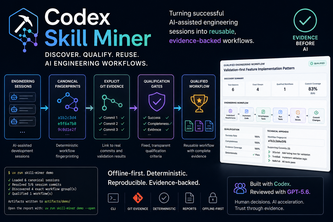
Codex Skill Miner is a self-reported offline-first developer tool built as a Python application that validates and reproduces AI-assisted engineering workflows from Git history. It claims to produce deterministic artifacts (JSON, Markdown, HTML) based on explicit Git SHAs and test evidence, without using LLMs or network dependencies at runtime.
What changed
The project is described as an MVP submitted to the OpenAI 2026 hackathon. It represents a proof-of-concept for extracting reusable engineering knowledge from Codex sessions, with emphasis on reproducibility, determinism, and evidence-based qualification of workflows.
Single most important open question
Is there any evidence that this tool has been used or validated in real-world development environments beyond the hackathon context?
What The Product Actually Is
The description states that Codex Skill Miner:
- Validates canonical session records using Git SHAs
- Resolves only explicit full Git SHAs, ignoring timestamps, branches, and commit messages
- Fingerprints ordered activity sequences with SHA-256
- Groups exact workflow matches
- Applies fixed recurrence, success, and completeness gates
- Produces deterministic artifacts:
evaluation.json,workflow.json,workflow.md,workflow.html - Does not use an LLM or network dependencies at runtime
- Is built as an offline-first Python application
Inference: The tool is a static analysis engine for extracting and validating engineering workflows from Git history, designed to be reproducible and inspectable.
Positioning & Claim Evolution
The description states:
- Codex Skill Miner aims to "discover reusable AI engineering workflows" from successful Codex sessions
- It emphasizes "deterministic Git and test evidence"
- It positions itself as "built for trustworthy workflow reuse"
- The tool is described as "offline-first, reproducible, and built for trustworthy workflow reuse"
Inference: The positioning evolves from a hackathon prototype to a vision of reusable AI engineering knowledge. The claim is that it enables trust in AI-assisted workflows by anchoring them in explicit evidence.
Target Customer & ICP
The description does not state:
- Who the target customer is
- What specific developer or team profile it targets
- Whether it's aimed at individual developers, teams, or enterprises
Not evidenced: No indication of a defined ICP or customer segment.
Business Model & Pricing Evidence
The description states:
- The tool is presented as an MVP for a hackathon
- It is described as a Python application with no runtime LLM or network dependencies
- There is no mention of pricing, monetization, or business model
Not evidenced: No evidence of a business model or pricing structure.
Technical & Delivery Signals
The description states:
- Built as an offline-first Python application
- Uses Python 3.10, Pydantic v2, Typer, Git, SHA-256 fingerprinting, Pytest, Ruff, uv
- Runtime has no network or OpenAI API dependency
- Human–AI collaboration was used for architecture reviews, documentation, and critique
- Milestones were defined with human ownership of research direction and engineering decisions
Inference: The technical stack is minimal and focused on reproducibility. The delivery process involved milestone-based human-AI collaboration.
Traction & Maturity Signals
The description states:
- This is an MVP submitted to the OpenAI 2026 hackathon
- It demonstrates end-to-end workflow using a bundled dataset that judges can reproduce locally in minutes
- It has no revenue, customers, or traction data beyond its own submission
Not evidenced: No evidence of usage, adoption, or traction beyond the hackathon.
Competitive Context
The description states:
- The project is built for "AI engineering workflows"
- It aims to enable "reusable AI engineering skills"
- It references OpenAI Codex and GPT-5.6 as tools used in its development
- No mention of direct competitors or market positioning
Not evidenced: No competitive landscape or differentiation from other tools.
Open Questions & Risks
The description states:
- The tool is built for offline-first, deterministic behavior
- It does not use LLMs or network dependencies at runtime
- It relies on explicit Git SHAs and test evidence
- It was built as an MVP in a hackathon context
Inference: Key risks include:
- Limited real-world validation beyond the hackathon
- No evidence of adoption or usage in production environments
- The tool may not scale to complex, multi-repo workflows without further development
- The focus on deterministic behavior may limit its utility for dynamic or exploratory AI engineering sessions
Questions the description leaves open
- What is the actual use case that drove this project? Was it a specific problem in your own workflow or team?
- How do you plan to extend this MVP into a product usable by others beyond the hackathon context?
- Have you tested this tool with real engineering teams or workflows outside of the demo dataset?
- What are the limitations of the current deterministic approach for broader adoption?
- How do you intend to validate that the workflow artifacts produced are actually reusable in practice?
Overall Assessment
The description states:
- This is an MVP submitted to a hackathon
- It is described as a proof-of-concept with no revenue or traction data
- The tool is built for offline-first, deterministic behavior and evidence-based workflows
Not evidenced: No commercial viability or investment potential can be inferred from the self-reported description alone.
Inference: While the concept of reproducible AI engineering workflows is interesting, there is insufficient evidence to assess whether this project has commercial traction, scalability, or a clear path to market. The tool remains in an early-stage prototype phase with no demonstrated adoption or revenue.
User Stories BotA demo video on every pull request
Get a demo video on every new feature
GitHub App that watches your pull requests and records a narrated, captioned demo.
Save time on demo prep and make informed decisions faster with a video walkthrough of every new feature.
Source
Submitted to the OpenAI 2026 hackathon on Devpost. Project home on Devpost. Back to the full gallery on Devpost.
This competitive analysis was produced by top-founders.com (opens in a new tab)
Generated by a language model from this project's public Devpost page — its tagline, the author's own write-up and any built-with tags listed there — as captured in August 2026. Short quotations are the author's words. It is an opinion on the idea as a business, not on the people behind it, and it reflects the description as published then. If the project has moved on, request a correction below. The analysis is not independent research and contains no verified traction, revenue or customer data.
An independent guide by KFG International LLC — not affiliated with, endorsed by, or connected to Devpost or OpenAI.