

Archive position — measured, not model output
0 likes on Devpost
2,263 of the 7,850 archived projects have more likes, and 5,587 share exactly 0 — so this project's #4,772 place in the like-ranked listing is a tie-break inside that group, not a ranking.
Projects (log scale)
Likes on Devpost. ▲ marks this project's group.
Show the figures
| Likes | Projects | Share of archive |
|---|---|---|
| 0 | 5,587 | 71.2% |
| 1 | 1,758 | 22.4% |
| 2 | 284 | 3.6% |
| 3–4 | 132 | 1.7% |
| 5–9 | 75 | 1.0% |
| 10+ | 14 | 0.2% |
 User Stories BotA demo video on every pull request
Get a demo video on every new feature
GitHub App that watches your pull requests and records a narrated, captioned demo.
Save time on demo prep and make informed decisions faster with a video walkthrough of every new feature.
Executive Summary
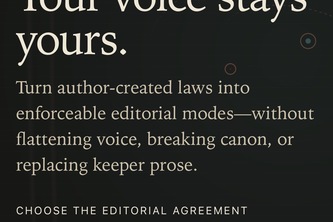
Keeper: Canon-Safe Editorial Workspace is a self-reported author-governed AI workspace built by one individual for long-form writers. The project claims to separate three editorial tasks—Review, Revision, and Generation—while enforcing strict canon protection rules that prevent AI from altering prose without explicit approval. It uses OpenAI APIs (including GPT-5.6) and structured outputs to enforce these rules deterministically.
The author states they built this during a hackathon using Codex for translation of creative processes into product behavior. The system includes a demonstration website, an installable Codex skill, and a change ledger for auditable revisions.
Key commercial due-diligence read
There is no evidence of revenue, customers, or adoption beyond the author’s own description. The project appears to be a proof-of-concept prototype with no demonstrated traction. The single most important open question is whether this concept can scale into a viable product for real authors and publishers.
What The Product Actually Is
The description states that Keeper is an author-governed editorial workspace designed to separate three distinct editorial functions:
- Review: Diagnoses problems and suggests corrections but does not change the manuscript.
- Revision: Applies only exact changes approved by the author.
- Generation: Creates new writing within active canon, but keeps it separate until the author decides whether to include it.
It enforces these roles through canon locks, which protect "keeper prose" and prevent suggestions from silently becoming part of the manuscript. Every accepted revision is recorded in a change ledger.
The system uses deterministic verification to ensure compliance with these rules:
- Review and Generation must preserve the source exactly.
- Revision must match an explicit approved substitution.
- Protected text cannot disappear.
It also includes a public demonstration engine, which is clearly labeled as non-live, and a server-side GPT-5.6 Responses API path using strict Structured Outputs.
Inference: The product appears to be a prototype or MVP built for a hackathon, not yet a commercial offering with real users or monetization.
Positioning & Claim Evolution
The author states that Keeper began from their personal experience as a long-form author, where they needed AI assistance without it rewriting their work. The system was designed to enforce “creative laws” and maintain author authority over prose.
It positions itself as:
- An AI workspace that respects the author’s voice.
- A tool that separates review, revision, and generation to avoid unintended changes.
- A system that never alters prose without approval, using structured outputs and deterministic verification.
The project evolved from an intuitive creative process into a software product through Codex assistance. The author claims this was done by translating their own editorial method into enforceable product behavior.
Inference: The positioning is centered on author control and AI safety, but there is no evidence of market validation or competitive differentiation beyond the author’s personal need.
Target Customer & ICP
The description states that Keeper is built for long-form authors, particularly those working on multi-book stories who want to protect their voice, canon, cultural language, and authority.
It also implies a potential use case in publishing workflows, where authors define project-specific canon, protected language, character laws, and approval rules across entire book series.
However, the author does not name specific customer segments or describe how they would reach them. There is no evidence of:
- Customer personas
- Market size
- Use cases beyond the author’s own experience
- Target industries or verticals
Inference: The ICP appears to be long-form authors and creative writers, but there is no evidence of market research or customer validation.
Business Model & Pricing Evidence
The description does not state anything about:
- Revenue model
- Pricing structure
- Monetization strategy
- Subscription plans or usage fees
It only mentions that the system includes:
- A public demonstration engine
- An installable Codex skill
- A deployable website
There is no indication of how the product would be sold, licensed, or offered to users.
Inference: No business model or pricing evidence is provided. The project appears to be a prototype with no commercialization plan.
Technical & Delivery Signals
The author states that Keeper was built using:
- OpenAI APIs, including GPT-5.6
- Codex
- Structured Outputs and post-validation
- Next.js, React, Python, TypeScript
- A server-side API path
- Automated tests
- A change ledger
It includes a publicly accessible demo, a Codex skill, and a deployable website.
The system uses deterministic verification to enforce editorial rules:
- Review and Generation preserve source text.
- Revision applies only approved substitutions.
- Protected text cannot be altered or removed.
There is no mention of scalability, infrastructure, or production deployment beyond the hackathon prototype.
Inference: The technical stack is evident but limited to a prototype. There is no evidence of production-grade infrastructure or long-term delivery strategy.
Traction & Maturity Signals
The description states that Keeper:
- Was built during a hackathon
- Includes a working responsive website
- Has an installable Codex skill
- Contains automated tests
- Has a change ledger
- Uses deterministic verification
However, there is no evidence of:
- Customers
- Revenue
- Usage metrics
- Product adoption
- Market traction
The author notes that the project was built to demonstrate rules without exposing unpublished material, suggesting it is not yet in production use.
Inference: The product is at a very early stage, likely a prototype or MVP. No traction or maturity signals are evident.
Competitive Context
The description does not mention any competitors or existing solutions in the market for AI-assisted editorial workspaces or canon protection tools.
It does not reference:
- Other AI writing tools
- Editorial platforms
- Content governance systems
- Tools for managing creative workflows
There is no evidence of competitive analysis, market positioning, or differentiation from existing tools.
Inference: No competitive context is provided. The project appears to be a novel concept, but there is no evidence of prior art or market presence.
Open Questions & Risks
- No revenue, customers, or traction: The product is described as a prototype with no commercialization.
- Unproven market demand: The author’s own experience is the only evidence of need.
- Limited technical depth: The system uses structured outputs and deterministic verification, but there is no evidence of scalability or robustness for real-world use.
- Single-founder project: With only one team member, there are concerns about execution capacity.
- No monetization plan: No pricing, licensing, or revenue model is described.
- Self-reported only: All claims are unverified and based on the author’s own account.
Inference: The main risk is that this is a conceptual prototype, not a viable product for market entry or commercial use.
Questions the description leaves open
- What specific long-form writing workflows do you see as the core use cases for Keeper?
- How would you monetize this product if it were to scale beyond a prototype?
- Have you validated your concept with real authors or publishers?
- What are the technical limitations of the current implementation that would prevent scaling?
- How does Keeper handle edge cases where AI-generated content conflicts with canon in unexpected ways?
- Are there any legal or ethical implications of enforcing strict author control over AI-generated content?
Overall Assessment
The project is described as a self-contained prototype built during a hackathon. There is no evidence of:
- Revenue
- Customers
- Product-market fit
- Commercial traction
- Scalable infrastructure or team
It is an author-driven concept, not a commercial product.
Assessment: Not ready for investment or partnership at this stage. It may be a promising idea, but lacks the evidence to support a commercial due-diligence read. The author’s own description indicates that it is a proof-of-concept, not a product in development or production.
User Stories BotA demo video on every pull request
Get a demo video on every new feature
GitHub App that watches your pull requests and records a narrated, captioned demo.
Save time on demo prep and make informed decisions faster with a video walkthrough of every new feature.
Source
Submitted to the OpenAI 2026 hackathon on Devpost. Project home on Devpost. Back to the full gallery on Devpost.
This competitive analysis was produced by top-founders.com (opens in a new tab)
Generated by a language model from this project's public Devpost page — its tagline, the author's own write-up and any built-with tags listed there — as captured in August 2026. Short quotations are the author's words. It is an opinion on the idea as a business, not on the people behind it, and it reflects the description as published then. If the project has moved on, request a correction below. The analysis is not independent research and contains no verified traction, revenue or customer data.
An independent guide by KFG International LLC — not affiliated with, endorsed by, or connected to Devpost or OpenAI.