

Archive position — measured, not model output
0 likes on Devpost
2,263 of the 7,850 archived projects have more likes, and 5,587 share exactly 0 — so this project's #4,774 place in the like-ranked listing is a tie-break inside that group, not a ranking.
Projects (log scale)
Likes on Devpost. ▲ marks this project's group.
Show the figures
| Likes | Projects | Share of archive |
|---|---|---|
| 0 | 5,587 | 71.2% |
| 1 | 1,758 | 22.4% |
| 2 | 284 | 3.6% |
| 3–4 | 132 | 1.7% |
| 5–9 | 75 | 1.0% |
| 10+ | 14 | 0.2% |
 User Stories BotA demo video on every pull request
Get a demo video on every new feature
GitHub App that watches your pull requests and records a narrated, captioned demo.
Save time on demo prep and make informed decisions faster with a video walkthrough of every new feature.
Executive Summary
What the company appears to be
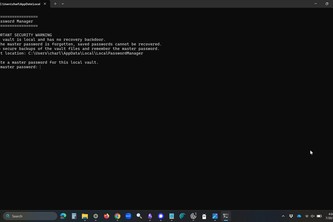
KeepLocal is a self-reported local password manager for Windows, built as a command-line tool in Python by one developer (Charles Cadenhead). It stores encrypted login records locally on the user’s machine and does not connect to any cloud services or AI platforms at runtime. The author states it was developed with help from Codex and GPT-5.6 during development but claims no AI dependency in the final product.
What changed
The project evolved from a simple password generator into a structured prototype with modular code, encryption logic using Fernet and PBKDF2, and support for backups and clipboard operations. It was submitted to the OpenAI 2026 hackathon on Devpost.
Single most important open question
Is there any evidence of actual user adoption or feedback beyond the author’s own experience? The description contains no data about usage, customers, revenue, or market traction — only claims and self-assessment.
What The Product Actually Is
The description states that KeepLocal is a local, encrypted password vault for Windows, built in Python. It allows users to:
- Set a master password
- Save encrypted login records (website/app label, username/email, password, optional note)
- Search, edit, delete entries
- Copy usernames or passwords to clipboard
- Make encrypted local backups
Vault files are stored locally under the user's AppData folder. The app uses Fernet encryption and derives the encryption key from the master password using PBKDF2 with a local salt, without storing keys on disk.
Not evidenced:
- Whether it has a graphical interface (GUI) or only CLI
- If it supports import/export of other formats
- Any integration with Windows OS features beyond AppData
Positioning & Claim Evolution
The author positions KeepLocal as an alternative to online password managers, emphasizing local ownership of data, no cloud storage, and no backdoors. The core claim is that it offers a secure, private solution where even the developer cannot access user data.
Evolution from initial idea:
- Started as a password generator
- Evolved into a structured prototype with modular code
- Developed with AI tools (Codex, GPT-5.6) for design and debugging but not used in runtime
Inference:
The shift from a basic tool to a more robust prototype suggests intent toward usability and scalability — though this is not confirmed by any external metrics or user feedback.
Target Customer & ICP
The author states that the product was inspired by his son’s distrust of online password managers, who used an Excel spreadsheet instead. This implies a target audience of:
- Users who are security-conscious
- People who prefer local solutions over cloud-based ones
- Individuals who want to avoid entrusting sensitive login data to third parties
Not evidenced:
- Specific customer segments or personas
- Market size or demographics
- Competitor analysis or user research
Business Model & Pricing Evidence
The description does not mention any pricing, monetization strategy, or business model. The product is presented as a free open-source tool, built for personal use and submitted to a hackathon.
Inference:
If the project becomes commercialized, it may follow a freemium or one-time purchase model — but no such plans are stated.
Technical & Delivery Signals
The author reports that:
- The app is built in Python
- Uses Fernet encryption and PBKDF2 key derivation
- Stores vaults in the AppData folder
- Does not use AI at runtime
- Was developed with help from Codex and GPT-5.6, but these were used only during development, not in product execution
Not evidenced:
- Code quality or architecture review
- Security audit or penetration testing results
- Scalability or performance benchmarks
- Availability of source code or documentation beyond the write-up
Traction & Maturity Signals
The project is described as a working console prototype submitted to a hackathon. There is no evidence of:
- User adoption or feedback
- Revenue or monetization
- Customer base or market traction
- Product iteration history or roadmap beyond stated future features
Inference:
It appears to be an early-stage development effort, likely not yet in production use by end users.
Competitive Context
The author does not reference competitors directly. However, the positioning implies a role in the local password manager space, which typically includes tools like Bitwarden (self-hosted), KeePass, and 1Password.
Not evidenced:
- Any competitive analysis or differentiation strategy
- Comparison with existing tools
- Market share or usage data
Open Questions & Risks
- No external validation: The entire product is self-reported; no third-party verification of functionality, security, or performance.
- Single developer team: Only one person involved in development raises concerns about long-term maintenance and scalability.
- Limited scope: Currently only a CLI prototype with no GUI or packaging as a Windows executable.
- AI dependency in development but not runtime: While AI helped build the tool, the final product is intentionally offline — this could be misleading if not clearly communicated.
- No user feedback loop: No evidence of real-world usage or iteration based on user input.
Questions the description leaves open
- What specific security vulnerabilities were considered during development?
- How does the app handle edge cases like corrupted vault files or failed backups?
- Has the product been tested by anyone other than the developer?
- Are there plans to support cross-platform use (e.g., macOS, Linux)?
- What is the timeline for adding GUI and executable packaging?
- Is there any intention to monetize this tool in the future?
Overall Assessment
Not evidenced.
The project is described as a personal hackathon submission with no evidence of traction, revenue, or customer base. It is currently a command-line prototype, not yet a commercial product. The author has not indicated any intention to scale or monetize the tool beyond personal use.
Confidence level: Low
This is a self-reported, unverified concept with no external validation or market data. Any investment or partnership decision would require further due diligence into actual usage, security audits, and scalability plans.
User Stories BotA demo video on every pull request
Get a demo video on every new feature
GitHub App that watches your pull requests and records a narrated, captioned demo.
Save time on demo prep and make informed decisions faster with a video walkthrough of every new feature.
Source
Submitted to the OpenAI 2026 hackathon on Devpost. Project home on Devpost. Back to the full gallery on Devpost.
This competitive analysis was produced by top-founders.com (opens in a new tab)
Generated by a language model from this project's public Devpost page — its tagline, the author's own write-up and any built-with tags listed there — as captured in August 2026. Short quotations are the author's words. It is an opinion on the idea as a business, not on the people behind it, and it reflects the description as published then. If the project has moved on, request a correction below. The analysis is not independent research and contains no verified traction, revenue or customer data.
An independent guide by KFG International LLC — not affiliated with, endorsed by, or connected to Devpost or OpenAI.