

Archive position — measured, not model output
0 likes on Devpost
2,263 of the 7,850 archived projects have more likes, and 5,587 share exactly 0 — so this project's #6,732 place in the like-ranked listing is a tie-break inside that group, not a ranking.
Projects (log scale)
Likes on Devpost. ▲ marks this project's group.
Show the figures
| Likes | Projects | Share of archive |
|---|---|---|
| 0 | 5,587 | 71.2% |
| 1 | 1,758 | 22.4% |
| 2 | 284 | 3.6% |
| 3–4 | 132 | 1.7% |
| 5–9 | 75 | 1.0% |
| 10+ | 14 | 0.2% |
 User Stories BotA demo video on every pull request
Get a demo video on every new feature
GitHub App that watches your pull requests and records a narrated, captioned demo.
Save time on demo prep and make informed decisions faster with a video walkthrough of every new feature.
Executive Summary
What the company appears to be
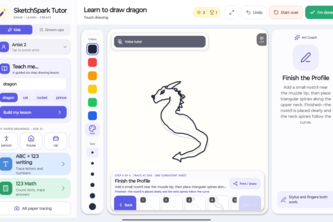
SketchSpark Tutor is a self-reported AI-powered drawing tutor for children, built as a tablet app using GPT-5.6, gpt-image-2, and GPT-Realtime. It claims to see a child's canvas in real time, generate consistent lesson plans and visual guides, and provide voice feedback during drawing.
What changed
The author states that this is a hackathon project built end-to-end with Codex (GPT-5.6), using a structured build process where the AI implemented modules, tested, and committed code. It was submitted to the OpenAI 2026 hackathon.
Single most important open question
Is there any evidence of real-world usage or traction beyond the author's own demonstration?
What The Product Actually Is
The description states that SketchSpark Tutor is a tablet drawing studio where an AI art teacher "sees" the child’s work. It uses:
- GPT-5.6 for lesson planning and vision validation
- gpt-image-2 to render 6-step lessons as one consistent sprite sheet
- GPT-Realtime for voice coaching during drawing
The app is built using React Native, Expo.io, TypeScript, and Cloudflare Workers.
Inference It appears to be a child-focused creative learning tool, designed to guide children through structured drawing tasks with AI feedback. The system integrates real-time canvas observation, lesson generation, and interactive voice coaching.
Positioning & Claim Evolution
The author claims that SketchSpark Tutor addresses a gap in existing art instruction: most tutorials “can show what to do, but it can’t see what the child actually did.” It positions itself as an AI teacher that watches the canvas — a novel framing for digital art education.
Inference This is a self-stated positioning of a personal, family-oriented educational tool. The author does not reference any prior product or market positioning beyond this one-off project.
Target Customer & ICP
The description states that the app is built as a complete family product, with features like:
- Onboarding with age bands
- Voice or text coaching
- Parental-gated settings
- Moderation on free text
- Printable lesson sheets
- Offline states
- Lesson caching
- Save-and-continue
Inference The target customer is likely parents of young children (ages 3–10) who want to support their kids’ drawing development, possibly in the absence of one-on-one instruction.
Business Model & Pricing Evidence
There is no evidence provided about a business model or pricing structure. The description does not mention monetization, subscriptions, or sales channels.
Not evidenced
Technical & Delivery Signals
The author states:
- The app was built using Codex (GPT-5.6) in one session
- Codex implemented modules, tested, and committed code
- The system uses OpenAI APIs, including GPT-5.6 structured outputs, vision, gpt-image-2, and GPT-Realtime over WebSocket
- A thin Cloudflare Worker enforces per-device quotas
- The app supports pressure-sensitive strokes, offline states, lesson caching, and save-and-continue
Inference The technical stack is AI-driven with a focus on real-time interaction and structured outputs. The use of Codex suggests an experimental or early-stage development approach.
Traction & Maturity Signals
There is no evidence of traction, revenue, customers, or adoption beyond the author’s own demonstration. The project was submitted to a hackathon and has no stated user base or usage metrics.
Not evidenced
Competitive Context
The description does not mention any competitors or market context. It does not reference existing drawing apps, AI art tools, or educational platforms for children.
Not evidenced
Open Questions & Risks
- Unverified claims: All features and functionality are self-reported without external validation.
- No traction or revenue: No evidence of real-world usage or monetization.
- Single-person team: The project was built by one person, raising questions about scalability or long-term maintenance.
- Hackathon product: The app is a prototype submitted to a hackathon — not a commercial product.
- AI dependency: Heavy reliance on proprietary APIs (e.g., GPT-5.6) raises concerns about availability and cost.
Questions the description leaves open
- What is the actual user experience like beyond the author’s own use case?
- Has there been any testing with real children or parents?
- Are there plans to monetize, and if so, what model is being considered?
- How would the system scale beyond a single developer?
- What are the technical limitations of relying on GPT-5.6 and other APIs for real-time interaction?
Overall Assessment
This is a self-reported hackathon project with no evidence of traction, revenue, or customer adoption. The author describes an ambitious product concept but provides no data to support its viability or commercial potential.
Confidence: Low
Assessment Not ready for investment or partnership consideration at this stage. This is a proof-of-concept with no demonstrated market fit or business model.
User Stories BotA demo video on every pull request
Get a demo video on every new feature
GitHub App that watches your pull requests and records a narrated, captioned demo.
Save time on demo prep and make informed decisions faster with a video walkthrough of every new feature.
Source
Submitted to the OpenAI 2026 hackathon on Devpost. Project home on Devpost. Back to the full gallery on Devpost.
This competitive analysis was produced by top-founders.com (opens in a new tab)
Generated by a language model from this project's public Devpost page — its tagline, the author's own write-up and any built-with tags listed there — as captured in August 2026. Short quotations are the author's words. It is an opinion on the idea as a business, not on the people behind it, and it reflects the description as published then. If the project has moved on, request a correction below. The analysis is not independent research and contains no verified traction, revenue or customer data.
An independent guide by KFG International LLC — not affiliated with, endorsed by, or connected to Devpost or OpenAI.