

Archive position — measured, not model output
0 likes on Devpost
2,263 of the 7,850 archived projects have more likes, and 5,587 share exactly 0 — so this project's #2,808 place in the like-ranked listing is a tie-break inside that group, not a ranking.
Projects (log scale)
Likes on Devpost. ▲ marks this project's group.
Show the figures
| Likes | Projects | Share of archive |
|---|---|---|
| 0 | 5,587 | 71.2% |
| 1 | 1,758 | 22.4% |
| 2 | 284 | 3.6% |
| 3–4 | 132 | 1.7% |
| 5–9 | 75 | 1.0% |
| 10+ | 14 | 0.2% |
 User Stories BotA demo video on every pull request
Get a demo video on every new feature
GitHub App that watches your pull requests and records a narrated, captioned demo.
Save time on demo prep and make informed decisions faster with a video walkthrough of every new feature.
Executive Summary
Company: Auralis Master Lab
Self-reported basis: The analysis is based entirely on the project description provided by the author — a self-reported write-up submitted to the OpenAI 2026 hackathon on Devpost. No external verification, archived data or third-party sources are available.
What it appears to be: A desktop audio mastering application and companion VST3 plugin for Windows, built with C++20, JUCE, Codex (GPT-5.6), and other tools. The author states it enables independent artists to achieve polished, high-definition sound.
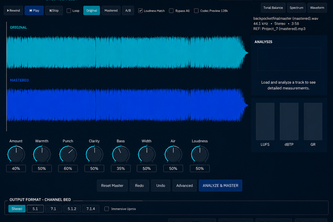
What changed: The project evolved from an idea into a functional desktop audio mastering tool that supports waveform comparison, reference-track matching, loudness control, and export in WAV, FLAC, and MP3 formats. It includes both a standalone app and a VST3 processor.
Single most important open question: Is there evidence of any commercial traction or user feedback beyond the author’s own account?
What The Product Actually Is
The description states that Auralis Master Lab is:
- A Windows desktop audio mastering application
- A companion VST3 processor
- Built with C++20, JUCE, CMake, Codex (GPT-5.6)
- Designed to allow users to:
- Load a song
- Analyze it
- Adjust mastering character
- Compare original and mastered versions
- Export finished masters in WAV, FLAC, or MP3
It also includes features such as:
- Waveform comparison
- Genre-based workflows
- Reference-track matching
- Loudness and A/B comparison controls
- Tonal-balance, spectrum, and waveform views
- LUFS, true-peak, and gain-reduction monitoring
- Stereo and immersive channel-bed options
The author reports that it was built as a modular signal chain, enabling independent testing of warmth, transient shaping, stereo depth, compression, tonal controls, and output processing.
Evidence: Self-reported by the author.
Confidence: Low — no external validation or demonstration of product functionality beyond the author’s own account.
Positioning & Claim Evolution
The author positions Auralis Master Lab as:
- A desktop mastering solution for independent artists
- Aimed at those who want to achieve “polished, high-definition sound”
- An alternative to expensive and slow traditional mastering services
- A tool that provides access to professional-level mastering features without needing a studio or engineer
The project evolved from an idea into a working application, according to the author. It is described as:
- Fast, visual, and easy to use
- Capable of loading real music and exporting finished masters
- Designed with a modular architecture for flexibility and scalability
Evidence: Self-reported by the author.
Confidence: Low — no external claims or market positioning data available.
Target Customer & ICP
The description states that Auralis Master Lab targets:
- Independent artists and producers
- Those who need professional mastering but find traditional services:
- Expensive
- Slow
- Difficult to access
It is implied that the product is aimed at users with some familiarity with digital audio workstations (DAWs) or music production, given its VST3 integration.
Evidence: Self-reported by the author.
Confidence: Low — no explicit customer segmentation or user data provided.
Business Model & Pricing Evidence
There is no evidence in the description of:
- A pricing model
- Revenue streams
- Monetization strategy
- Commercial release plans beyond “a commercial release through Auralis Audio”
The author mentions that the next steps include:
- Installer signing
- Licensing infrastructure
- Commercial release
But no details are given about how or when this will be monetized.
Evidence: Not evidenced.
Confidence: Very low — no indication of business model or pricing.
Technical & Delivery Signals
The author reports:
- Built with C++20, JUCE, CMake, Codex (GPT-5.6)
- Uses a modular signal chain for processing
- Supports:
- Standalone Windows application
- VST3 plugin
- Real-time audio performance
- Export in WAV, FLAC, MP3 formats
- Multichannel and immersive-output options
Codex was used throughout the development process to assist with:
- Code generation and refinement
- Debugging
- Audio-processing behavior
- UI development
- Installer preparation
- Testing workflows
Evidence: Self-reported by the author.
Confidence: Medium — technical details are provided, but no independent verification of performance or stability.
Traction & Maturity Signals
The description states:
- The project was submitted to a hackathon (OpenAI 2026)
- It evolved from an idea into a working commercial-style audio product
- The author is proud of:
- Loading real music
- Processing it
- Comparing original and mastered versions
- Exporting finished audio
There is no evidence of:
- Customers or user feedback
- Revenue or sales data
- Product adoption metrics
- Market traction beyond the author’s own account
Evidence: Self-reported by the author.
Confidence: Very low — no signs of commercial traction.
Competitive Context
The description does not mention any competitors or market positioning relative to existing mastering tools.
It is implied that Auralis Master Lab aims to compete with:
- Traditional mastering services
- Other desktop mastering software (e.g., iZotope, FabFilter, Logic Pro, Reaper)
But no comparison or competitive analysis is provided.
Evidence: Not evidenced.
Confidence: Low — no competitive landscape data.
Open Questions & Risks
Key risks and open questions based on the description:
- No commercial traction or revenue evidence
- Single-person team (Termaine Lee)
- Unverified claims about performance, stability, or usability
- Use of Codex as a development tool — raises questions about whether this is a prototype or a production-ready product
- No mention of licensing, installer signing, or distribution strategy
- No evidence of testing with real users or feedback loops
- No indication of how the product will be monetized or scaled
Evidence: Self-reported by the author.
Confidence: Medium — risks are inferred from lack of data.
Questions the description leaves open
- What is the current state of the product? Is it fully functional, tested, and ready for release?
- Have you conducted any user testing or received feedback from independent artists?
- How do you plan to monetize Auralis Master Lab?
- What are your plans for macOS support and cross-platform compatibility?
- Are there any technical limitations or known issues with real-time audio performance?
- What is the timeline for commercial release?
- Have you considered partnerships or distribution channels?
- How do you plan to handle licensing, installer signing, and software distribution?
Overall Assessment
Assessment: Not evidenced.
The description provides no evidence of:
- Revenue
- Customers
- Traction
- Market validation
- Commercial viability
It is a self-reported project, submitted as part of a hackathon. The author claims to have built a working desktop mastering tool, but there is no independent verification or data on adoption, usage, or performance.
Confidence: Very low — this is a pre-product concept with no demonstrated commercial readiness or traction. It is not yet clear whether it will become a viable product or business.
User Stories BotA demo video on every pull request
Get a demo video on every new feature
GitHub App that watches your pull requests and records a narrated, captioned demo.
Save time on demo prep and make informed decisions faster with a video walkthrough of every new feature.
Source
Submitted to the OpenAI 2026 hackathon on Devpost. Project home on Devpost. Back to the full gallery on Devpost.
This competitive analysis was produced by top-founders.com (opens in a new tab)
Generated by a language model from this project's public Devpost page — its tagline, the author's own write-up and any built-with tags listed there — as captured in August 2026. Short quotations are the author's words. It is an opinion on the idea as a business, not on the people behind it, and it reflects the description as published then. If the project has moved on, request a correction below. The analysis is not independent research and contains no verified traction, revenue or customer data.
An independent guide by KFG International LLC — not affiliated with, endorsed by, or connected to Devpost or OpenAI.