

Archive position — measured, not model output
0 likes on Devpost
2,263 of the 7,850 archived projects have more likes, and 5,587 share exactly 0 — so this project's #2,810 place in the like-ranked listing is a tie-break inside that group, not a ranking.
Projects (log scale)
Likes on Devpost. ▲ marks this project's group.
Show the figures
| Likes | Projects | Share of archive |
|---|---|---|
| 0 | 5,587 | 71.2% |
| 1 | 1,758 | 22.4% |
| 2 | 284 | 3.6% |
| 3–4 | 132 | 1.7% |
| 5–9 | 75 | 1.0% |
| 10+ | 14 | 0.2% |
 User Stories BotA demo video on every pull request
Get a demo video on every new feature
GitHub App that watches your pull requests and records a narrated, captioned demo.
Save time on demo prep and make informed decisions faster with a video walkthrough of every new feature.
Executive Summary
Company: Aureola
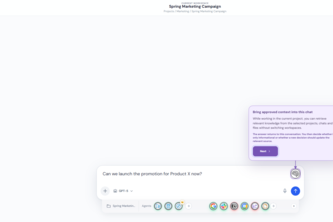
Self-reported purpose: A workspace that brings knowledge from multiple projects, chats and files into the current conversation, using specialist agents to turn it into one clear decision.
Key commercial signals: Not evidenced.
What changed: The author describes a prototype built for a hackathon, with no evidence of product-market fit, revenue, customers or adoption.
Single most important open question: Is there a real market need for this type of AI workspace, and does the author have a path to product-market fit beyond a single-person prototype?
What The Product Actually Is
The description states that Aureola is an interactive web prototype built as part of a hackathon. It includes two main functions:
- Multi-Source: Allows users to select trusted projects, chats and files in advance. When needed, they activate Multi-Source with one button to retrieve relevant context and return the answer directly to the chat where the user is already working.
- Agent Orchestration: Provides a quick-access panel for specialist agents, tools and connected applications. Multiple agents can analyze a business problem from different perspectives, with one crowned agent preparing a final recommendation.
The author notes that the prototype uses Codex with GPT-5.6, and is built using technologies such as React, Node.js, TypeScript, and Vite. It is described as a local workflow to ensure reliability without requiring paid API keys.
Inference: The product is not yet a production-ready solution but a demonstration of a concept in an early-stage prototype.
Positioning & Claim Evolution
The author states that Aureola was inspired by the problem of AI-assisted work where useful knowledge is spread across different projects, chats and files. The goal is to bring relevant knowledge into the current conversation, avoiding the need to switch between workspaces.
The positioning is:
- A tool for contextual AI workflows
- That manages context, sources, responsibility and user control
- With a focus on user agency (e.g., no automatic updates)
Claim: The product aims to reduce friction in decision-making by keeping users in one conversation while pulling in relevant knowledge from multiple sources.
Inference: The positioning is centered on AI workspace efficiency, not on a specific vertical or use case. It is a general-purpose tool for AI-assisted work.
Target Customer & ICP
The description does not state the target customer or ideal customer profile (ICP). It only describes a single-user prototype built by one person, with no mention of team or organizational adoption.
Inference: The product is likely aimed at individuals or small teams who use AI tools for knowledge-intensive tasks. However, there is no evidence of a defined ICP beyond the author’s own use case.
Business Model & Pricing Evidence
There is no evidence in the description of any business model or pricing strategy. The project is described as a hackathon prototype, and no mention is made of monetization, subscriptions, or paid features.
Inference: No commercial model has been defined or demonstrated.
Technical & Delivery Signals
The author built Aureola using:
- Codex with GPT-5.6
- React, Node.js, TypeScript, Vite
- A local workflow, avoiding reliance on external APIs
- A guided product experience and two demonstration workflows
The prototype is described as interactive, with a focus on clarity in presenting complex workflows.
Inference: The technical approach is AI-assisted development, with a strong emphasis on user experience and interface design. It uses local execution to avoid dependency on external services, which may be a deliberate choice for demo purposes.
Traction & Maturity Signals
There is no evidence of traction or maturity beyond the hackathon prototype. The project is described as:
- A single-person effort
- Built for a hackathon
- With no mention of users, customers, revenue, or adoption
Inference: No commercial traction or product-market fit has been demonstrated.
Competitive Context
The description does not mention any competitors. It is unclear whether the author considered existing tools in this space (e.g., AI workspaces, agent orchestration platforms, knowledge management systems).
Inference: No competitive analysis or positioning against existing solutions is evident.
Open Questions & Risks
- Single-person prototype: The entire product was built by one person, with no evidence of team, funding or external validation.
- No commercial model: No pricing, monetization or business model is described.
- Hackathon origin: The project is a hackathon submission, not a product in development.
- No user feedback or testing: There is no mention of user testing, feedback loops or iterative improvements beyond the author’s own experience.
- Unproven market need: No evidence that there is a real demand for this type of AI workspace.
Questions the description leaves open
- What specific problem are you solving, and how do you know users have it?
- How did you validate the need for this product beyond your own use case?
- What is your plan to scale beyond a single-person prototype?
- Are there any existing tools that solve similar problems? How does Aureola differ?
- What are your plans for monetization and pricing?
- How do you intend to build a team or attract users beyond the initial prototype?
Overall Assessment
Not evidenced.
The project is described as a single-person hackathon prototype, with no evidence of traction, revenue, customers, or commercial viability. The author states that the next step would be to connect it to real data and live AI models, but there is no indication of progress beyond the prototype stage.
Inference: This is an early-stage idea with no demonstrated product-market fit or business model. It is not ready for investment or partnership consideration at this time.
User Stories BotA demo video on every pull request
Get a demo video on every new feature
GitHub App that watches your pull requests and records a narrated, captioned demo.
Save time on demo prep and make informed decisions faster with a video walkthrough of every new feature.
Source
Submitted to the OpenAI 2026 hackathon on Devpost. Project home on Devpost. Back to the full gallery on Devpost.
This competitive analysis was produced by top-founders.com (opens in a new tab)
Generated by a language model from this project's public Devpost page — its tagline, the author's own write-up and any built-with tags listed there — as captured in August 2026. Short quotations are the author's words. It is an opinion on the idea as a business, not on the people behind it, and it reflects the description as published then. If the project has moved on, request a correction below. The analysis is not independent research and contains no verified traction, revenue or customer data.
An independent guide by KFG International LLC — not affiliated with, endorsed by, or connected to Devpost or OpenAI.