

Archive position — measured, not model output
0 likes on Devpost
2,263 of the 7,850 archived projects have more likes, and 5,587 share exactly 0 — so this project's #2,812 place in the like-ranked listing is a tie-break inside that group, not a ranking.
Projects (log scale)
Likes on Devpost. ▲ marks this project's group.
Show the figures
| Likes | Projects | Share of archive |
|---|---|---|
| 0 | 5,587 | 71.2% |
| 1 | 1,758 | 22.4% |
| 2 | 284 | 3.6% |
| 3–4 | 132 | 1.7% |
| 5–9 | 75 | 1.0% |
| 10+ | 14 | 0.2% |
 User Stories BotA demo video on every pull request
Get a demo video on every new feature
GitHub App that watches your pull requests and records a narrated, captioned demo.
Save time on demo prep and make informed decisions faster with a video walkthrough of every new feature.
Executive Summary
The company appears to be a solo-engineered productivity tool that uses AI to automate setup of Notion, Linear, Airtable, and Trello workspaces from user context. The author states this is a CLI-first tool built with TypeScript and Node.js, using Codex and GPT-5.6 for development. It supports structured workspace creation through context input, previews, approval, and safe execution.
What changed
The project was submitted to the OpenAI 2026 hackathon, indicating it emerged from a hackathon context rather than an established product or company.
The single most important open question
Is there evidence of any traction, revenue, or customer adoption beyond the author's own development and submission?
What The Product Actually Is
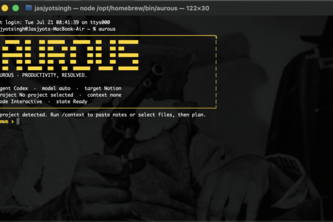
- The description states Aurous is a CLI-first setup layer.
- It connects to Codex or Claude Code, and supports:
- Notion
- Linear
- Airtable
- Trello
- Users provide context through:
- Project files
- Markdown documents
- Reusable context prompts
- It analyzes that context, creates a workspace plan, previews actions, waits for approval, and then executes changes.
- It includes its own context layer to understand how each supported platform should be structured.
- The tool uses locally authenticated coding agents, official integrations, and records exact results, object IDs, skipped actions, and diagnostics.
Note
This is a self-reported description. No evidence of actual product usage, customers, or revenue is provided.
Positioning & Claim Evolution
- The author states Aurous was built to solve the problem of "setting up productivity tools properly takes time, experience, and repeated trial and error."
- It aims to turn a user’s personal context into a structured workspace that is ready to use.
- The tool is positioned as a way to avoid generic templates and instead create systems tailored to how users actually work.
- The tagline: “A CLI-first setup layer that turns your context into structured Notion, Linear, Airtable, and Trello workspaces, with planning, previews, approval, and safe execution.” — this is a self-stated positioning.
Inference The tool appears to be positioned as an AI-powered onboarding assistant for productivity platforms. It claims to reduce friction in setup by automating it with user context.
Target Customer & ICP
- The description states that the tool is aimed at users who:
- Use Notion, Linear, Airtable, or Trello
- Have personal context (project files, Markdown documents, etc.)
- Want to avoid generic templates and instead build systems that reflect their actual workflow
- It is not evidenced whether there are specific personas or segments defined beyond the general user of these tools.
Note
No evidence of customer segmentation, target personas, or buyer profiles is provided. The tool appears to be aimed at individual users or small teams who want to set up workspaces quickly and efficiently.
Business Model & Pricing Evidence
- There is no evidence of a business model or pricing structure.
- The author states the project was built for a hackathon, with no mention of monetization or commercial use.
Inference If this tool were to become a product, it would likely be priced as a SaaS or CLI tool, but there is no indication of such plans in the description.
Technical & Delivery Signals
- Built with:
- TypeScript
- Node.js
- Codex
- GPT-5.6
- Uses locally authenticated coding agents
- Integrates with:
- Notion
- Linear
- Airtable
- Trello
- The tool supports:
- Context input (Markdown, project files)
- Plan generation
- Preview of actions
- Approval before execution
- Execution through official integrations
- Diagnostics and result tracking
Note
The technical stack is self-reported. No evidence of scalability, performance, or infrastructure details.
Traction & Maturity Signals
- The project was submitted to the OpenAI 2026 hackathon.
- It is a solo-engineered project by one person (Jasjyot Singh).
- No evidence of:
- Revenue
- Customers
- User adoption
- Product usage metrics
- Product maturity beyond a prototype
Inference The tool is in early development, likely a prototype or proof-of-concept. It has no demonstrated traction.
Competitive Context
- The author does not reference any competitors.
- No evidence of competitive analysis, market positioning, or differentiation from existing tools like:
- Notion templates
- Linear setup tools
- Airtable automation
- Trello workflow builders
- The tool is described as solving a problem around workspace setup, which overlaps with many existing platforms.
Note
No competitive landscape or positioning against other tools is provided. This is an unverified claim of uniqueness.
Open Questions & Risks
- Solo-engineered project — no team, no external validation.
- No traction or revenue — only a hackathon submission.
- Unverified claims — the author states what it does, but there’s no evidence of execution or adoption.
- High technical risk — integrating with multiple platforms and ensuring safe execution is complex.
- No pricing or monetization strategy — unclear how this would become a sustainable business.
- No user feedback or testing — the tool is described as built by one person, not validated with users.
Inference The project is a solo-engineered prototype. It has no commercial viability or traction to date.
Questions the description leaves open
- What specific user context do you use to generate workspace plans?
- How does the tool handle conflicts between different platforms (e.g., Notion vs Linear)?
- Have you tested this with real users, or is it only a prototype?
- Is there any plan for monetization or commercial deployment?
- What are the technical limitations of the current integrations?
- How do you ensure idempotency and safe execution across multiple platforms?
Overall Assessment
- Not evidenced — no data on revenue, customers, traction, or business model.
- The project is a self-reported hackathon submission, not a product with commercial traction.
- It is not clear if this will evolve into a product or service.
- No evidence of team, funding, or market validation.
Assessment This is an early-stage idea or prototype. There is no basis for investment or partnership at this time. The author states what the tool does, but there is no evidence of execution, adoption, or commercial viability.
User Stories BotA demo video on every pull request
Get a demo video on every new feature
GitHub App that watches your pull requests and records a narrated, captioned demo.
Save time on demo prep and make informed decisions faster with a video walkthrough of every new feature.
Source
Submitted to the OpenAI 2026 hackathon on Devpost. Project home on Devpost. Back to the full gallery on Devpost.
This competitive analysis was produced by top-founders.com (opens in a new tab)
Generated by a language model from this project's public Devpost page — its tagline, the author's own write-up and any built-with tags listed there — as captured in August 2026. Short quotations are the author's words. It is an opinion on the idea as a business, not on the people behind it, and it reflects the description as published then. If the project has moved on, request a correction below. The analysis is not independent research and contains no verified traction, revenue or customer data.
An independent guide by KFG International LLC — not affiliated with, endorsed by, or connected to Devpost or OpenAI.