

Archive position — measured, not model output
0 likes on Devpost
2,263 of the 7,850 archived projects have more likes, and 5,587 share exactly 0 — so this project's #2,813 place in the like-ranked listing is a tie-break inside that group, not a ranking.
Projects (log scale)
Likes on Devpost. ▲ marks this project's group.
Show the figures
| Likes | Projects | Share of archive |
|---|---|---|
| 0 | 5,587 | 71.2% |
| 1 | 1,758 | 22.4% |
| 2 | 284 | 3.6% |
| 3–4 | 132 | 1.7% |
| 5–9 | 75 | 1.0% |
| 10+ | 14 | 0.2% |
 User Stories BotA demo video on every pull request
Get a demo video on every new feature
GitHub App that watches your pull requests and records a narrated, captioned demo.
Save time on demo prep and make informed decisions faster with a video walkthrough of every new feature.
Executive Summary
What the company appears to be
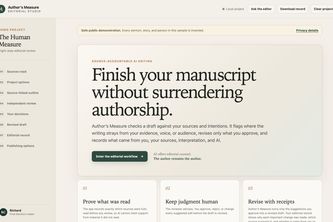
Author’s Measure, as described by its author, is a browser-based AI editor for nonfiction writers that emphasizes source accountability and human control. It allows authors to provide a draft and sources, then uses AI to check the draft against those sources, flag unsupported claims or drift in voice/genre, and redraft only based on approved findings.
What changed
The project emerged from a real-world editing challenge: how to use AI without losing authorship or control. It is positioned as a tool that supports editorial counsel while preserving the writer’s authority.
Single most important open question
Is there evidence of traction, revenue, or actual adoption by writers or publishers? The description contains no data on usage, customers, or monetization.
Note: This analysis is based entirely on the self-reported, unverified account provided in the project description. No third-party verification or historical data is available.
What The Product Actually Is
- The description states that Author’s Measure is a source-accountable AI editor for serious nonfiction.
- It does not replace the author or silently rewrite manuscripts.
- The tool records which sources were reviewed, tracks coverage at the paragraph level, and compares possible publishing formats.
- It flags unsupported claims, inference, voice or genre drift, audience concerns, and confidentiality risks.
- It allows writers to approve, reject, modify, or question every finding.
- It redrafts only using approved findings.
- The author remains the final authority.
Inference: The product is designed for high-stakes nonfiction writing (e.g., books, academic work) where source accountability and control are critical.
Not evidenced: No details on how it handles large-scale manuscripts or integrates with existing writing tools.
Positioning & Claim Evolution
- The author states that the tool grew from a real book-editing process.
- It was built to address issues like AI not fully reading sources, introducing interpretations not stated by the writer, changing voice or genre, and mishandling confidential material.
- The positioning is: “AI offers editorial counsel. The author remains the author—with every suggestion traceable to sources, inference, and AI.”
- It positions itself as a tool that supports AI without surrendering authorship.
Inference: The product evolved from a personal need into a solution for a broader class of writers who value control and accountability.
Not evidenced: No mention of prior versions, user feedback loops, or market validation beyond the hackathon submission.
Target Customer & ICP
- The description states that Author’s Measure is for “serious nonfiction” writers.
- It is intended to support those who work with extensive source material and need to maintain control over their narrative.
- It is not described as targeting general-purpose AI writing tools or casual content creators.
Inference: The ICP likely includes professional authors, researchers, or editors working on long-form, source-intensive projects.
Not evidenced: No explicit customer personas, segmentation, or buyer journey details.
Business Model & Pricing Evidence
- The description does not mention any pricing model, monetization strategy, or business model.
- It is described as a prototype built for a hackathon.
- There is no indication of whether it will be offered as SaaS, freemium, or enterprise.
Not evidenced: No evidence of revenue streams, pricing tiers, or commercial intent beyond the demo.
Technical & Delivery Signals
- The working prototype uses a browser-based JavaScript interface and a Node.js server.
- It optionally runs with GPT-5.6 Sol via OpenAI Responses API.
- The system includes two distinct AI roles: Independent Critic and Redrafter.
- Structured outputs require evidence references to match real source-section IDs.
- Rejected findings are blocked from reaching the redrafting stage.
- A deterministic demonstration fixture is included for testing without an API key.
Inference: The architecture is designed with traceability, separation of concerns, and human-in-the-loop controls.
Not evidenced: No information on scalability, cloud infrastructure, or deployment strategy beyond the prototype.
Traction & Maturity Signals
- The project was submitted to the OpenAI 2026 hackathon.
- It includes a working prototype with an eight-stage editorial workflow.
- It demonstrates source-coverage gates, evidence-linked findings, and author approval controls.
- It is described as having been tested with sample sources and a draft.
Not evidenced: No data on user adoption, retention, or usage metrics. No mention of customers, revenue, or product-market fit beyond the demo.
Competitive Context
- The description does not reference direct competitors.
- It positions itself as distinct from general-purpose AI writing tools by emphasizing traceability and human control.
- It is implied to be in a niche space focused on source-intensive nonfiction writing.
Inference: It may compete with tools like Grammarly, ProWritingAid, or AI-assisted editing platforms that lack source accountability features.
Not evidenced: No competitive analysis, market size, or positioning against existing tools.
Open Questions & Risks
- The product is described as a hackathon prototype with no commercial traction or revenue.
- It has not been tested in real-world publishing environments.
- The author is a single individual (Richard Chung), suggesting limited team capacity.
- There is no evidence of monetization, customer feedback, or market validation.
- The tool’s AI dependencies (GPT-5.6 Sol) are tied to an external API and may be unstable or costly.
Inference: The risk of failure is high if the product does not evolve beyond a demo into a scalable, commercially viable offering.
Not evidenced: No evidence of team scaling, funding, or roadmap beyond the prototype.
Questions the description leaves open
- What is the actual user feedback from writers who have tried this tool?
- How do you plan to monetize this product? Is there a pricing model or business model in place?
- Have you tested the tool with real manuscripts and real users, not just sample data?
- What are your plans for scaling beyond the prototype and hackathon demo?
- Are there any legal or privacy implications of using AI to redraft content based on source coverage?
- How do you plan to compete with existing editing tools that already offer AI features?
Overall Assessment
- The project is described as a hackathon prototype with no evidence of traction, revenue, or commercial viability.
- It shows strong conceptual design and alignment with current trends in AI-assisted writing and source accountability.
- However, it lacks any evidence of real-world adoption, monetization, or team capacity to scale.
Assessment: Not ready for investment or partnership. The product is conceptually compelling but unproven in market conditions. It requires further development, testing, and validation before any commercial or strategic move can be justified.
Confidence Level: Low — based on self-reported evidence only, with no external data or traction signals.
User Stories BotA demo video on every pull request
Get a demo video on every new feature
GitHub App that watches your pull requests and records a narrated, captioned demo.
Save time on demo prep and make informed decisions faster with a video walkthrough of every new feature.
Source
Submitted to the OpenAI 2026 hackathon on Devpost. Project home on Devpost. Back to the full gallery on Devpost.
This competitive analysis was produced by top-founders.com (opens in a new tab)
Generated by a language model from this project's public Devpost page — its tagline, the author's own write-up and any built-with tags listed there — as captured in August 2026. Short quotations are the author's words. It is an opinion on the idea as a business, not on the people behind it, and it reflects the description as published then. If the project has moved on, request a correction below. The analysis is not independent research and contains no verified traction, revenue or customer data.
An independent guide by KFG International LLC — not affiliated with, endorsed by, or connected to Devpost or OpenAI.