

Archive position — measured, not model output
0 likes on Devpost
2,263 of the 7,850 archived projects have more likes, and 5,587 share exactly 0 — so this project's #2,811 place in the like-ranked listing is a tie-break inside that group, not a ranking.
Projects (log scale)
Likes on Devpost. ▲ marks this project's group.
Show the figures
| Likes | Projects | Share of archive |
|---|---|---|
| 0 | 5,587 | 71.2% |
| 1 | 1,758 | 22.4% |
| 2 | 284 | 3.6% |
| 3–4 | 132 | 1.7% |
| 5–9 | 75 | 1.0% |
| 10+ | 14 | 0.2% |
 User Stories BotA demo video on every pull request
Get a demo video on every new feature
GitHub App that watches your pull requests and records a narrated, captioned demo.
Save time on demo prep and make informed decisions faster with a video walkthrough of every new feature.
Executive Summary
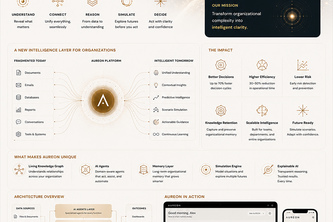
The company appears to be a solo-project, self-reported AI product named AUREON, designed to act as an "organizational intelligence layer" that connects enterprise data sources and enables decision-makers to query them via natural language. The author describes it as an AI-powered system using GPT-5.6, RAG, and LLMs to extract insights from fragmented enterprise knowledge.
What changed: This is a hackathon submission with no evidence of prior traction or commercial activity. It represents a conceptual product idea rather than a functioning business.
Single most important open question: Is there any evidence that AUREON has been tested in real enterprise environments, or that it can actually integrate with existing enterprise systems?
Analysis basis: Self-reported only. The description is from the project author’s own submission to the OpenAI 2026 hackathon on Devpost. No third-party verification, revenue data, customer feedback, or product usage metrics are available.
What The Product Actually Is
The description states that AUREON is:
- An AI-powered Organizational Intelligence Experience
- Designed for decision-makers to interact with enterprise knowledge through natural conversation
- Not a chatbot but an intelligence layer across enterprise systems
- Capable of:
- Connecting information from multiple enterprise sources
- Understanding relationships in structured and unstructured data
- Detecting hidden patterns and operational bottlenecks
- Predicting potential risks
- Generating explainable recommendations
- Simulating possible outcomes before decisions are made
Inference: Based on the author's own description, AUREON is a conversational AI interface that aggregates enterprise data and uses LLMs to interpret it.
Evidence: Author's own write-up. No independent confirmation or demonstration of actual functionality.
Positioning & Claim Evolution
The author positions AUREON as:
- The first Organizational Intelligence Experience
- A tool that turns disconnected enterprise data into understandable, explainable, and actionable intelligence
- A shift from traditional dashboards to a natural language interface
Key claims include:
- “Every organization already contains the answers it needs. AUREON simply reveals them.”
- It challenges the assumption that users must navigate dashboards or disconnected applications.
- It aims to be an intelligence layer above enterprise systems.
Inference: The positioning is aspirational and focused on solving data fragmentation, not yet proven in practice.
Evidence: Self-reported. No evidence of market validation or prior product iteration.
Target Customer & ICP
The description states that AUREON targets:
- Decision-makers within organizations
- Users who need to make confident decisions based on organizational knowledge
- Organizations with fragmented enterprise data across systems like ERP, dashboards, emails, reports, and documents
Inference: The target is likely C-suite executives, managers, or analysts in large enterprises with complex data landscapes.
Evidence: Author's own description. No evidence of customer interviews, personas, or segmentation.
Business Model & Pricing Evidence
No information provided about:
- Revenue model
- Pricing structure
- Monetization strategy
- Customer acquisition plans
Inference: The project is a hackathon submission with no business model evident.
Evidence: Not evidenced. No mention of how the product would be sold or monetized.
Technical & Delivery Signals
The author describes:
- Built with GPT-5.6, RAG, LLMs, and enterprise knowledge integration
- Uses OpenAI models and interactive AI-first interface
- Architecture includes:
- Retrieval-Augmented Generation (RAG)
- Intelligent workflow orchestration
- Explainable AI outputs
- Interactive visual storytelling
Technology stack includes: Next.js, React, Python, SQL, Tailwind, Vercel, OpenAI, RAG, LLMs, Graph, Vector DB, REST APIs
Inference: The project is technically ambitious and uses modern AI tools, but lacks evidence of deployment or scalability.
Evidence: Author’s own description. No demonstration, architecture diagrams, or delivery proof.
Traction & Maturity Signals
The project is described as:
- A hackathon submission
- Built by a single person (Maede Habibi)
- Not yet integrated with real enterprise systems
- A vision for future features including:
- Live enterprise integrations
- Real-time intelligence
- Predictive simulations
- Autonomous workflow orchestration
Inference: No traction, no customers, no live product. This is a conceptual prototype.
Evidence: Not evidenced. No revenue, users, or product usage data.
Competitive Context
The author does not mention any competitors. The description implies AUREON is positioned as a first-of-its-kind solution for organizational intelligence.
Inference: The competitive landscape is unknown. No evidence of existing solutions in this space.
Evidence: Not evidenced. No mention of competitors or market analysis.
Open Questions & Risks
- Solo founder: Only one team member (Maede Habibi) listed
- No traction or revenue: This is a hackathon project with no commercial history
- Unproven integrations: No evidence that it can actually connect to real enterprise systems
- High technical ambition without delivery proof: Uses advanced AI tools but no working prototype
- No business model: No indication of how the product would be monetized or sold
Evidence: Self-reported. No external validation, customer feedback, or financials.
Questions the description leaves open
- What specific enterprise systems have you attempted to integrate with?
- Have you conducted any user testing or interviews with decision-makers?
- How do you plan to monetize this product in the enterprise space?
- What are the technical limitations of your current prototype?
- Are there any existing partnerships or pilot programs in progress?
Inference: These questions aim to uncover whether the idea has moved beyond concept into real-world application.
Overall Assessment
Not evidenced — this is a hackathon submission with no commercial traction, revenue, or customer data. The author describes an ambitious vision but provides no evidence of execution or product-market fit.
Confidence level: Very low. This is a conceptual idea, not a business.
User Stories BotA demo video on every pull request
Get a demo video on every new feature
GitHub App that watches your pull requests and records a narrated, captioned demo.
Save time on demo prep and make informed decisions faster with a video walkthrough of every new feature.
Source
Submitted to the OpenAI 2026 hackathon on Devpost. Project home on Devpost. Back to the full gallery on Devpost.
This competitive analysis was produced by top-founders.com (opens in a new tab)
Generated by a language model from this project's public Devpost page — its tagline, the author's own write-up and any built-with tags listed there — as captured in August 2026. Short quotations are the author's words. It is an opinion on the idea as a business, not on the people behind it, and it reflects the description as published then. If the project has moved on, request a correction below. The analysis is not independent research and contains no verified traction, revenue or customer data.
An independent guide by KFG International LLC — not affiliated with, endorsed by, or connected to Devpost or OpenAI.