

Archive position — measured, not model output
1 like on Devpost
505 of the 7,850 archived projects have more likes, and 1,758 share exactly 1 — so this project's #844 place in the like-ranked listing is a tie-break inside that group, not a ranking.
Projects (log scale)
Likes on Devpost. ▲ marks this project's group.
Show the figures
| Likes | Projects | Share of archive |
|---|---|---|
| 0 | 5,587 | 71.2% |
| 1 | 1,758 | 22.4% |
| 2 | 284 | 3.6% |
| 3–4 | 132 | 1.7% |
| 5–9 | 75 | 1.0% |
| 10+ | 14 | 0.2% |
 User Stories BotA demo video on every pull request
Get a demo video on every new feature
GitHub App that watches your pull requests and records a narrated, captioned demo.
Save time on demo prep and make informed decisions faster with a video walkthrough of every new feature.
Executive Summary
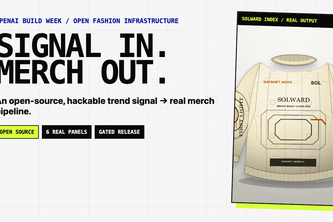
Codex Merch is a self-reported project that claims to turn cultural signals from X (presumably Twitter/X) into production-ready fashion via Printful. The author, Elliot Vaucher, built it during an OpenAI hackathon using tools like GPT-5.6, OpenAI Codex, and Playwright. It appears to be a proof-of-concept or personal project with no evidence of revenue, customers, or traction beyond one purchase by the founder’s friend.
The single most important open question is: What is the actual commercial intent behind this project? The description implies it may be a prototype for a broader signal-to-product pipeline in fashion — but there is no evidence that such a business model has been validated or tested with real customers, partners, or markets.
This analysis is based entirely on self-reported information from the author. No third-party verification, revenue data, customer feedback, or market traction is available.
What The Product Actually Is
The description states that Codex Merch “turns trend signals from X into real purchaseable merch, via Printful.” It uses tools such as GPT-5.6, OpenAI Codex, Playwright, and others to automate the process of generating fashion products based on social media trends.
It is not evidenced whether this system actually produces usable or saleable merchandise — only that it was built with a pipeline involving LLMs and Printful integration.
Inference: The product seems to be an automated toolchain for generating fashion designs from social media signals, intended to bridge LLMs and physical products. However, the author does not describe how this works beyond high-level claims.
Positioning & Claim Evolution
The author states that they were inspired by early OpenAI supply co shop and wanted to build something similar — but with an LLM acting as an Art Director. The project is positioned as a creative way to connect LLMs with real-world outputs, especially in fashion.
There is no evidence of prior positioning or evolution of claims beyond the single submission to a hackathon. The author does not describe any strategic shift or commercial development over time.
Inference: This appears to be a one-off experiment or prototype, not a developed product or platform with evolving positioning.
Target Customer & ICP
The description does not identify specific target customers or ideal customer profiles (ICP). It suggests that the system could be useful for “Zara” or “Richemond,” but these are speculative references without further detail.
Inference: The author implies potential interest from fashion brands, but no evidence of actual brand engagement, market research, or customer interviews exists.
Business Model & Pricing Evidence
There is no evidence of pricing, monetization strategy, or business model beyond the idea that it uses Printful to produce merch. The author mentions purchasing one item for a friend, but does not describe any sales process, pricing tiers, or revenue streams.
Inference: If this were a commercial product, it would likely rely on a marketplace or subscription-style model using LLMs to generate content for print-on-demand services — but there is no evidence of such a model being implemented or tested.
Technical & Delivery Signals
The project was built using technologies including:
- GPT-5.6
- OpenAI Codex
- Playwright
- React, Node.js, PostgreSQL, Stripe, Vercel
- Printful API integration
The author describes challenges related to model precision and environment variables, particularly with newer versions of models like Sol Ultra.
Inference: The technical stack suggests a full-stack application integrating LLMs with web delivery and e-commerce infrastructure. However, the project is described as a hackathon effort, not a scalable or production-ready system.
Traction & Maturity Signals
There is no evidence of traction, adoption, or usage beyond one purchase by the founder’s friend. The author notes that they “think it’s cute and likeable,” but does not provide metrics, user feedback, or market validation.
Inference: This is a personal project with limited maturity. No data on customer acquisition, retention, or revenue exists.
Competitive Context
The author references OpenAI’s supply co shop and mentions Zara and Richemond as potential interested parties, but provides no competitive analysis or market positioning beyond these vague references.
Inference: The idea of using LLMs to generate fashion trends is not unique — but there is no evidence that Codex Merch competes with or differentiates from existing tools in this space.
Open Questions & Risks
- Lack of commercial traction: No revenue, customers, or usage data.
- Unproven business model: The author does not describe how the product would scale or monetize.
- Limited scope: Built as a hackathon project with no indication of long-term development.
- Unclear value proposition: The system is described as “cute and likeable,” but not as a viable commercial offering.
- Dependency on LLMs: Reliance on models that may be unstable or require frequent updates.
Questions the description leaves open
- What specific cultural signals from X (Twitter/X) does the system process, and how are they translated into product decisions?
- Has there been any testing with real users or brands to validate demand for this type of service?
- How is the pipeline intended to scale beyond a single prototype?
- Are there any partnerships or integrations already in place with Printful or other vendors?
- What is the long-term vision for Codex Merch — is it meant to be a product, platform, or just an experiment?
Overall Assessment
Not evidenced.
The description provides no information about financials, team traction, market opportunity, or commercial viability. It reads as a personal project or hackathon prototype with no clear path to investment or partnership.
Inference: Without evidence of product-market fit, revenue, or scalable business model, there is insufficient basis to recommend investment or partnership at this stage.
User Stories BotA demo video on every pull request
Get a demo video on every new feature
GitHub App that watches your pull requests and records a narrated, captioned demo.
Save time on demo prep and make informed decisions faster with a video walkthrough of every new feature.
Source
Submitted to the OpenAI 2026 hackathon on Devpost. Project home on Devpost. Back to the full gallery on Devpost.
This competitive analysis was produced by top-founders.com (opens in a new tab)
Generated by a language model from this project's public Devpost page — its tagline, the author's own write-up and any built-with tags listed there — as captured in August 2026. Short quotations are the author's words. It is an opinion on the idea as a business, not on the people behind it, and it reflects the description as published then. If the project has moved on, request a correction below. The analysis is not independent research and contains no verified traction, revenue or customer data.
An independent guide by KFG International LLC — not affiliated with, endorsed by, or connected to Devpost or OpenAI.