

Archive position — measured, not model output
0 likes on Devpost
2,263 of the 7,850 archived projects have more likes, and 5,587 share exactly 0 — so this project's #6,708 place in the like-ranked listing is a tie-break inside that group, not a ranking.
Projects (log scale)
Likes on Devpost. ▲ marks this project's group.
Show the figures
| Likes | Projects | Share of archive |
|---|---|---|
| 0 | 5,587 | 71.2% |
| 1 | 1,758 | 22.4% |
| 2 | 284 | 3.6% |
| 3–4 | 132 | 1.7% |
| 5–9 | 75 | 1.0% |
| 10+ | 14 | 0.2% |
 User Stories BotA demo video on every pull request
Get a demo video on every new feature
GitHub App that watches your pull requests and records a narrated, captioned demo.
Save time on demo prep and make informed decisions faster with a video walkthrough of every new feature.
Executive Summary
What the company appears to be
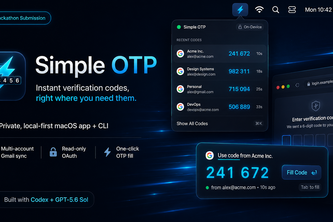
Simple OTP is a self-reported macOS menu bar application (with CLI companion) that detects verification codes from multiple Gmail accounts and surfaces them for one-click filling in browser fields. It uses local-first principles, OAuth for access, and integrates with Apple’s Accessibility API.
What changed
The author states this is their second public app, built during a hackathon. The project was submitted to the OpenAI 2026 hackathon on Devpost.
Single most important open question
Is there any evidence of user adoption or usage beyond the author's personal use case?
What The Product Actually Is
The description states that Simple OTP is:
- A private, local-first macOS menu bar app with a CLI companion
- Built using SwiftUI and AppKit
- Uses Google OAuth for read-only access to Gmail accounts
- Detects new verification emails and extracts one-time codes
- Surfaces the code in the menu bar or next to OTP input fields via Apple’s Accessibility API
- Stores OAuth tokens in the macOS Keychain
- Synchronizes Gmail using history cursors, claims messages once, and persists deduplication state in SQLite
- Uses a shared SimpleOTPCore package for both app and CLI
- Handles various code formats (numeric, grouped, alphanumeric, Unicode, HTML, localized) while rejecting irrelevant identifiers
Evidence strength This is all self-reported by the author. No third-party verification or independent evidence of functionality.
Positioning & Claim Evolution
The author claims:
- Verification codes should feel instant but currently involve a multi-step process
- The app removes friction without forwarding mail to a third-party service
- It is designed for users who use multiple Gmail accounts or browsers outside Apple’s ecosystem
Inference This suggests the product is positioned as a productivity tool for developers or power users, not a commercial SaaS offering.
Evidence strength Claims are self-reported and lack traction or market validation data.
Target Customer & ICP
The description states:
- The app targets users who use multiple Gmail accounts
- Users who use browsers outside Apple’s ecosystem
- The author personally uses it every day
Inference The ICP appears to be technical users, possibly developers or power users, who are frustrated by the current OTP experience.
Evidence strength Only personal usage is stated. No evidence of a broader customer base or market segmentation.
Business Model & Pricing Evidence
The description states:
- The app is a menu bar app with CLI companion
- It is built as a personal tool, not a commercial product
- No pricing, subscription model, or monetization strategy is mentioned
Inference It appears to be a free, personal utility app, possibly open-source or freemium.
Evidence strength No evidence of any business model or pricing structure.
Technical & Delivery Signals
The description states:
- Built with SwiftUI and AppKit
- Uses OAuth 2.0 for Gmail access
- Stores tokens in macOS Keychain
- Synchronizes using history cursors, claims messages once, deduplicates with SQLite
- Extraction pipeline handles multiple formats and rejects irrelevant identifiers
- Uses Apple’s Accessibility API to detect OTP fields
- A shared SimpleOTPCore package powers both app and CLI
- Built with Codex and GPT-5.6
Inference The technical stack is solid for a macOS-native tool, and the architecture shows attention to security (local-first, Keychain), deduplication, and code extraction.
Evidence strength All technical claims are self-reported and unverified.
Traction & Maturity Signals
The description states:
- The author built it as their second public app
- It was submitted to the OpenAI 2026 hackathon
- The author personally uses it every day
- It is a personal tool, not a commercial product
Inference There is no evidence of user adoption, revenue, or customer traction beyond personal use.
Evidence strength No data on downloads, usage metrics, or market response.
Competitive Context
The description states:
- The app solves a problem with verification codes in browsers outside Apple’s ecosystem
- It avoids forwarding mail to third-party services
Inference It may compete with browser extensions or tools that automate OTP handling, but no specific competitors are named.
Evidence strength No mention of existing tools or competitive landscape.
Open Questions & Risks
- No commercial traction or revenue: The app is described as personal use only.
- No evidence of user adoption beyond the author
- No pricing or monetization strategy
- No third-party verification or independent testing
- No mention of scalability or long-term maintenance plans
- No evidence of a broader product roadmap or team
Inference This is a personal project, not a commercial venture. It may be a prototype or proof-of-concept.
Questions the description leaves open
- What is the actual user base beyond your own use?
- Are you planning to monetize this tool, and if so, how?
- Have you considered expanding support for other email providers or messaging platforms?
- How do you plan to maintain or scale the code extraction logic as formats evolve?
- Is there any intention to open-source or release this beyond personal use?
Overall Assessment
Not evidenced
The description states that Simple OTP is a personal tool, built during a hackathon, and used by the author daily. There is no evidence of:
- Revenue
- Customers
- Market traction
- Commercial strategy
- Team or funding
This appears to be a prototype or personal project, not a commercial venture.
Confidence level Very low — all claims are self-reported with no external validation.
User Stories BotA demo video on every pull request
Get a demo video on every new feature
GitHub App that watches your pull requests and records a narrated, captioned demo.
Save time on demo prep and make informed decisions faster with a video walkthrough of every new feature.
Source
Submitted to the OpenAI 2026 hackathon on Devpost. Project home on Devpost. Back to the full gallery on Devpost.
This competitive analysis was produced by top-founders.com (opens in a new tab)
Generated by a language model from this project's public Devpost page — its tagline, the author's own write-up and any built-with tags listed there — as captured in August 2026. Short quotations are the author's words. It is an opinion on the idea as a business, not on the people behind it, and it reflects the description as published then. If the project has moved on, request a correction below. The analysis is not independent research and contains no verified traction, revenue or customer data.
An independent guide by KFG International LLC — not affiliated with, endorsed by, or connected to Devpost or OpenAI.