

Archive position — measured, not model output
0 likes on Devpost
2,263 of the 7,850 archived projects have more likes, and 5,587 share exactly 0 — so this project's #6,709 place in the like-ranked listing is a tie-break inside that group, not a ranking.
Projects (log scale)
Likes on Devpost. ▲ marks this project's group.
Show the figures
| Likes | Projects | Share of archive |
|---|---|---|
| 0 | 5,587 | 71.2% |
| 1 | 1,758 | 22.4% |
| 2 | 284 | 3.6% |
| 3–4 | 132 | 1.7% |
| 5–9 | 75 | 1.0% |
| 10+ | 14 | 0.2% |
 User Stories BotA demo video on every pull request
Get a demo video on every new feature
GitHub App that watches your pull requests and records a narrated, captioned demo.
Save time on demo prep and make informed decisions faster with a video walkthrough of every new feature.
Executive Summary
Company
SimpleBoard
Self-reported basis
The analysis is based entirely on the project description provided by the caller — its name, tagline, author's own write-up, and technology tags. No external verification or historical data are available.
Confidence level Low. The description contains no evidence of revenue, customers, traction, or adoption. It is a self-reported account of a hackathon project.
What the company appears to be
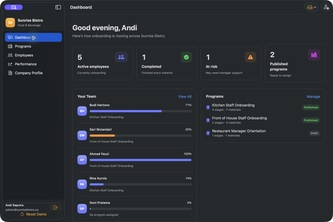
SimpleBoard is a macOS-native onboarding tool for small teams that allows owners to create structured onboarding programs with various content types and track employee progress. The product supports both local-first data persistence and cloud-backed access for employees, using Supabase for secure, passwordless sharing.
What changed
The project was built as a hackathon submission (Devpost entry) and is described as a native macOS app using SwiftUI and Supabase. No prior version or commercial history is evidenced.
Single most important open question
Is there any evidence of real-world usage or customer feedback beyond the self-reported developer narrative?
What The Product Actually Is
The description states that SimpleBoard is a native macOS app built with SwiftUI, designed to help small teams create structured onboarding programs. It supports:
- Seven types of learning materials: videos, readings, checklists, quizzes, tasks, documents, and meetings.
- Assignment of onboarding programs to employees.
- Progress tracking for owners.
- Employee experience that shows only assigned journeys and next steps.
- Local-first data persistence using versioned JSON and Keychain storage.
- Cloud-backed access via Supabase with private links (passwordless).
- Support for remote access without requiring Apple Accounts or shared company passwords.
Inference The product is a desktop application, not a web or mobile app, and it integrates local and cloud data models. It is built for small teams and focuses on onboarding workflows.
Positioning & Claim Evolution
The description states that SimpleBoard aims to provide “a thoughtful first-day experience” by replacing fragmented onboarding methods (documents, chat, spreadsheets) with a structured platform.
It positions itself as a solution for small teams who want a clear, centralized place to manage onboarding. The tagline — “Effortless onboarding that helps every new hire start strong.” — reflects this intent.
The project also claims to have solved challenges around offline experience, secure access, and device synchronization, which are framed as key differentiators.
Inference The positioning is early-stage, focused on solving a clarity problem in onboarding, and built for small business use cases. It does not claim market dominance or widespread adoption.
Target Customer & ICP
The description states that SimpleBoard is intended for small teams. It mentions that the app supports remote employee access without Apple Accounts, which implies a target audience where such constraints are relevant.
It also suggests that managers need to know when someone needs help, indicating a managerial user role in the system.
Inference The ICP is likely small business or startup teams with remote employees and limited onboarding infrastructure. There is no evidence of enterprise or large-scale adoption.
Business Model & Pricing Evidence
The description does not include any information about pricing, monetization, or business model.
Not evidenced.
Technical & Delivery Signals
The project was built as a native macOS app using SwiftUI, and integrates:
- Local-first data persistence with versioned JSON.
- Keychain credential storage.
- Supabase for cloud-backed access.
- Passwordless employee access via private tokens.
- Keyboard navigation, accessibility support, and responsive layouts.
It also mentions use of Codex as an engineering partner during development.
Inference The technical stack is macOS-native, with a hybrid local/cloud architecture. It shows attention to UX patterns like split-view navigation and keyboard shortcuts. The use of Codex suggests a developer-focused approach to prototyping and tooling.
Traction & Maturity Signals
The description states that this was a hackathon submission (Devpost entry for OpenAI 2026 hackathon). There is no evidence of:
- Revenue
- Customers
- Product usage
- Adoption
- Iteration beyond the hackathon version
Not evidenced.
Competitive Context
The description does not mention any competitors or market positioning relative to existing onboarding tools.
Not evidenced.
Open Questions & Risks
- No traction evidence: The product is described as a hackathon submission with no real-world usage.
- Unproven market fit: No customer feedback, user interviews, or market validation are reported.
- Limited scope: The app is built for macOS only and lacks cross-platform support.
- Self-reported maturity: There is no evidence of product iteration or feedback loops beyond the developer narrative.
Inference The project is in a very early stage. It may not have validated its core assumptions or addressed real-world use cases beyond the hackathon context.
Questions the description leaves open
- What was the actual user feedback during the hackathon, if any?
- Are there plans to expand beyond macOS or support other platforms?
- How does SimpleBoard handle data privacy and compliance (e.g., GDPR)?
- Has the team considered how this would scale with larger teams or organizations?
- What is the current roadmap for product development post-hackathon?
Overall Assessment
Not evidenced.
The description provides no information on financials, traction, or commercial viability. It is a self-reported hackathon project, not a product in market. Any investment or partnership decision would require further due diligence into real-world usage, customer feedback, and product-market fit.
Confidence level Very low. The project is described as a prototype with no evidence of commercial traction or adoption.
User Stories BotA demo video on every pull request
Get a demo video on every new feature
GitHub App that watches your pull requests and records a narrated, captioned demo.
Save time on demo prep and make informed decisions faster with a video walkthrough of every new feature.
Source
Submitted to the OpenAI 2026 hackathon on Devpost. Project home on Devpost. Back to the full gallery on Devpost.
This competitive analysis was produced by top-founders.com (opens in a new tab)
Generated by a language model from this project's public Devpost page — its tagline, the author's own write-up and any built-with tags listed there — as captured in August 2026. Short quotations are the author's words. It is an opinion on the idea as a business, not on the people behind it, and it reflects the description as published then. If the project has moved on, request a correction below. The analysis is not independent research and contains no verified traction, revenue or customer data.
An independent guide by KFG International LLC — not affiliated with, endorsed by, or connected to Devpost or OpenAI.