

Archive position — measured, not model output
0 likes on Devpost
2,263 of the 7,850 archived projects have more likes, and 5,587 share exactly 0 — so this project's #6,710 place in the like-ranked listing is a tie-break inside that group, not a ranking.
Projects (log scale)
Likes on Devpost. ▲ marks this project's group.
Show the figures
| Likes | Projects | Share of archive |
|---|---|---|
| 0 | 5,587 | 71.2% |
| 1 | 1,758 | 22.4% |
| 2 | 284 | 3.6% |
| 3–4 | 132 | 1.7% |
| 5–9 | 75 | 1.0% |
| 10+ | 14 | 0.2% |
 User Stories BotA demo video on every pull request
Get a demo video on every new feature
GitHub App that watches your pull requests and records a narrated, captioned demo.
Save time on demo prep and make informed decisions faster with a video walkthrough of every new feature.
Executive Summary
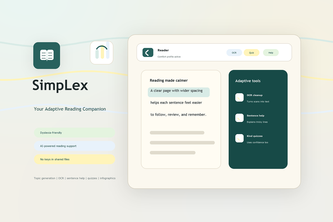
SimpLex: Adaptive Reading Companion is a self-reported AI-powered web application designed to make reading more accessible for dyslexic learners and struggling readers. The project was built as part of the OpenAI 2026 hackathon, with no evidence of revenue, customers or traction beyond its prototype stage.
The product claims to offer personalized learning experiences through OCR support, multilingual capabilities, visual learning modes, adaptive assessments, and an AI companion named Ari that learns from user behavior without storing sensitive data. It is built using HTML, CSS, JavaScript, Python APIs, and OpenAI tools including GPT-5.6.
Key commercial due-diligence read
The description states the product aims to transform complex text into personalized learning experiences for dyslexic learners but provides no evidence of actual users, revenue, or adoption. The team size is small (4 members) and the project is described as a prototype with no commercial traction. The most important open question is whether SimpLex can scale beyond its current prototype form to deliver measurable impact in real-world educational settings.
What The Product Actually Is
The description states that SimpLex is an "AI-powered adaptive reading companion" built as a "lightweight web app". It uses:
- HTML, CSS, JavaScript, Python APIs
- Vercel serverless function-ready architecture
- OpenAI tools including GPT-5.6, Codex, and various API services
The product transforms complex content into personalized, accessible learning experiences for dyslexic readers using:
- Topic-based reading generation
- Visual, story, and logic learning modes
- Clickable sentence help
- OCR support for worksheets, PDFs, and images
- Infographic learning cards with readable HTML captions
- Confidence-based quizzes
- Multilingual support
- Age-aware themes
- Ari, an AI learning companion that uses browser-local signals
Inference The product appears to be a web-based tool that leverages AI to simplify reading materials for dyslexic learners while maintaining privacy through local data handling.
Positioning & Claim Evolution
The description states SimpLex is inspired by the belief that "many learners do not struggle because they lack ability. They struggle because learning content is often dense, visually overwhelming, and delivered in only one way."
Key claims include:
- Making reading feel "calmer, clearer, and more personal"
- Helping dyslexic readers through "topic-based reading generation", "visual, story, and logic learning modes", and "clickable sentence help"
- Using AI to deliver "more personalized, effective, and confidence-building reading support over time"
- Being "not just another AI text generator" but an "adaptive reading companion designed around how learners actually read, struggle, recover, and grow"
Inference The positioning evolved from a general accessibility tool to a specific adaptive learning companion focused on dyslexia support, emphasizing personalization and privacy.
Target Customer & ICP
The description states SimpLex targets "dyslexic readers" and "struggling readers", with age-aware themes for "elementary, middle school, high school, and adult learners."
It also mentions:
- "Learners can switch between visual explanations, story-based learning, logic-based breakdowns, vocabulary help, sentence support, and confidence quizzes"
- "Accessibility-first experience" including adjustable spacing, reading width, font choice, focus mode, calm mode, multilingual support, and text-to-speech
Inference The primary customer segments appear to be educational institutions, parents, or caregivers of dyslexic learners across multiple age groups, though no specific institutional customers are mentioned.
Business Model & Pricing Evidence
The description does not provide any evidence of:
- Revenue streams
- Pricing models
- Customer acquisition costs
- Customer lifetime value
- Monetization strategy
Inference No business model or pricing information is evidenced in the self-reported description.
Technical & Delivery Signals
The description states SimpLex is built as a "lightweight web app" using:
- HTML, CSS, JavaScript
- Python APIs
- Vercel serverless function-ready architecture
- OpenAI tools including GPT-5.6, Codex, and various API services
Key technical claims include:
- "Working adaptive prototype"
- "Solved challenges around structured AI responses, local server integration, deployment readiness, and secure HTTPS handling on a managed network"
- "Uses browser-local aggregate signals and avoids storing raw answers, uploaded source text, diagnoses, or permanent ability judgments"
Inference The technical approach appears to be web-based with AI integration through OpenAI services, using local data handling for privacy.
Traction & Maturity Signals
The description states:
- This is a "prototype" built for the OpenAI 2026 hackathon
- Team size: 4 members
- No evidence of revenue, customers, or adoption beyond the prototype stage
- The project was submitted to a hackathon and has no commercial traction
Inference There are no evidenced traction or maturity signals beyond its status as a hackathon submission.
Competitive Context
The description does not provide any information about:
- Competitors in the dyslexia support or accessibility space
- Market positioning relative to existing solutions
- Competitive advantages or differentiators
- Market size or addressable market
Inference No competitive context is evidenced in the self-reported description.
Open Questions & Risks
Key risks and open questions based on the description:
- Prototype-only status: The project is described as a prototype with no commercial traction
- Small team size: Only 4 members, which may limit execution capability
- No revenue or customer evidence: No proof of monetization or user adoption
- Unverified claims: All functionality and impact claims are self-reported without independent verification
- Privacy implementation uncertainty: While privacy is emphasized, the technical details of how browser-local signals work are not fully explained
- Market validation gap: No evidence that dyslexic learners or educational institutions actually need this solution
Questions the description leaves open
- What specific user research was conducted with dyslexic learners?
- How does SimpLex plan to validate its effectiveness in real-world educational settings?
- What is the path from prototype to commercial product?
- How will the team address scalability challenges beyond the current 4-person team?
- What are the specific technical limitations of the current prototype that need to be overcome?
- How does SimpLex plan to monetize its service?
- What evidence exists that educational institutions would adopt this solution?
- How does the team plan to ensure privacy compliance while maintaining adaptive functionality?
Overall Assessment
Not evidenced.
The description provides no information about:
- Revenue or financial performance
- Customer base or user adoption
- Market size or competitive landscape
- Team track record or execution capability beyond the prototype stage
- Commercial viability or scalability plans
Inference This is a self-reported hackathon project with no demonstrated commercial traction, revenue, or customer evidence. The investment/partnership potential cannot be assessed without additional information about market validation, team execution capability, and business model development.
User Stories BotA demo video on every pull request
Get a demo video on every new feature
GitHub App that watches your pull requests and records a narrated, captioned demo.
Save time on demo prep and make informed decisions faster with a video walkthrough of every new feature.
Source
Submitted to the OpenAI 2026 hackathon on Devpost. Project home on Devpost. Back to the full gallery on Devpost.
This competitive analysis was produced by top-founders.com (opens in a new tab)
Generated by a language model from this project's public Devpost page — its tagline, the author's own write-up and any built-with tags listed there — as captured in August 2026. Short quotations are the author's words. It is an opinion on the idea as a business, not on the people behind it, and it reflects the description as published then. If the project has moved on, request a correction below. The analysis is not independent research and contains no verified traction, revenue or customer data.
An independent guide by KFG International LLC — not affiliated with, endorsed by, or connected to Devpost or OpenAI.