

Archive position — measured, not model output
1 like on Devpost
505 of the 7,850 archived projects have more likes, and 1,758 share exactly 1 — so this project's #823 place in the like-ranked listing is a tie-break inside that group, not a ranking.
Projects (log scale)
Likes on Devpost. ▲ marks this project's group.
Show the figures
| Likes | Projects | Share of archive |
|---|---|---|
| 0 | 5,587 | 71.2% |
| 1 | 1,758 | 22.4% |
| 2 | 284 | 3.6% |
| 3–4 | 132 | 1.7% |
| 5–9 | 75 | 1.0% |
| 10+ | 14 | 0.2% |
 User Stories BotA demo video on every pull request
Get a demo video on every new feature
GitHub App that watches your pull requests and records a narrated, captioned demo.
Save time on demo prep and make informed decisions faster with a video walkthrough of every new feature.
Executive Summary
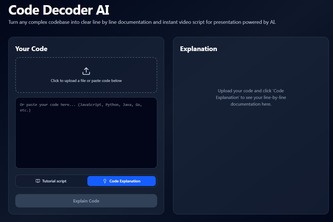
The company appears to be a solo-developer project named Code Decoder AI, self-described as an educational platform that translates complex code into line-by-line English explanations using AI models like GPT-5.6 and Codex. The author states the tool aims to act as a "24/7 personalized computer science tutor" rather than simply fixing code, emphasizing pedagogical design and critical thinking development.
What changed: This is a hackathon submission (submitted to OpenAI 2026) with no evidence of prior traction or commercial activity. The project description indicates it was built in 7 days as part of a sprint.
Single most important open question: Is there any evidence that the described educational tool has been used by students or educators, or that it generates any revenue or user engagement beyond the author's own claims?
What The Product Actually Is
The description states:
- Code Decoder AI is an interactive educational platform
- It translates complex, multi-language source code into clear, step-by-step universal English
- Users paste a block of confusing code and receive line-by-line breakdowns
- It explains programming concepts (loops, recursion, OOP) using analogies
- The system uses AI models including GPT-5.6 and Codex via OpenAI API
Inference: Based on the author's own description, this is a tool that claims to provide educational value by breaking down code into digestible explanations, not just auto-completing or fixing it.
Not evidenced: No information about actual functionality beyond the author’s self-reporting. No screenshots, demos, or user interface details are provided.
Positioning & Claim Evolution
The description states:
- The tool is positioned as a 24/7 personalized computer science tutor
- It aims to "teach how to read, understand, and master the logic behind the code"
- It contrasts itself with standard AI tools that "just fix" code, arguing it preserves learning experience
- The author claims it shifts AI from an “auto-complete shortcut” to an “interactive tool that elevates human potential”
Inference: The positioning has evolved from a simple code explanation tool into a pedagogical framework focused on deep comprehension and critical thinking.
Not evidenced: No evidence of how this compares to existing tools or whether the claims have been validated in practice. No mention of prior versions, user feedback, or market positioning beyond the hackathon submission.
Target Customer & ICP
The description states:
- Target users: Beginners, bootcamp students, and non-technical founders
- These users are described as being "overwhelmed by complex, cryptic code syntax"
- The platform is designed for student developers who want to understand logic behind code
Inference: The target customer profile is defined as learners at an entry or intermediate level in computer science education.
Not evidenced: No evidence of actual customers, usage data, or segmentation beyond the author’s self-description. No indication of whether these users have adopted or engaged with the tool.
Business Model & Pricing Evidence
The description states:
- The platform is described as a fully functional educational tool
- There is no mention of pricing, subscriptions, monetization, or business model
- The author mentions future plans to expand into a "comprehensive learning suite"
Inference: No commercial model is evident from the description. It appears to be an experimental or prototype offering.
Not evidenced: No revenue streams, pricing tiers, or monetization strategy are described. No indication of whether this will ever be sold or offered for free.
Technical & Delivery Signals
The description states:
- Built using AI-native architecture
- Uses OpenAI’s GPT-5.6 and Codex models via the API
- Custom pedagogical prompts were engineered to slow down model responses
- Front-end built with a lightweight, responsive interface
- The system forces the AI to trace code execution linearly before explaining it
Inference: The technical approach involves prompt engineering and integration of specific AI models to achieve educational outcomes.
Not evidenced: No information about scalability, performance metrics, or deployment architecture beyond the hackathon build. No mention of infrastructure, data handling, or user experience testing.
Traction & Maturity Signals
The description states:
- The tool was built in a 7-day sprint
- It is described as fully functional and highly intuitive
- The author notes they are proud of its "highly intuitive educational tool"
- Future milestones include visual diagnostics, quizzes, and IDE extensions
Inference: This is an early-stage prototype with no evidence of traction or adoption.
Not evidenced: No data on users, engagement, retention, or revenue. No mention of any prior versions, customer feedback, or product maturity beyond the hackathon submission.
Competitive Context
The description states:
- It contrasts itself with "standard AI tools that just fix code"
- The author positions it as a tool that "doesn't rob them of the learning experience"
Inference: The competitive landscape includes generic AI coding assistants (e.g., GitHub Copilot, ChatGPT) that focus on completion or correction rather than explanation.
Not evidenced: No analysis of competitors, market share, or differentiation in terms of features or adoption. No mention of existing platforms like Codecademy, Udemy, or Coursera.
Open Questions & Risks
The description states:
- The tool was built in a 7-day sprint
- It uses GPT-5.6, which is not a confirmed model name (author may be conflating versions)
- The author notes overcoming "AI hallucination" through prompt engineering
- No mention of user testing, validation, or feedback loops
Inference: Risk factors include:
- Lack of real-world usage or validation
- Uncertainty around the accuracy and reliability of AI outputs
- Potential over-reliance on a single developer with limited team resources
Not evidenced: No evidence of risk mitigation strategies, user validation, or product-market fit. No mention of any pilot programs, beta users, or institutional partnerships.
Questions the description leaves open
- What specific programming languages does the tool support?
- How is the AI output validated for accuracy and pedagogical value?
- Have you tested this with actual students or educators? If so, what were the results?
- Is there any plan to monetize the platform beyond the current prototype?
- What are your plans for scaling beyond the hackathon version?
- How do you intend to differentiate from existing educational platforms or AI tools in the space?
Overall Assessment
The description states:
- This is a hackathon submission (OpenAI 2026)
- The tool was built in 7 days
- It is described as a fully functional, highly intuitive educational tool
- No evidence of revenue, traction, or commercial viability beyond the author’s own claims
Inference: At this stage, it appears to be an experimental prototype with no demonstrated market traction or business model.
Not evidenced: No data on user engagement, monetization potential, or competitive positioning. No indication of whether the founder intends to pursue a full product or partnership opportunity.
User Stories BotA demo video on every pull request
Get a demo video on every new feature
GitHub App that watches your pull requests and records a narrated, captioned demo.
Save time on demo prep and make informed decisions faster with a video walkthrough of every new feature.
Source
Submitted to the OpenAI 2026 hackathon on Devpost. Project home on Devpost. Back to the full gallery on Devpost.
This competitive analysis was produced by top-founders.com (opens in a new tab)
Generated by a language model from this project's public Devpost page — its tagline, the author's own write-up and any built-with tags listed there — as captured in August 2026. Short quotations are the author's words. It is an opinion on the idea as a business, not on the people behind it, and it reflects the description as published then. If the project has moved on, request a correction below. The analysis is not independent research and contains no verified traction, revenue or customer data.
An independent guide by KFG International LLC — not affiliated with, endorsed by, or connected to Devpost or OpenAI.